
Is a 30-Minute Workout Enough? How Weekly Minutes Add Up to 150
Five moderate 30-minute workouts a week meet the 150-minute guideline, and three vigorous ones clear the 75-minute mark. Here's how intensity, strength days, and shorter bouts change the math.


If your workouts come in 30-minute blocks squeezed between meetings and dinner plans, here’s the good news: for most adults, a 30-minute workout is enough to meet the weekly exercise guidelines, as long as you do it often enough. The CDC sets the adult baseline at 150 minutes of moderate-intensity activity a week, which works out to 30 minutes a day, five days a week, plus at least two days of muscle-strengthening work.
The catch is in the details. How hard you work changes how many sessions you need, the strength days sit on top of the cardio minutes, and the guidelines treat 150 minutes as a floor (more time brings more benefit). Below, we break down the weekly minute targets, how many days of 30-minute workouts it takes to hit each one, and how intensity shifts the math.
Do 30-Minute Workouts Meet the Weekly Exercise Guidelines?
Yes, five of them do. The federal Physical Activity Guidelines for Americans (second edition) say adults need at least 150 to 300 minutes of moderate-intensity aerobic activity each week, along with muscle-strengthening activity like lifting weights or push-ups on at least two days. Five moderate 30-minute workouts land you exactly on the 150-minute minimum.
The CDC also accepts 75 minutes of vigorous-intensity activity (running, for example) or an equivalent mix of moderate and vigorous effort. Globally, the World Health Organization uses the same baseline and adds that any amount of physical activity is better than none. Its November 2026 fact sheet puts nearly one third (31%) of the world’s adults in the physically inactive group as of 2022.
So if you’re hitting your 30-minute class or home sweat sesh most days of the week, you’re doing better than a lot of people. In 2024, 47.2% of US adults met the aerobic guidelines, and only 42.4% of women did (compared with 52.3% of men).
How 30-Minute Sessions Add Up Over a Week
Here’s the weekly math for one to seven 30-minute sessions. The vigorous column uses the CDC rule of thumb that one vigorous minute counts about the same as two moderate minutes, which we explain below.
| 30-minute sessions per week | Moderate minutes | Vigorous minutes (moderate equivalent) | Where that lands |
|---|---|---|---|
| 1 | 30 | 30 (60) | Below both minimums, still better than none |
| 2 | 60 | 60 (120) | Below both minimums |
| 3 | 90 | 90 (180) | Vigorous: past the 75-minute minimum |
| 4 | 120 | 120 (240) | Vigorous: inside the 75 to 150 range |
| 5 | 150 | 150 (300) | Moderate: 150-minute minimum met. Vigorous: top of the range |
| 6 | 180 | 180 (360) | Moderate: inside the 150 to 300 range |
| 7 | 210 | 210 (420) | Moderate: inside the range. Vigorous: past the 150-minute top |
Reaching the 300-minute top of the moderate range takes 10 sessions of 30 minutes, so that’s where doubling up on some days (a morning walk plus an evening class) comes in.
How Many Days a Week Should You Do 30-Minute Workouts?
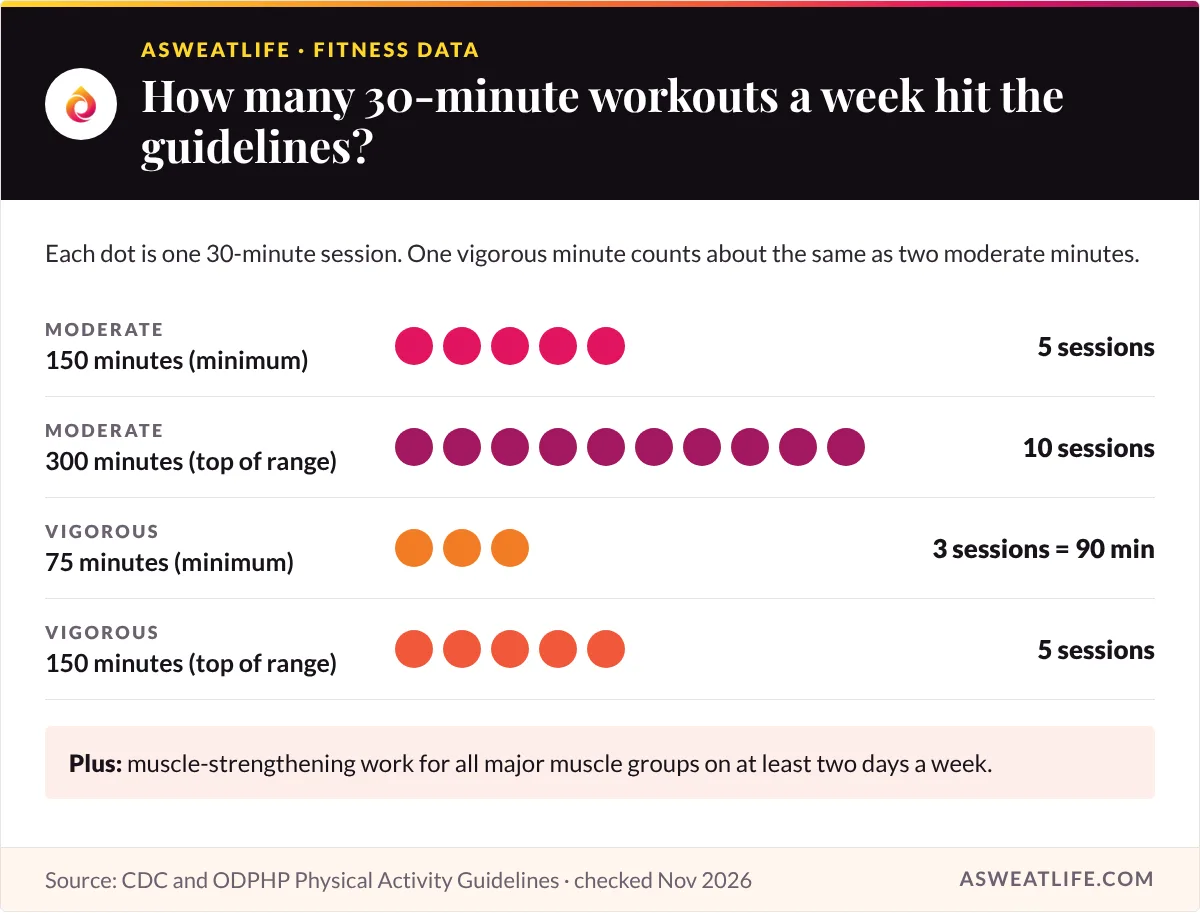
For moderate workouts, plan on five days a week to reach 150 minutes. For vigorous workouts, three sessions (90 minutes) clears the 75-minute minimum, and five sessions (150 minutes) reaches the top of the vigorous range. Mixing the two works too: a couple of brisk walks plus two harder sessions can add up to the same total.
The American Heart Association recommends spreading that activity preferably throughout the week, and spacing it out leaves room to recover between harder days. (Need a gut check on when to back off? These are the signs it’s time to take a rest day.)
That said, a packed Monday-to-Friday doesn’t wreck your week. A 2023 JAMA study of 89,573 UK Biobank participants who wore activity trackers for a week found that adults who packed at least half of their 150 minutes into one or two days had similarly lower risks of atrial fibrillation, heart attack, heart failure, and stroke as those who spread it out. Compared with inactive participants, those “weekend warriors” had 27%, 38%, 22%, and 21% lower risks of heart attack, heart failure, atrial fibrillation, and stroke. (Honest caveat: it’s an observational study, so it shows a link and can’t prove the pattern caused the result.) The takeaway for a busy week is that total minutes matter more than a perfect daily streak.
Where Strength Days Fit
The two strength days are on top of your aerobic minutes. The CDC asks for muscle-strengthening work on at least two days that hits all major muscle groups: legs, hips, back, chest, abdomen, shoulders, and arms. A 30-minute full-body strength session covers that nicely, and building muscle is a big part of why gaining muscle is a focus of longevity medicine.
Put together, a week that meets both guidelines with 30-minute blocks might look like this:
- Five-day plan: five 30-minute brisk walks or easy bike rides for your 150 aerobic minutes, with a 30-minute strength session on two of those days.
- Three-day plan: three 30-minute vigorous sessions (running, a spin class, jump rope intervals), with a short strength circuit tacked onto two of them.
- Mixed plan: two vigorous 30-minute classes (120 moderate-equivalent minutes) plus one brisk 30-minute walk (30 minutes) gets you to 150, with strength on two of those days.
Does Intensity Change How Much Time You Need?
It does, and by a lot. The CDC’s rule of thumb is that one minute of vigorous-intensity activity is about the same as two minutes of moderate-intensity activity. That’s why the vigorous target (75 minutes) is half the moderate one (150 minutes), and why three hard 30-minute workouts can do the job of five easier ones.
Pick how many 30-minute sessions you do and how hard they feel to see where your week lands against the guidelines.
The simplest way to tell which zone you’re in is the talk test. At moderate intensity, you’re breathing harder but can still talk. At vigorous intensity, you can’t say much without stopping for a breath. The AHA lists brisk walking, water aerobics, social dancing, gardening, and doubles tennis as moderate, and running, swimming laps, hiking uphill, singles tennis, and jumping rope as vigorous.
One honest note on intervals: a 30-minute HIIT class isn’t 30 vigorous minutes. The warm-up, rest periods, and cooldown count at whatever intensity you’re actually working, so a session like this 15-minute HIIT workout usually blends vigorous and moderate time. Count the hard intervals as vigorous and the rest as moderate, and use the calculator above to see where your week lands.
Can You Split a 30-Minute Workout Into Shorter Bouts?
Yes. Older guidance only counted activity done in bouts of at least 10 minutes. The second edition of the US guidelines removes this requirement to encourage Americans to move more throughout the day, and the CDC says you can break your activity into smaller chunks spread across the week.
In practice, three 10-minute brisk walks on a busy workday count the same as one 30-minute walk. Short sessions have perks of their own, too: even a very slow 10-minute jog gives your brain a lift.
When a 30-Minute Workout Isn’t Enough
The 150-minute mark is a minimum. The American Heart Association says you gain even more benefits at 300 minutes (five hours) a week, and a 2022 study in Circulation backs that up. Using 30 years of records from more than 100,000 adults, researchers linked 300 to 600 minutes a week of moderate activity to a 26% to 31% lower risk of death from any cause, while 150 to 300 minutes of vigorous activity came with a 21% to 23% lower risk. The extra benefit leveled off past 600 moderate or 300 vigorous minutes. (Like the weekend warrior research, this one is observational, and its participants were health professionals.)
Your goals matter here too. Training for a half marathon, building strength, or prepping for a hiking-heavy fitcation all call for more targeted volume than the health baseline. And if your 30 minutes is the only time you move all day, the AHA also suggests you spend less time sitting, since even light activity offsets some of the risks of being sedentary. If a sit-heavy job is your reality, a big student survey found that swapping 15 minutes of sitting for a real sweat was linked to slightly better mood.
Not hitting 150 yet? That’s OK. The CDC says some physical activity is better than none, and less than 150 weekly minutes can still offer significant health benefits compared with doing nothing. Start with the number of 30-minute sessions you can actually keep, then add one.
What Should a 30-Minute Workout Include?
On strength days, the CDC suggests working each muscle group until another rep would be hard without help, with 8 to 12 repetitions per exercise as one set; one set counts, and two or three sets bring more benefit. A full-body routine like this 30-minute strength workout with weights and a bench fits that format.
If you’re starting from zero, our four-week beginner workout plan pairs three 30-minute strength sessions with brisk walks each week. Prefer a coach and a playlist? Plenty of studios run 30-minute group fitness classes built for exactly this kind of schedule. Pick the plan that matches your week, count your minutes for the next seven days, and adjust from there. (And if a week goes sideways, no big deal: next week’s minutes count just as much.)
FAQ
Does Walking Count Toward the 150 Minutes?
Yes. Brisk walking at 2.5 miles per hour or faster counts as moderate-intensity activity, so five 30-minute brisk walks a week meet the aerobic guideline for adults.
Are the Exercise Guidelines Different for Women?
No. The adult guidelines of 150 to 300 moderate minutes (or 75 to 150 vigorous minutes) and two strength days apply to all adults.
Does Yoga Count as Exercise Toward the Guidelines?
The CDC lists yoga postures as a muscle-strengthening activity, so a strength-focused flow can count toward your two strength days. Faster styles such as Vinyasa or power yoga only count as aerobic minutes if they pass the talk test for moderate effort. Slower, restorative classes are great for recovery but usually don’t reach that intensity.
Can I Do All My 30-Minute Workouts on the Weekend?
You can’t fit 150 moderate minutes into two 30-minute sessions, but longer weekend sessions that add up to 150 minutes appear to work. The 2023 JAMA study found that adults who did at least half of their weekly activity in one or two days had heart risks similar to those who spread it out.