No Time for a Hard Run? Researchers Say a Very Slow 10-Minute Jog Still Gives Your Brain a Lift
A University of Tsukuba study found that 10 minutes of running at near-walking pace improved mood and focus in 24 young adults. Here's how slow they went.


If a hard, sweaty run feels impossible to fit into your day, a new study has welcome news: 10 minutes of very slow running improved mood and sharpened a key measure of focus in a University of Tsukuba experiment. Participants jogged on a treadmill at about 3 to 6 km/h (roughly 1.9 to 3.7 mph), a pace close to walking and an effort of about 35% of their peak oxygen uptake.
The research, published in 2026 in the journal Imaging Neuroscience, suggests the brain benefits of running don’t depend on pushing hard.
What the Slow-Running Study Found
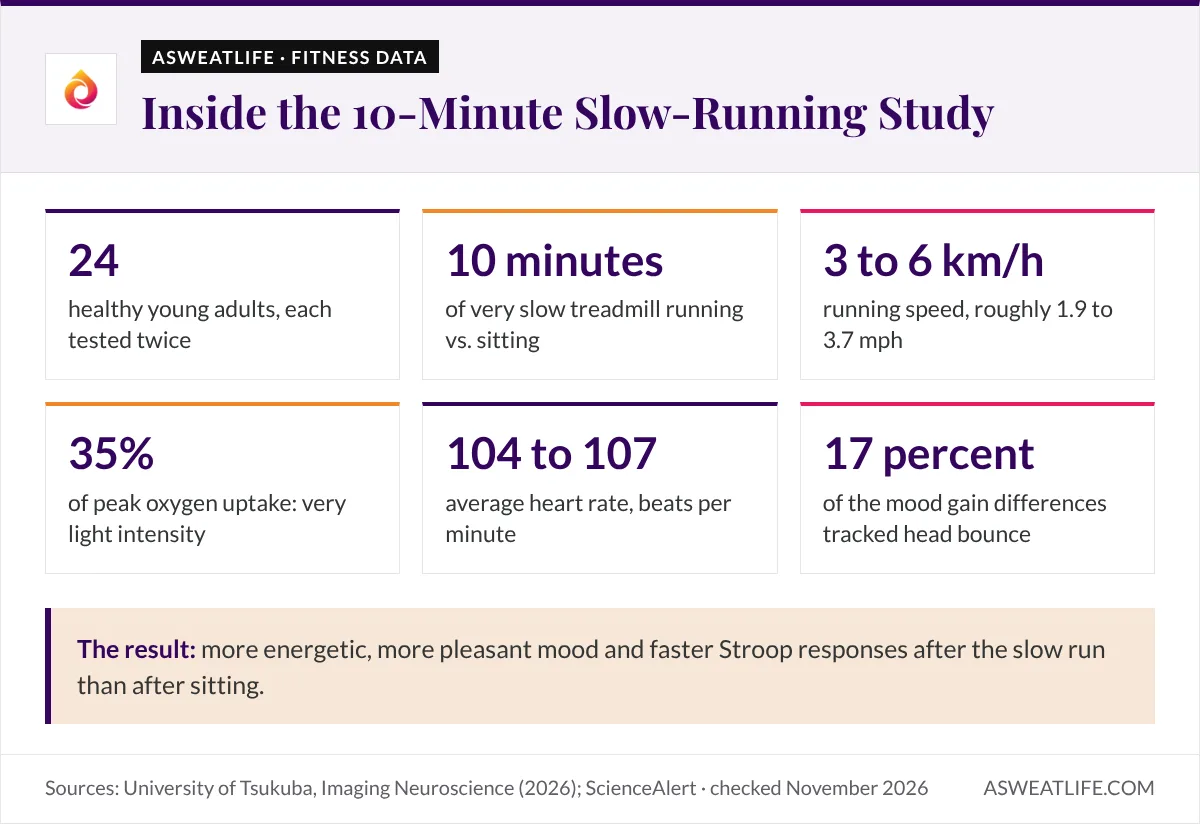
The research team, led by Hideaki Soya, professor emeritus at the University of Tsukuba, and assistant professor Ryuta Kuwamizu, brought 24 healthy young adults into the lab twice. On one day they sat quietly on a treadmill for 10 minutes. On another, they ran very slowly on the treadmill for 10 minutes, at speeds set to each person’s fitness. Before and after each session, they rated their mood and took the Stroop test, a classic check of focus and self-control.
Compared with sitting, the slow run left people feeling more energetic and more pleasant, and they responded faster when the Stroop test’s color words and ink colors clashed. Brain imaging showed more activity in two areas on the left side of the prefrontal cortex, the left dorsolateral prefrontal cortex and the left frontopolar cortex, regions tied to executive function and mood regulation.
The mood lift stood out most. “Notably, the increase in pleasant mood was particularly strong, suggesting that slow running may be especially effective at improving how people feel,” Soya and Kuwamizu said, noting it looked stronger than in their earlier studies of very light pedaling on a stationary bike.
The effort itself was gentle. Heart rates averaged 104 to 107 beats per minute during the slow runs.
How Slow Is Very Slow Running?
The study’s pace is slower than most people picture when they hear the word run. The treadmill speeds of about 3 to 6 km/h overlap with a brisk walk, and the effort sat at about 35% of peak oxygen uptake, which the researchers class as very light intensity. Men in the study averaged about 3.4 mph and women about 2.4 mph, and everyone kept a running form with small steps.
Curious whether your own easy jog is slow enough? Plug in your usual pace and see how it stacks up against the study runners.
In the minutes-per-mile terms most runners use, 3.4 mph works out to about 17 minutes 39 seconds per mile, and 2.4 mph to 25 minutes per mile. The top of the study’s range, 3.7 mph, is about 16 minutes 13 seconds per mile.
For comparison, the same lab’s 2021 study of 26 healthy adults used a 10-minute moderate jog that left runners “breathing hard and could barely speak.” The new experiment asked whether that much effort was needed for a short-term brain boost. For mood and focus right after the run, it wasn’t.
Why the Bounce in Your Stride May Lift Your Mood
During a separate two-minute run, the researchers fixed a sensor to each runner’s head to measure vertical acceleration. People whose heads moved up and down more tended to report bigger gains in pleasant mood, and head acceleration explained about 17 percent of the variation in mood improvement between participants.
That’s a correlation, and the team calls the link exploratory, so it doesn’t prove the bounce caused the better mood. The authors describe the head-motion idea as “a new and challenging hypothesis” in their paper, and Soya and Kuwamizu put it plainly: “We are beginning to think that slow running may be more than simply running slowly.”
Much of the earlier lab research on exercise, mood and thinking used cycling, which makes intensity easy to control. Running adds a rhythmic, whole-body bounce that pedaling doesn’t, and the team now wants to test whether that motion drives part of the mood effect. It’s one more piece of the bigger picture of why running might help your mental health.
What the Researchers and an Outside Expert Say
Soya, who competed in track and field for many years, summed up the finding simply: “running does not have to be hard to be good for your brain.” He added that “running at the gentlest possible pace, for just 10 minutes, is enough to brighten moods and sharpen prefrontal function.”
He also has a specific use in mind. A 10-minute slow run before a presentation or a demanding mental task is “exactly the kind of use we have in mind,” Soya said.
Henriette van Praag, an associate professor of biomedical science at Florida Atlantic University’s Charles E. Schmidt College of Medicine, studies exercise and the brain and was not involved in the research. She called it “a very nicely done study.”
The authors are careful about how the results get read, too. “Please do not read this as ‘slow running is better than harder running,'” Soya and Kuwamizu said. Their long-term goal “is to establish slow running as an evidence-based, easily accessible daily habit.”
What the Slow-Running Research Can’t Tell Us Yet
- A small, young sample. All 24 participants were healthy young adults, so results may differ for older adults, newer runners or people with health conditions.
- Short-term effects only. Mood and focus were measured right after a single session, so the study doesn’t show lasting gains from a regular habit.
- No walking comparison. The slow run was compared only with sitting, so the team can’t yet separate the running motion from simply being upright and moving.
- Imaging limits. The brain scans used functional near-infrared spectroscopy (fNIRS), which reads blood oxygen near the brain’s surface and is less precise than MRI.
Next, the team plans to test slow running in older adults, people with low fitness and people with depressive symptoms, to look at whether it engages the brain’s dopamine and noradrenaline systems, and to compare running directly with walking. Soya called the current findings “a starting point.”
How to Try a 10-Minute Slow Run This Week
Don’t have time for a sweaty, intense run? This research gives you permission to go easy. Here’s how to borrow the study’s setup:
- Keep it to 10 minutes. That’s the whole dose the participants ran, and a slow loop around the block fits easily into a lunch break.
- Shorten your stride. Participants ran with small steps at roughly 1.9 to 3.7 mph, so a pace that feels close to walking is right on target.
- Time it before something that needs focus. Soya suggests a slow run ahead of a presentation or a demanding task.
- Notice how you feel. Rate your mood before and after, the way participants did. If you like numbers, tracking your running data in a spreadsheet makes the pattern easy to spot over a few weeks.
If time is the real hurdle, try making your own “But I don’t have any time” list to find where 10 minutes could live. And everything is better with friends: here’s how to reboot your walking or running routine with others, and Chicago Readers can find an easygoing crew in our love letter to Chicago run clubs.
Slow Running and Your Brain: FAQ
What Is the Stroop Test?
The Stroop test shows color words printed in ink that may not match the word, such as “red” printed in blue, and measures the extra time it takes to name the ink color when the two conflict. A shorter interference time points to better executive function, the mental skills behind focus and self-control.
What Is fNIRS?
Functional near-infrared spectroscopy (fNIRS) uses light from a wearable cap to track changes in blood oxygen in the outer layers of the brain. Its portability suits exercise studies, though it is less precise than an MRI scan.
Did Earlier Research Find Brain Benefits From Very Light Exercise?
Yes. A 2018 study in PNAS from Soya’s group found that a 10-minute bout of very light exercise enhanced memory that depends on the hippocampus, the brain’s memory hub.
Who Funded the Slow-Running Study?
The University of Tsukuba slow-running study was funded by grants from the Japan Society for the Promotion of Science and the Japan Science and Technology Agency, along with University of Tsukuba research programs.
This article is for educational purposes and does not replace advice from a doctor, registered dietitian or qualified trainer.