Beginner Workout Plan: A Simple Four-Week Routine You Can Keep
Three 30-minute full-body strength sessions a week, brisk walks in between, and a four-week ramp that explains sets, reps, and rest in plain English.

If you’re starting from zero, a simple beginner workout plan looks like this: three 30-minute full-body strength sessions a week on nonconsecutive days, a few brisk walks in between, and two days that are fully yours. That clears the CDC’s call for muscle-strengthening activity on at least two days a week with a spare session to absorb the week you have a work dinner, a sick kid, or zero motivation.
The plan below spells out every piece a newcomer usually has to guess at: what a set and a rep are, how long to rest, how heavy to go, and exactly what to do in weeks one through four. It runs on two workouts (A and B) that use your bodyweight and a pair of dumbbells, so it works at home, in a hotel room, or in the corner of a gym you’re still getting used to. And because a plan only works if you keep doing it, we’ve built the habit side in too.
The Beginner Workout Plan at a Glance
Here’s the weekly template. Swap the days to fit your calendar; the only rule is to leave at least one day between strength sessions so the same muscles aren’t working two days in a row.
| Day | What You Do | Time |
|---|---|---|
| Monday | Workout A (strength) | About 30 minutes |
| Tuesday | Brisk walk | 20 to 30 minutes |
| Wednesday | Workout B (strength) | About 30 minutes |
| Thursday | Brisk walk or rest | 20 to 30 minutes |
| Friday | Workout A (strength) | About 30 minutes |
| Saturday | Brisk walk, hike, or a class you’re curious about | 20 to 30 minutes |
| Sunday | Rest | None |
The next week starts with Workout B, so A and B trade places week to week and each gets equal time. Between them, the two workouts hit every muscle group the CDC lists for strength work: legs, hips, back, abdomen, chest, shoulders, and arms.
Rest days are part of the plan. If you want to move on Sunday anyway, keep it easy: these ideas for active rest days should leave you feeling refreshed when you’re done.
Sets, Reps, and Rest Explained for Beginners
Workout plans are written in a shorthand that assumes you already speak gym. You don’t need to (yet). Here’s the translation.
What Sets and Reps Mean
A rep (repetition) is one full movement: you squat down and stand back up, that’s one rep. A set is a group of reps done without stopping. So “2 x 10 squats” means two sets of 10 squats, with a rest between the two sets.
A common beginner target is three sets of 10 to 12 reps of each resistance exercise. This plan starts you at two sets for the first two weeks and builds to three, so your first sessions feel doable and your muscles (and schedule) have time to adjust.
How Long to Rest Between Sets
Rest about 60 to 90 seconds between sets in weeks one and two, when the weights are light. As squats, rows, and other big moves get heavier, give them more: for exercises that use a lot of muscle at once, rest at least two minutes between sets, with up to five minutes acceptable, while smaller single-joint moves like curls need about one to two minutes. Use the rest to sip water and reset your posture. (Scrolling your phone counts, too, but only if you actually put it down when the timer goes off.)
How Heavy Is Heavy Enough?
Pick a weight you can lift for every rep in the set with good form while feeling like you could do about two more. Cleveland Clinic exercise specialist Ben Kuharik puts it simply: “You should always have two reps left in the tank.” If you could have done six more, go heavier next time. If your form fell apart on rep eight, go lighter. Over the weeks, let the weights climb: new NSCA guidelines say women respond to strength training much like men, so plan on moving past the lightest dumbbells as the weeks go by.
You don’t have to push to total exhaustion, either. The American College of Sports Medicine’s 2026 position stand found that training to muscle failure did not consistently impact outcomes for the average healthy adult, and neither did choosing machines over free weights. Dumbbells, bands, or your own bodyweight all count.
Warm Up First
Spend at least five minutes warming up before each strength session: march in place, do a few slow bodyweight squats and arm circles, or walk on a treadmill. Then do your first exercise once with no weight or a very light one before your working sets.
Workout A: Squat, Push, Pull, Bridge, Plank
Do each exercise for the sets and reps your week calls for (see the four-week plan below), resting between sets, then move to the next exercise. In week one, that’s two sets of 10 reps per exercise.
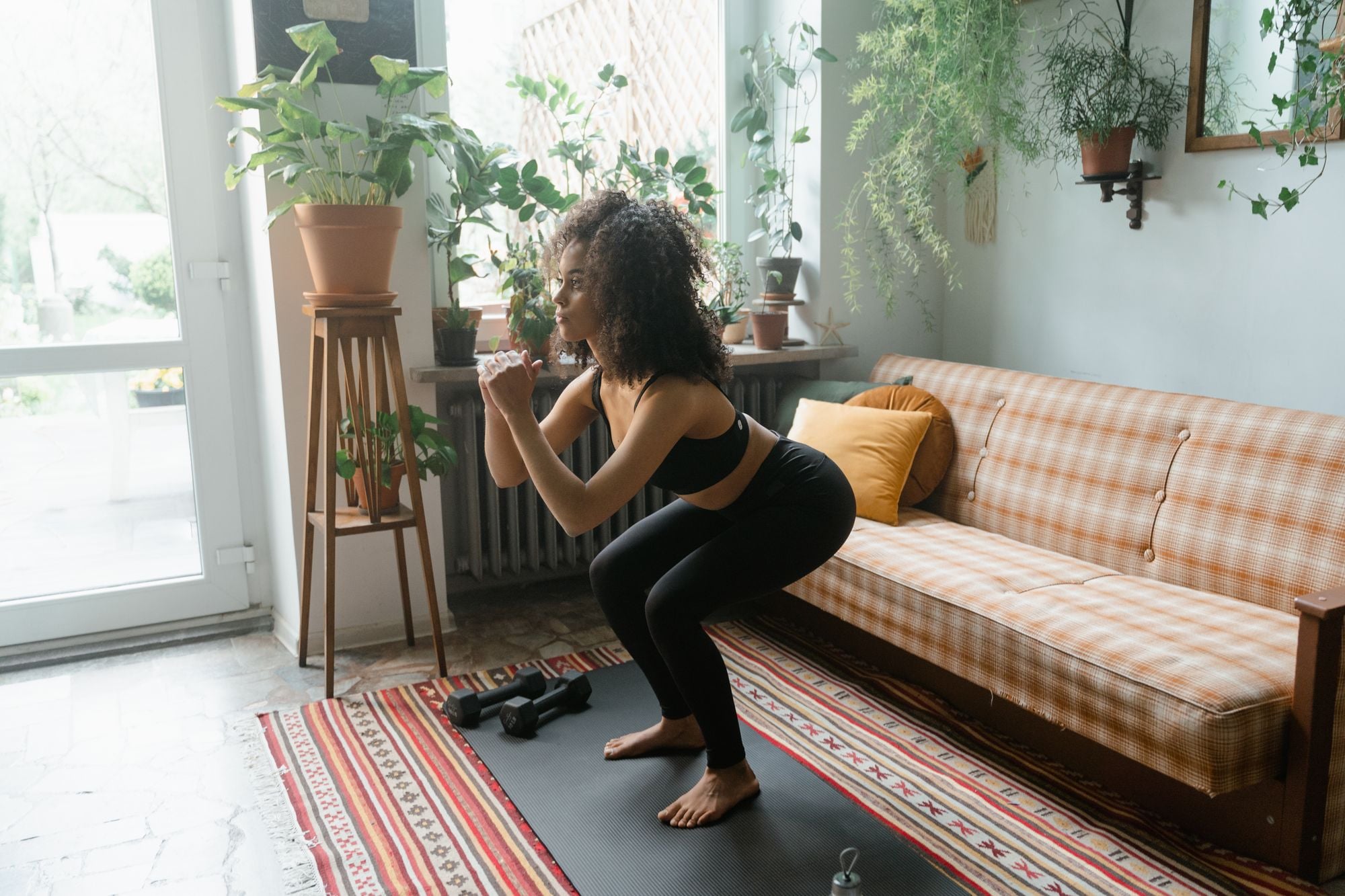
- Goblet squat (or bodyweight squat). Hold one dumbbell vertically against your chest, feet about shoulder-width apart, toes turned slightly out. Sit your hips back and down as if lowering onto a chair, keep your chest lifted, then press through your whole foot to stand. Start with no weight if squatting feels new.
- Incline push-up. Put your hands on a sturdy counter, desk, or bench, step your feet back into a straight line from head to heels, and lower your chest toward the edge. The higher the surface, the easier the push-up; move to a lower surface as you get stronger.
- One-arm dumbbell row. Rest one hand and knee on a bench or the seat of a chair, back flat, dumbbell in the other hand. Pull the weight toward your hip, pause, and lower it slowly. Do all reps on one side, then switch.
- Glute bridge. Lie on your back with knees bent and feet flat. Press through your heels to lift your hips until your body forms a straight line from shoulders to knees, squeeze your glutes at the top, and lower with control.
- Forearm plank. Elbows under shoulders, body long, belly braced. Hold for 20 to 30 seconds per set. Drop to your knees if your lower back starts to sag.
Workout B: Lunge, Press, Hinge, Core
Workout B uses the same muscles from different angles, which keeps the week from feeling repetitive and fills in the shoulders and hamstrings that Workout A only touches.
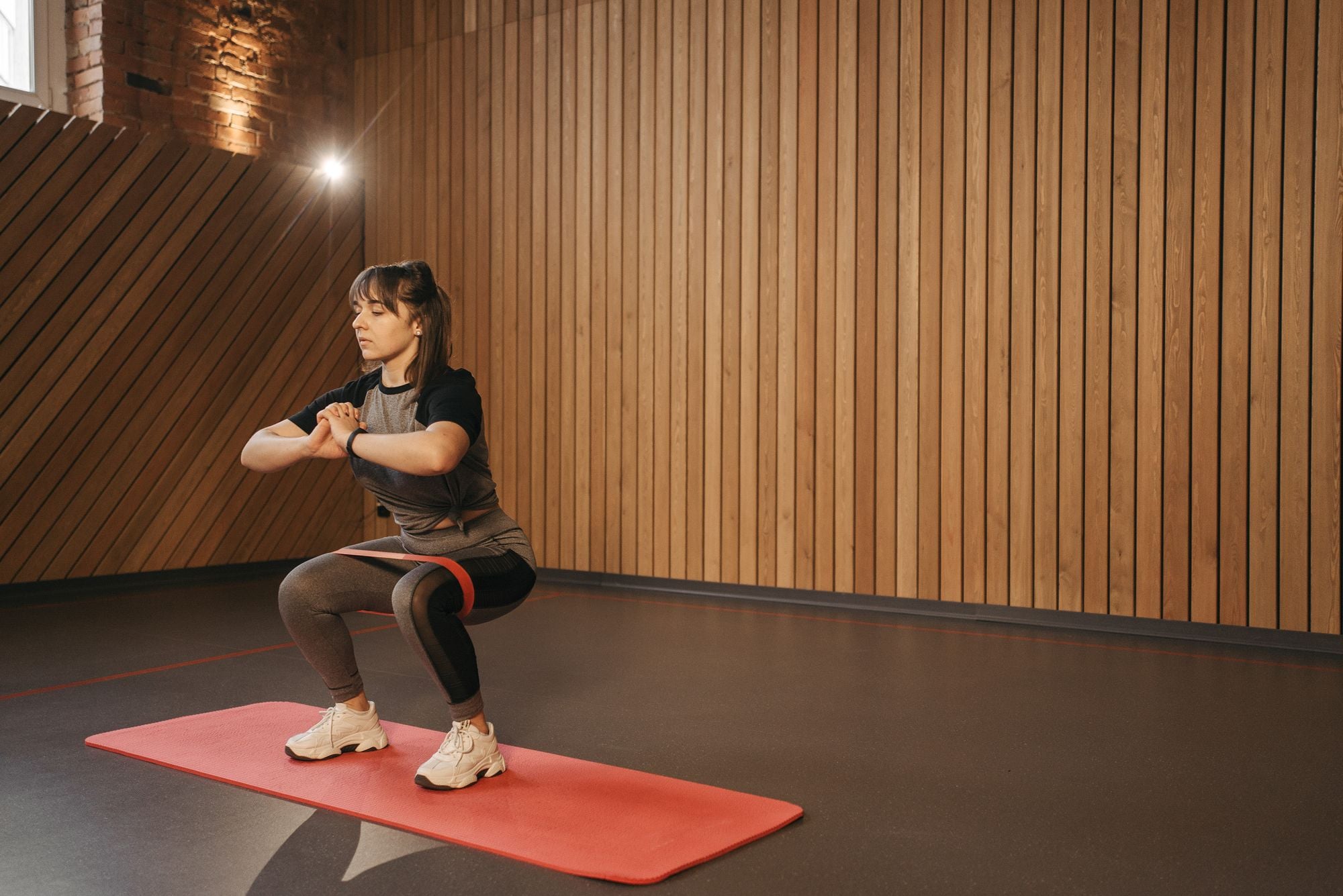
- Reverse lunge. From standing, step one foot back and lower until both knees bend to roughly 90 degrees, then push through your front foot to return. Hold a wall or the back of a chair for balance if you need it; count reps per leg.
- Dumbbell shoulder press. Sit or stand with dumbbells at shoulder height, palms facing forward. Press them overhead without arching your back, then lower slowly.
- Dumbbell Romanian deadlift. Stand tall with dumbbells in front of your thighs. With a slight bend in your knees, push your hips back and slide the weights down your legs until you feel a stretch in your hamstrings, then drive your hips forward to stand. Your back stays flat the whole time; the movement comes from your hips hinging back, with your spine staying long.
- Dead bug. Lie on your back with arms reaching to the ceiling and knees bent at 90 degrees over your hips. Press your lower back into the floor, then slowly lower the opposite arm and leg toward the floor and return. Alternate sides; each side counts as one rep.
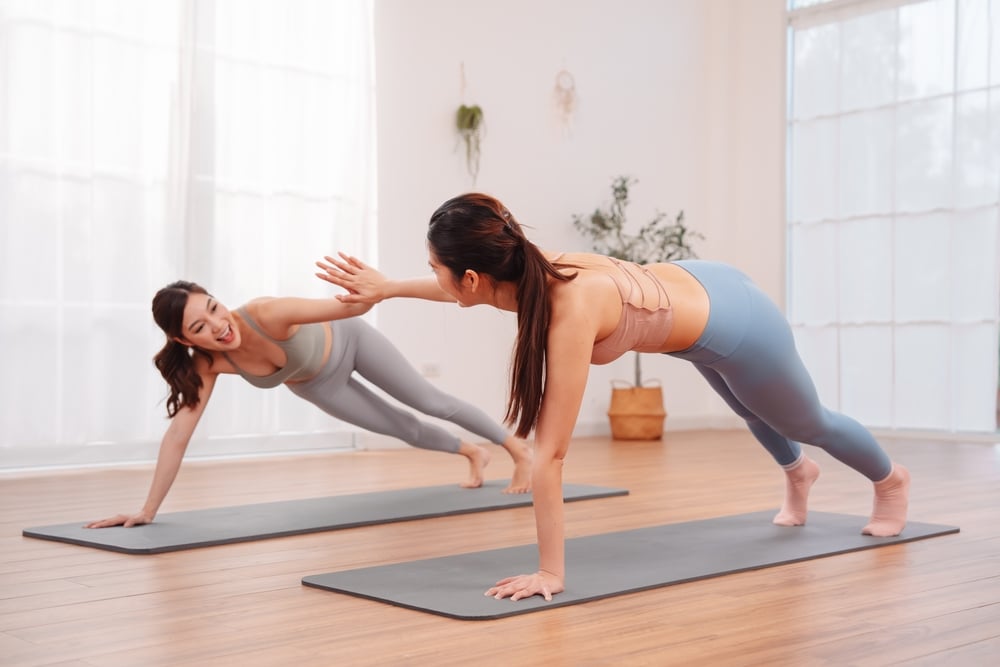
- Side plank. Prop up on one forearm with knees bent (easier) or legs straight (harder), hips lifted. Hold 15 to 20 seconds per side.
Lowering each rep slowly is where a lot of the work happens. If you’re curious why, here’s a primer on concentric and eccentric movements.
Your Four-Week Beginner Workout Plan Progression
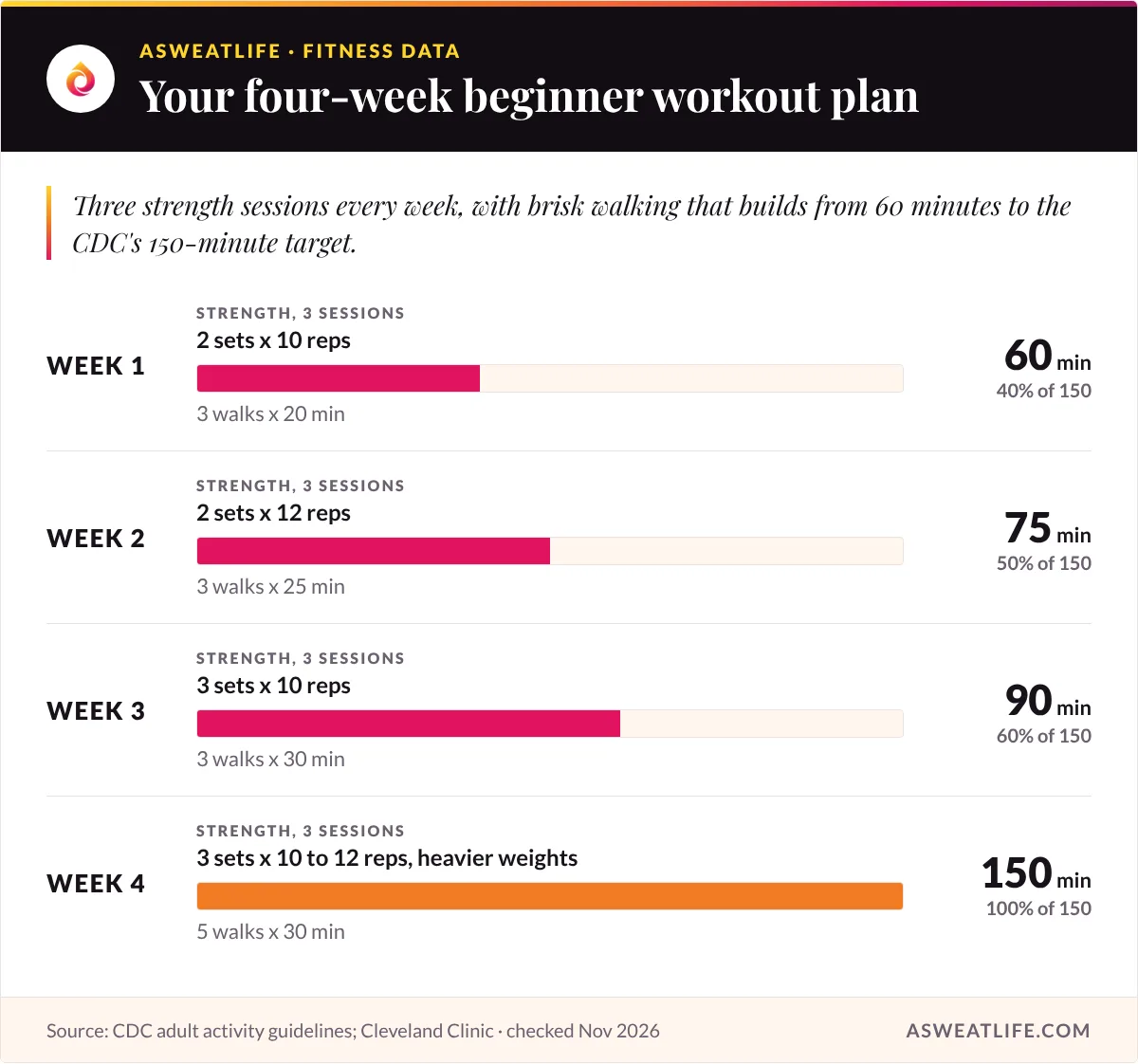
Each week asks for a little more than the last: an extra set, a couple more reps, or a slightly heavier dumbbell, plus a few more walking minutes. The goal is to finish week four doing three full strength sessions and hitting the CDC’s aerobic target of 150 minutes of moderate-intensity activity a week, which the CDC notes can be as simple as brisk walking for 30 minutes, five days a week.
Tap a week to see your day-by-day schedule and how close your walking gets to the 150-minute target.
| Week | Strength (3 sessions) | Brisk Walking | Walking Minutes | Share of 150-Minute Target |
|---|---|---|---|---|
| Week 1 | 2 sets x 10 reps | 3 walks x 20 min | 60 | 40% |
| Week 2 | 2 sets x 12 reps | 3 walks x 25 min | 75 | 50% |
| Week 3 | 3 sets x 10 reps | 3 walks x 30 min | 90 | 60% |
| Week 4 | 3 sets x 10 to 12 reps, heavier weights | 5 walks x 30 min | 150 | 100% |
In week four, two of those five walks land on strength days. A 30-minute walk after Workout A or B works, and so does splitting it into a 15-minute walk at lunch and another after dinner, since the CDC says you don’t have to do it all at once.
From week five on, keep the structure and keep nudging one thing at a time. When you can finish all three sets of 12 with two reps left in the tank, move up to the next dumbbell and drop back to 10 reps. If a week goes sideways, repeat it before moving on. Progress isn’t a race against the calendar.
Once this feels routine, our guide on how to start a strength training routine covers what comes next, from adding exercises to working with heavier weights.
How to Build a Workout Routine You Can Keep
Tell me if this sounds familiar: You start a new plan on a Monday, nail the first two weeks, and then one packed Thursday turns into a skipped week. The exercises are the easy part. Showing up in week six, when the novelty is gone, is the real skill, and the research on habits is reassuring here.
In health psychologist Phillippa Lally’s well-known habit study, the average time to reach maximum automaticity was 66 days, with a huge range of 18 days to a predicted 254 days. (Automaticity is just the point where a habit runs on autopilot, no willpower required.) Two findings from that study matter for you. First, participants who picked an exercise habit took about one and a half times as long to reach their plateau as those who picked an eating or drinking habit, so if working out still feels like effort a month in, you’re right on schedule. Second, a single missed day had little impact on later progress. One skipped workout doesn’t break the chain.
A few ways to make the plan stick:
- Put the sessions in your calendar like meetings. Same days, same time each week, so you’re not deciding from scratch every morning.
- Attach the workout to something you already do. Workout A right after your morning coffee, or a walk right after you close your laptop.
- Set a “minimum” version. On a rough day, one set of each exercise counts. Doing something keeps the habit alive.
- Track it. A checkmark on a paper calendar or a note in your phone is enough to see the streak building.
- Bring a friend. Everything is better with friends, and a walking buddy is much harder to cancel on than yourself.
The science backs the “keep it simple” approach. The ACSM’s 2026 position stand found that any amount of resistance training improves strength, muscle size, power and physical function, and one of its authors, McMaster University’s Stuart Phillips, put it plainly: “The best resistance training program is the one you’ll actually stick with.” For more small-step strategies, see how to build a wellness routine with small habits that last, or grab a few of these tips to keep you from skipping the gym.
If You’re Short on Time, Sore, or Training at Home

If You Only Have 20 Minutes
Do one fewer set of each exercise, or pair two moves and alternate them (squat, then push-up, then rest) so you rest less overall. If you can only manage two strength days that week, you still meet the CDC’s two-day minimum.
If You’re Sore After the First Week
Keep the walks, go lighter at your next session, and if you’re unsure whether you need a break, here are three signs it’s time to take a rest day. Sharp pain, joint pain, or pain that gets worse is different: stop that exercise and check with a doctor or physical therapist.
If You’re Working Out at Home
Two or three pairs of dumbbells (light, medium, and a heavier pair for squats and deadlifts) cover the whole plan. No dumbbells? Use filled water bottles or a backpack with books for the first weeks, and do squats, lunges, and bridges with bodyweight only.
If You Have a Health Condition
If you’re pregnant, recovering from an injury, or managing a heart, joint, or other chronic condition, talk to your doctor before you start. A physical therapist can adjust any of these moves to fit you.
Frequently Asked Questions
How Many Days a Week Should a Beginner Strength Train?
Two to three days a week is a solid start for a beginner. The CDC recommends muscle-strengthening activity that works all major muscle groups on at least two days a week, and this plan schedules three so one missed session still keeps you on track.
Do I Need a Gym Membership to Follow This Beginner Workout Plan?
No. Every exercise in this plan works with bodyweight and a set of dumbbells at home, and the ACSM’s 2026 position stand found that using machines versus free weights did not consistently change results for the average healthy adult.
Should I Do Cardio or Strength First on the Same Day?
For a beginner on this plan, do the strength workout first while you’re fresh, then walk. The walk doubles as a gentle cooldown.
What If I Miss a Whole Week?
Pick up where you left off, or repeat the last week you finished, and do it soon: in Lally’s habit study, a single missed day had little impact, while many missed repeats lowered how automatic the habit became.
Your Next Step
Open your calendar right now and block three 30-minute strength sessions for next week, with at least a day between each. Write “Workout A” on the first one. That’s the whole assignment. Week one is just about showing up three times, and once you’ve done that, you have a routine to build on.