7 Kit Checks Before Your First Powerlifting Meet
You’ve paid the entry fee, your numbers look good in training, and the meet info pack has just landed with a list of gear rules. Before your first powerlifting meet, check that your kit is legal: in federations that follow the IPF Technical Rulebook effective March 2026, for example, a belt can be no wider than 10 cm.
Work through these seven checks a few weeks out, while there is still time to fix anything: the rulebook, singlet, shirt, shoes and socks, belt and wraps, knee support and your meet-day bag.
1. Read Your Federation’s Rulebook First
Your federation’s current rulebook decides what you can wear on the platform, so read it before you buy anything. Federations set their own gear rules and update them, which means a training partner’s advice from two years ago may no longer apply.
Find the equipment and dress section, save or print it, then compare each item you own against it line by line. Some federations, including those affiliated with the International Powerlifting Federation (IPF), also require certain items to come from manufacturers on an approved list, so check that too.
Find the Right Document
Most federations post the rulebook on their website, and the meet entry page often links to it. If you can’t tell which version applies to your meet, confirm the version with the meet director.
Ask Before You Buy
If a rule is vague, such as how thick a knee sleeve can be or what a shirt must look like, email the meet director and keep the reply. A written answer settles a disagreement at equipment check far faster than “someone told me it was fine.”
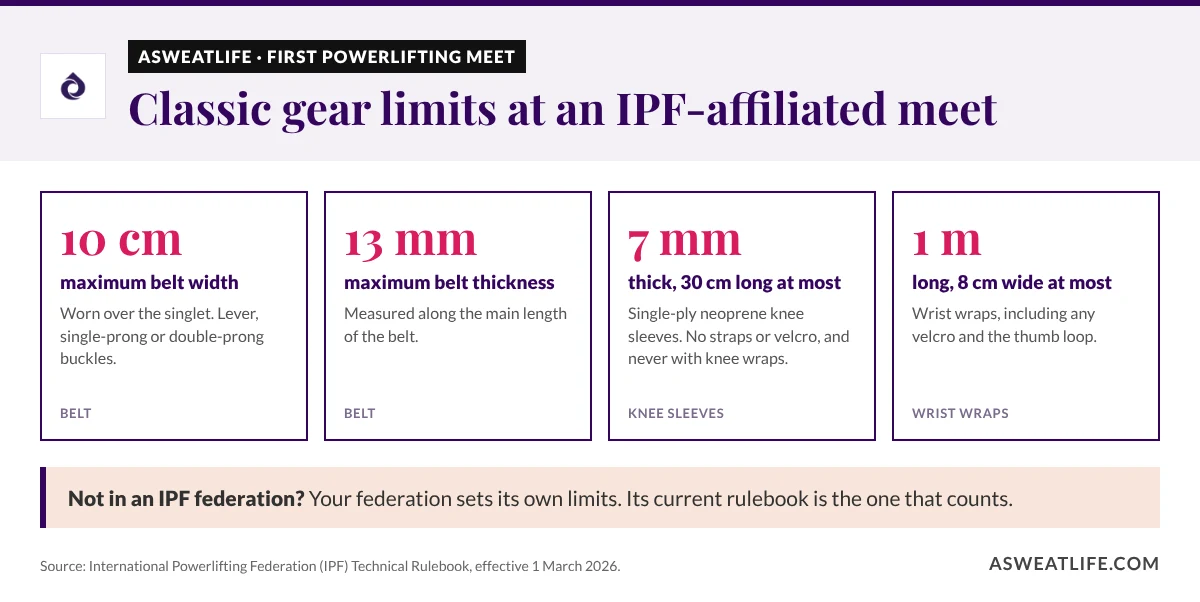
Here is what the IPF’s classic (raw) rules allow, as an example of the kind of detail to look for in your own federation’s book:
| Item | IPF classic limit | What to check on yours |
|---|---|---|
| Belt | Up to 10 cm wide and 13 mm thick; worn over the singlet | Width, thickness and buckle type |
| Knee sleeves | Single-ply neoprene, up to 7 mm thick and 30 cm long | Thickness, length, no straps or velcro |
| Wrist wraps | Up to 1 m long and 8 cm wide, including velcro and loop | Length and width |
| Socks | Must not touch the knee sleeves; shin-length socks for the deadlift | Length, and a spare pair |
| Approved list | Singlet, belt, sleeves and wraps from listed manufacturers | Brand and model against the list |

2. Get the Singlet Fit Right
A powerlifting singlet should fit snugly without pinching at the straps or restricting your hips in the squat. Order early, because you want several training sessions in it before meet day.
A size chart only helps if you’ve measured yourself, so measure your chest, waist and hips with a soft tape first. If your gym wants matching kit for the team, the size range on Sports Gear Swag’s moisture-wicking powerlifting singlets is the sort of thing to compare against your own measurements before you order. Whichever maker you choose, check that its singlet meets your federation’s rules, including any approved-list requirement.
Once it arrives, squat to depth in it, set up for a deadlift and press a bench. Watch for straps that slide, leg openings that ride up and any rubbing under the arms.
3. Choose the Right Shirt for Under Your Singlet
The shirt under your singlet is easy to overlook, and it is often covered by its own rule. A plain, close-fitting T-shirt is the usual starting point, but confirm that against your rulebook instead of assuming.
Check these points against your federation’s rules:
- Sleeve length, and whether a T-shirt is required for each lift
- Plain fabric with no zippers, buttons or pockets
- Whether logos and printed text are allowed
- A clean spare in case you sweat through the first
Then wear the exact shirt in training at least twice. A shirt that bunches up under the singlet on heavy squats is better discovered in your gym than on the platform.
4. Pick Meet-Legal Footwear and Socks
Platform footwear should be flat and stable, and it has to be allowed by your rulebook. Some federations accept flat-soled gym shoes, weightlifting shoes or deadlift slippers, and sock rules vary too, so check which apply to your meet.
Fit matters as much as style. MedlinePlus advises that you make sure your shoes fit properly and wear socks that fit well, noting that acrylic or nylon socks can help keep moisture away from your feet. Blisters usually come from friction on one spot, so a loose heel or a tight toe box will rub over a long day of warm-ups and attempts. If you are still choosing a pair, our roundup of training shoes for every type of workout is a useful starting point.
Top tip: wear your meet shoes for at least two weeks of training before the event. Pay attention to the heel on your heaviest squat and the toes on your deadlift setup, change the laces or insole now if anything slips or pinches, and pack a spare pair of socks.
5. Test Your Belt and Wrist Wraps
Belts and wrist wraps are the items most likely to be measured at equipment check, so confirm their size and construction before you buy. Federations set limits on belt width and thickness and on wrap length and width.
Before meet day, confirm each of these:
- Belt width and thickness within your federation’s limit
- A buckle or lever style your rules allow
- Wrap length and width within the limit
- Any logos or markings permitted on the belt and wraps
Then lift in your belt and wraps on your heaviest training sets. Set the belt at the same tightness every time so you aren’t guessing on the platform, and pick a wrap tension you can repeat when your hands are cold.
Tell us how long you have, tick what is already done, and see what to sort first.
1. How long until your meet?
2. What is done? Tick only what you have checked or trained in.
Sort these next
6. Add Knee Support Carefully
Federations often treat knee sleeves and knee wraps differently. In IPF classic lifting, for example, sleeves are capped at 7 mm thick and 30 cm long, and you can’t combine them with knee wraps. Check what your rulebook says for your division before you choose a pair.
Whichever you pick, train in the exact pair you plan to wear. A sleeve that is new on meet day will feel tighter than the one you’ve been squatting in, and tight sleeves can roll down at the bottom of the lift. Put them on at home, squat in them and see whether they stay in place.
If you have a past knee problem, ask your doctor or physical therapist what support suits you before you buy anything. Coming back after time off? Our guide to getting back to strength training safely covers how to rebuild before you test yourself on a platform.
7. Pack a Meet-Day Bag the Night Before
Meets run long, and you will spend hours waiting between warm-ups and attempts. The CDC notes that drinking water can prevent dehydration, which may cause unclear thinking and overheating. Bring more water than you expect to drink; if you sweat heavily, our guide to electrolyte drinks and powders compares the options.
Pack the bag the night before with these:
- Water and snacks you’ve already eaten in training
- Spare socks and a spare shirt
- Printed rulebook pages and the meet director’s emails
- Photo ID and any federation membership details the meet asks for
Use this countdown to spread the work out:
| When | What to do |
|---|---|
| 6 or more weeks out | Read the rulebook’s equipment section and list anything you need to buy |
| 4 weeks out | Order your singlet and any new gear; email the meet director with questions |
| 2 weeks out | Train in every item you will wear: singlet, shirt, shoes, socks, belt, wraps, sleeves |
| Meet week | No new gear; confirm weigh-in times, ID and membership details |
| Night before | Lay out every item, check it against your rulebook notes and pack the bag |
Lay Everything Out the Night Before
Lay each item on the floor and compare it with your rulebook notes one last time. Pack everything the night before so nothing is left on the kitchen counter when you leave.
Your first step today is simple: find your federation’s rulebook and read the equipment section. Then you will know what to buy, what to test and what to ask while you still have weeks to spare.
This article is general guidance and does not replace advice from your federation, a coach or a medical professional.
First Powerlifting Meet FAQs
What if my kit is questioned at equipment check?
A spare shirt and spare socks give you a quick fix if an item is questioned. Emailing the meet director beforehand and keeping the reply helps settle any disagreement.
How early should I buy my singlet?
Early enough to wear it through several training sessions, so you can test the fit in your lifting stance. Squat to depth and set up for a deadlift in it before meet day.
Should I break in new shoes before the meet?
Yes. Wear them in training for at least two weeks so you can spot loose heels and rubbing. Friction on one spot is what usually causes blisters.
What belt is allowed at a powerlifting meet?
It depends on your federation. In IPF classic lifting, belts can be up to 10 cm wide and 13 mm thick and must come from an approved manufacturer. Check your own rulebook for its limits.
Can I wear knee sleeves and knee wraps together?
Not in IPF competition: the rules say sleeves and wraps can’t be combined, and wraps are for equipped lifting only. Other federations may differ, so check yours.