Exercise Snacks and Micro Workouts: Nine Moves for a Busy Workday
Exercise snacks are micro workouts of five minutes or less. Here's what the research found and nine moves to do at your desk or at home.

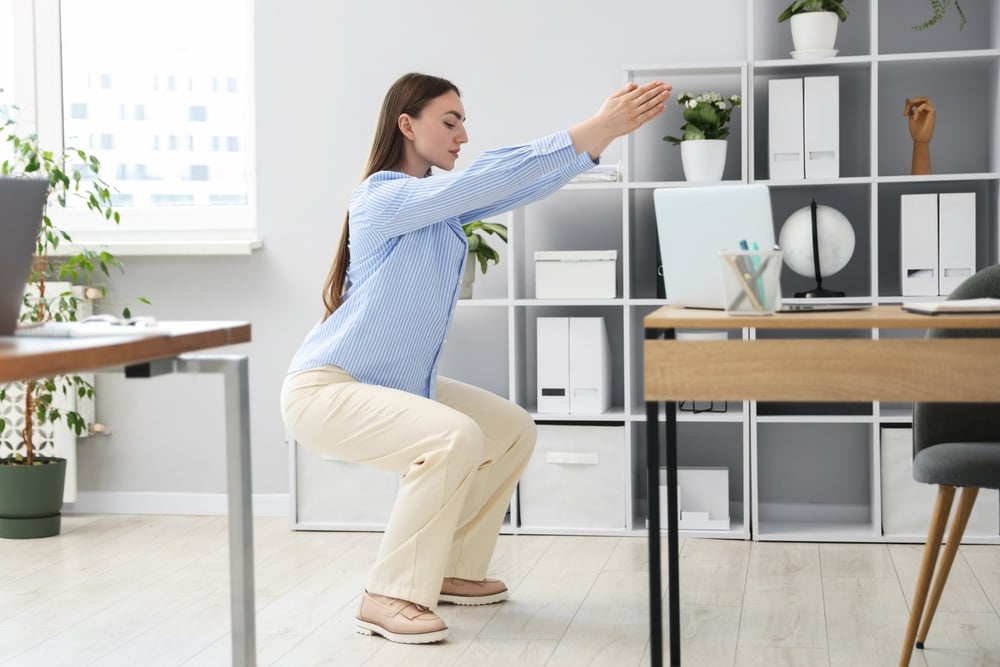
If your calendar is stacked with meetings and the gym keeps sliding to tomorrow, an exercise snack might be the most realistic sweat you get all day. Exercise snacks are micro workouts of five minutes or less, repeated a few times a day: a hard climb up three flights of stairs, 10 chair squats between calls, a fast lap of the office.
They do more than you’d expect for something this small. In a study that tracked 25,241 adults who didn’t exercise, three one- to two-minute bursts of vigorous everyday activity a day were linked to a 38% to 40% lower risk of death from any cause and from cancer. Below: what counts as an exercise snack, what the research actually asked people to do, and nine moves that fit beside your desk or in your living room.
What Is an Exercise Snack?
An exercise snack is an informal name for a very short bout of movement that gets your heart rate up, sprinkled through the day. A 2025 analysis of 11 trials defined them as bouts of moderate to vigorous activity lasting 5 minutes or less, done at least twice a day. Intensity is the point: a snack should leave you breathing harder than your usual walk to the printer.
You’ll also see the term VILPA, short for vigorous intermittent lifestyle physical activity. It describes the bursts you already do by accident (power walking to catch a train, taking the stairs two at a time, hauling heavy grocery bags) and turns them into something you do on purpose.
Do they count? Yes. The second edition of the Physical Activity Guidelines for Americans dropped the old rule that only 10-minute bouts counted, and its first key guideline for adults is to move more and sit less. The weekly target hasn’t changed: 150 to 300 minutes of moderate aerobic activity, plus muscle-strengthening work at least two days a week. If snacks are one piece of a busier puzzle, our list of five ways to fit fitness into your life adds lunch-break workouts and walking to work.
What Does Research Say About Micro Workouts?
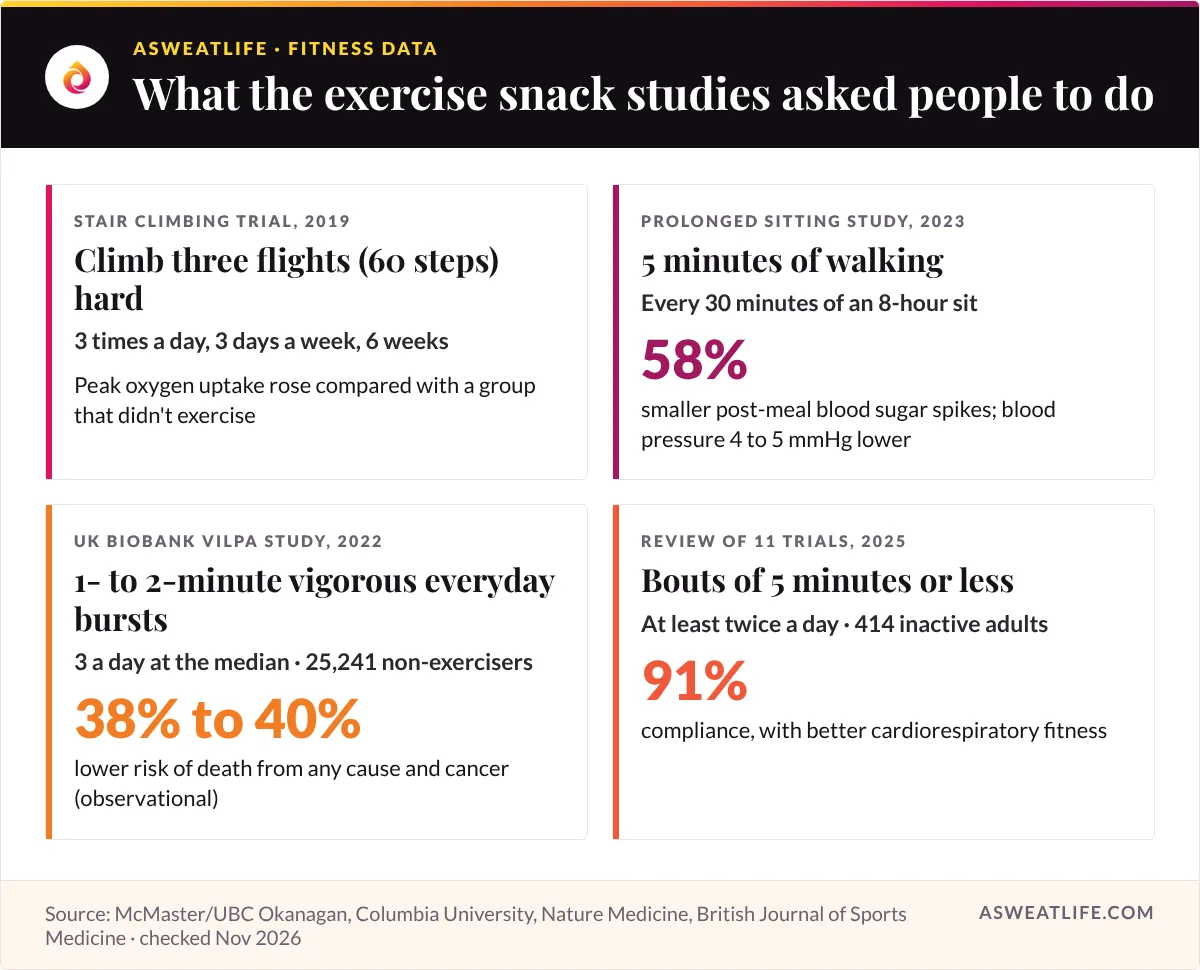
The science is young, but it agrees on one thing: short bursts improve fitness in people who were mostly sitting. Here’s what four of the best-known studies asked people to do, side by side.
| Study | Who | The snack | How often | What happened |
|---|---|---|---|---|
| Stair climbing trial, 2019 | Sedentary young adults, 12 per group | Climb three flights (60 steps) hard | 3 times a day, 3 days a week, 6 weeks | Peak oxygen uptake rose compared with a group that didn’t exercise |
| Prolonged sitting study, 2023 | 11 adults in their 40s, 50s and 60s | 5 minutes of walking | Every 30 minutes of an 8-hour sit | Post-meal blood sugar spikes 58% smaller; blood pressure 4 to 5 mmHg lower |
| UK Biobank VILPA study, 2022 | 25,241 non-exercisers, average age 61.8 | 1- to 2-minute vigorous everyday bursts | 3 a day at the median | 38% to 40% lower risk of death from any cause and cancer; 48% to 49% lower risk of cardiovascular death |
| Review of 11 trials, 2025 | 414 inactive adults | Bouts of 5 minutes or less | At least twice a day, 3 to 7 days a week, 4 to 12 weeks | Better cardiorespiratory fitness; 91% compliance |
Fitness: The Strongest Evidence
In the McMaster University and UBC Okanagan trial, sedentary young adults climbed a three-flight stairwell three times a day, three days a week, for six weeks, with one to four hours between climbs. Their peak oxygen uptake rose compared with the control group, though the authors call the gain modest. The climbers also produced more power in a maximal cycling test. “The findings make it even easier for people to incorporate ‘exercise snacks’ into their day,” said Martin Gibala, a kinesiology professor at McMaster and the study’s senior author. (More reasons to love a staircase: the benefits of taking the stairs.)
The 2025 review pooled 11 trials and found exercise snacks significantly improved cardiorespiratory fitness, with moderate certainty. People stuck with them, too: compliance was 91% and 83% finished their programs, which matters if lack of time is what keeps derailing you.
Blood Sugar, Blood Pressure and Mood
In the Columbia University study, volunteers sat for eight hours in a lab. Walking five minutes every 30 minutes cut post-meal blood sugar spikes by 58% compared with sitting all day, and every walking schedule tested lowered blood pressure by 4 to 5 mmHg. Every schedule except one minute per hour also reduced fatigue and improved mood. If that last part speaks to you, here’s more on how exercise helps mental health.
Long-Term Health
The VILPA findings come from wrist trackers worn by UK Biobank participants who said they didn’t exercise, followed for an average of 6.9 years. A follow-up study of 22,398 non-exercisers linked as little as 3.4 minutes a day of vigorous bursts to a 17% lower risk of cancer. Both are observational, so they show a link, not proof that the bursts caused the drop (the cancer study tested that by leaving out people in poor health and anyone diagnosed in the first two years).
What Snacks Haven’t Shown Yet
The same 2025 review found no significant effect on leg strength, blood pressure or blood lipids over several weeks, and its trials were small. Short-term drops like the Columbia result are promising; lasting changes need more research.
Which Moves Work in a Few Minutes at a Desk or at Home?
Pick moves that need no equipment, no changing clothes and almost no floor space. The desk set below comes from Cleveland Clinic physical therapist Eric Moogerfeld’s desk exercises with reps and form cues; string two or three together and you have a snack.
Pick where you are and how long you have, then tick off your snacks as the day goes.
At Your Desk
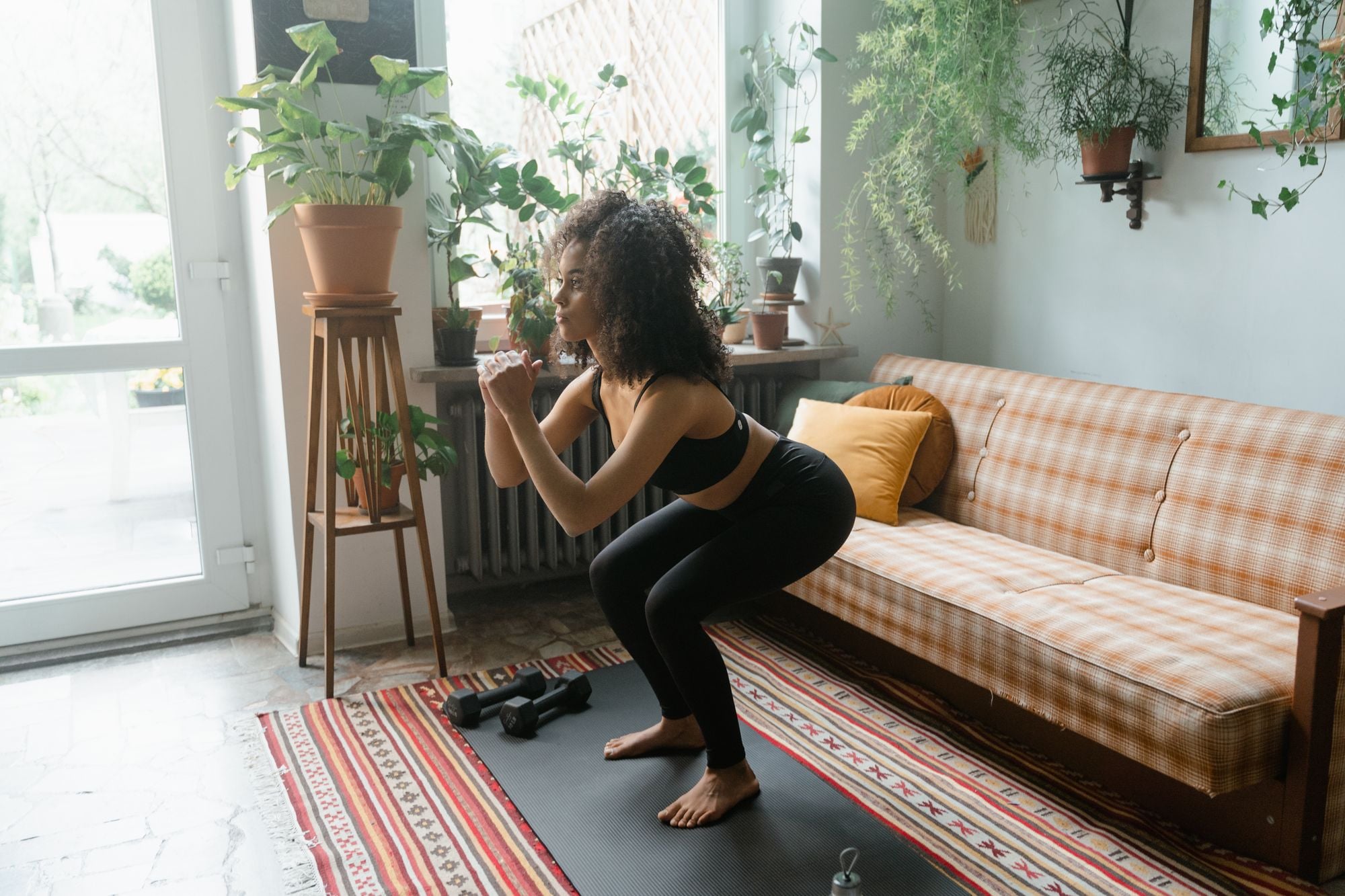
- Chair squats (10 reps). Stand in front of your chair, feet shoulder-width apart, chest up. Push your hips back as if to sit, stop just above the seat and stand.
- Desk push-ups or desk plank (10 reps or 30 seconds). Hands on the desk edge, walk your feet back until your body is a straight line. New to push-ups? Use a wall.
- Seated leg extensions (10 per side). Sit tall, straighten one leg with the foot flexed and lift it without locking the knee.
- Calf raises (10 reps). Rise onto your toes, hold, lower. Stand behind your chair to make it harder.
- Isometric holds (3 to 10 seconds each). Squeeze your glutes, press your palms together or push your knees out against your hands, then relax. Work up to three sets of 10.
- A brisk five-minute lap. Five minutes of walking every half hour was the schedule that moved blood sugar in the Columbia study.
At Home or Near a Staircase
- A hard stair climb. Three flights, about 60 steps, at a pace that leaves you breathing hard, the same dose as the stair trial. Keep a hand near the railing.
- A one- to two-minute burst. Squats, jumping jacks or jogging in place, done hard enough that talking gets tricky. That matches the length of the VILPA bouts.
- A purposeful fast walk. The VILPA researchers counted very fast walking on the commute and carrying heavy shopping. Walk to lunch like you’re late.
Want a little structure for your calls? The conference call workout for your lower body assigns a move to every awkward silence, and the 30-day plank challenge for beginners turns move two into a habit.
How To Fit Exercise Snacks Into a Busy Workday
The trick is attaching snacks to things you already do, so you don’t have to remember them.
- Use transitions as cues. Do chair squats before you sit down, and a plank or a couple of push-ups each time you get up from your desk.
- Set a 30-minute timer for a five-minute walk, the interval that worked in the Columbia study. Refill your water bottle on the far floor or take a call on foot.
- Aim for three a day. Three bouts a day was the stair trial’s dose and the VILPA median. Try one mid-morning, one after lunch and one before your last meeting.
- Take the stairs as the workout. One fast climb to a meeting two floors up is a snack.
Missed one? Do the next. Snacks work because they’re forgiving: a busy afternoon costs you one bout, not the whole week. And if you have a heart condition or high blood pressure, or haven’t been active in a while, check with your doctor before adding vigorous bursts. When you do have 10 minutes to spare, our ten-minute shoulders and back workout is a good next step up.
Can Exercise Snacks Replace a Full 30-Minute Workout?
Not entirely. Snack trials haven’t shown gains in leg strength, and the guidelines still ask for muscle-strengthening work at least two days a week. “For optimal health, you need to move regularly at work, in addition to a daily exercise routine,” said Keith Diaz, PhD, the Columbia associate professor of behavioral medicine who led the sitting study.
Use snacks to fill the gaps, and keep two or three longer sessions on the calendar when you can. If you need a template, this simple four-week beginner workout plan builds three 30-minute full-body sessions a week.
So here’s your next step: pick one move from the desk list, set that 30-minute timer, and do your first snack before lunch today. (Your afternoon slump will thank you.)
Exercise Snacks FAQ
Do I Need Equipment for Exercise Snacks?
No. Every move in this guide uses a chair, a desk, a wall, a staircase or your own body weight, which is what makes exercise snacks practical at work.
Can I Do Exercise Snacks Every Day?
Yes. The trials pooled in the 2025 review had people do exercise snacks three to seven days a week for four to 12 weeks, and most participants kept up with the schedule.
Will Exercise Snacks Make Me Sweaty at Work?
Desk moves such as chair squats, calf raises and isometric holds rarely raise a real sweat. Save the hardest bursts, like a fast stair climb, for before lunch or your commute home.