Short Walking Workouts: A 20-Minute Interval Walk for Busy Days
Short walking workouts that count: how to make a 20-minute walk harder, a minute-by-minute interval walk, and realistic ways to fit walks into a packed workday.

If your calendar only leaves room for a 20-minute walk, you can still make it a real workout. The formula for short walking workouts is simple: walk fast enough that you can talk but not sing, add a few harder intervals, and use a hill or a staircase when you pass one.
And yes, a short walk counts. Even five minutes of physical activity has health benefits, and it all adds up toward your weekly goal. Below you’ll find how to make a short walk harder, a 20-minute interval walk you can do on any sidewalk or treadmill, and realistic ways to squeeze walks into a workday that’s already packed.
How To Make a Short Walk More Intense
Your first lever is pace, because a stroll and a brisk walk are two different workouts. (Sorry, window-shopping laps.) The CDC counts walking briskly at 2.5 miles per hour or faster as moderate-intensity activity. You don’t need a speedometer to find that pace, though. These three checks work on any route.
Use the Talk Test
During moderate activity you can talk, but not sing. During vigorous activity you can’t say more than a few words without pausing for a breath. It’s a handy rule for intervals: your easy minutes should feel chatty, and your fast minutes should make full sentences hard work.
Count Your Steps for 15 Seconds
In a UMass Amherst study, walking about 100 steps per minute counted as moderate intensity for adults aged 21 to 40, and vigorous walking starts at about 130 steps per minute. To check yours, count steps for 15 seconds and multiply by four. That works out to 25 steps in 15 seconds for a moderate pace and about 33 for a vigorous one. (Cadence is a rough guide: your fitness and leg length shift the numbers a bit.)
| Check | Moderate walk | Vigorous walk |
|---|---|---|
| Talk test | You can talk, but not sing | Only a few words before you need a breath |
| Steps per minute (adults 21 to 40) | About 100 | About 130 |
| Steps in 15 seconds | 25 | About 33 |
Find a Hill, a Staircase or an Incline
Walking up hills and stairs, or on an inclined treadmill, adds resistance that helps build the muscles in your lower body. Start with a minute or two of stair climbing, or raise the treadmill incline for 30 seconds to a minute at a time. (Stairs for days.)
Pump Your Arms or Grab Poles
Bent, driving arms help you hold a faster pace. If you want your upper body in on it, Nordic walking poles work the muscles in your arms, back, shoulders, and core while you walk.
What a 20-Minute Interval Walk Looks Like
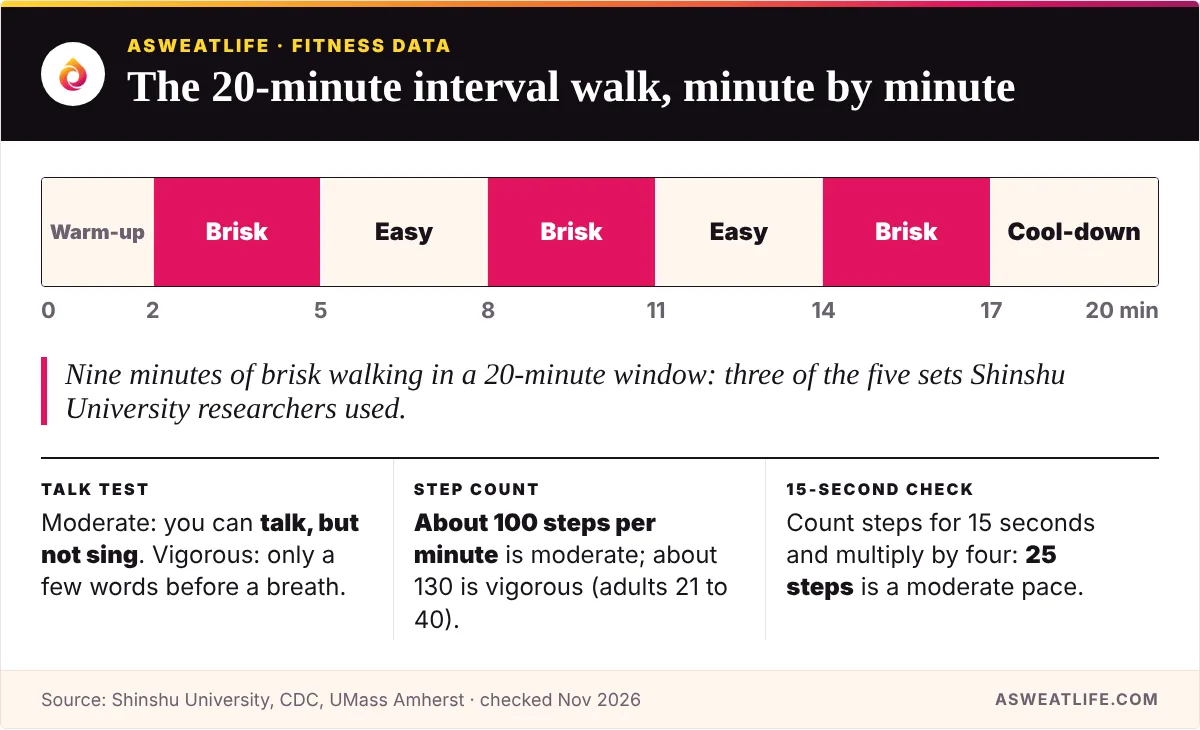
One well-studied version is interval walking training, sometimes called Japanese walking, developed by researchers at Shinshu University. Each round is three minutes of brisk walking until you’re out of breath, then three minutes of slow walking. In their programs, people did five sets a day on four or more days a week for five months, and the method can improve physical fitness by up to 20%. A 2025 study of 234 postmenopausal women also found it raised bone mineral density in women who started with low bone density, while women who started higher held steady.
Five sets takes 30 minutes. Here’s how to fit three of them into 20:
- Minutes 0 to 2: Easy warm-up walk. Loosen your shoulders and let your arms swing.
- Minutes 2 to 5: Brisk. Push until full sentences get hard (about 100 steps per minute or more).
- Minutes 5 to 8: Slow and easy. Breathe through your nose if you can.
- Minutes 8 to 11: Brisk. If there’s a hill nearby, use it here.
- Minutes 11 to 14: Slow and easy.
- Minutes 14 to 17: Brisk. Last push, so drive your arms.
- Minutes 17 to 20: Slow walk to cool down.
That’s nine minutes of brisk walking in a 20-minute window. If you have a heart condition, joint pain, or haven’t been active in a while, check with your doctor before adding fast intervals.
Three Ways To Structure Your 20 Minutes
Three minutes fast can feel like a lot on day one. (Your lungs may have opinions.) These formats fill the same 20 minutes with different amounts of hard work, so you can start easy and move up.
Pick a format to see exactly how your 20 minutes break down, and how many of them are brisk.
| Format | Pattern | Brisk minutes in 20 |
|---|---|---|
| Speed bursts | 3 minutes at your usual pace, then 30 seconds brisk, five times; finish with 2.5 easy minutes | 2.5 |
| One-two ladder | 2-minute warm-up, then 1 minute brisk and 2 minutes easy, six times | 6 |
| Japanese interval walk | 2-minute warm-up, then 3 minutes brisk and 3 minutes easy, three times | 9 |
The speed-burst pattern is the gentlest way in: three to four minutes at your average pace and a 30-second brisk burst, repeated five to 10 times. Once the bursts feel easy, try the ladder, then the full three-minute intervals.
How To Fit Walks Into a Workday
Your 20 minutes don’t have to arrive in one piece. The CDC’s weekly target is 150 minutes of moderate-intensity activity, such as brisk walking, which could be 30 minutes a day, five days a week. Two 10-minute walks or four five-minute walks get you there just as well on a day full of meetings.
- Walk after lunch. In a review of seven trials, light walking breaks lowered post-meal blood sugar and insulin more than sitting or standing breaks did. Many of those trials used two-minute breaks every 20 minutes or five-minute breaks every 30, so even a lap of the office counts.
- Take your brainstorm outside. In four Stanford experiments with 176 people, creative output rose by an average of 60% while walking, and the boost lasted when people sat back down shortly after. A walking one-on-one or a solo idea walk before a big project both qualify.
- Book it like a meeting. A 20-minute hold on your calendar is harder to give away than a vague plan to “walk later.” More ideas live in our five ways to fit fitness into your life.
- Use the in-between moments. Take the stairs, walk to a coworker’s desk, and pace during calls. Here’s how much movement at work can make up for a missed workout.
- Stretch your commute. Get off the train a stop early or park at the far end of the lot, and run one brisk interval on the way in.
Need a reason to get out the door on a gray afternoon? Here are five reasons to go for a daily walk, and a five-minute outdoor reset for days when 20 minutes truly isn’t happening.
Add Strength Moves to Your Walking Workout
The CDC also asks adults for muscle-strengthening activity on at least two days a week, and a walk is an easy place to start. During an easy interval, stop at a bench for 10 squats or step-ups, add a set of calf raises at a crosswalk, or do walking lunges along a quiet stretch of path. If you’d like a full no-equipment session on a day with more time, try this 30-minute bodyweight functional movement workout, or follow a four-week beginner workout plan that pairs strength sessions with brisk walks.
Itching to jog a few of those fast intervals? The run/walk method is the natural next step.
How Often To Do Short Walking Workouts
A brisk 20-minute walk every day adds up to 140 minutes a week, close to the CDC’s 150. Two or three of those can be interval walks; the Shinshu programs ran their intervals on four or more days a week, so build toward that if you enjoy them. On the other days, walk at a steady, chatty pace and let your legs recover.
Pick one format from the table, put it on tomorrow’s calendar, and do it. If you miss a day, give yourself some grace and walk the next one.
Short Walking Workouts FAQ
Do I Need a Treadmill for Interval Walking?
No. Interval walking works on any sidewalk, track, or trail: you change your pace, and a watch or phone timer marks the switches. A treadmill helps when you want a set incline or the weather won’t cooperate.
Is a Slow Walk Still Worth It on a Busy Day?
Yes. Even five minutes of physical activity has health benefits, and light walking after a meal lowered post-meal blood sugar more than sitting did in short-term trials. Save the intervals for days when you have the full 20 minutes.
Is Walking Enough on Its Own?
Brisk walking covers the aerobic half of the CDC’s guidelines, but adults also need muscle-strengthening activity on at least two days a week. Adding squats, step-ups, or lunges to a walk, or doing a short strength workout twice a week, covers it.