
HIIT vs Steady-State Cardio in 30 Minutes: Which Fits Your Goal
HIIT and steady cardio both build fitness in 30 minutes. Here's how they differ, which fits fat loss, fitness or a fresh start, and how to mix them across your week.


If you’ve got 30 minutes and you’re trying to decide how to spend them, HIIT versus steady-state cardio in short sessions comes down to your goal more than the clock. Both build fitness, and both lower body fat by similar amounts: across 29 trials in young and middle-aged adults, HIIT gave a small extra boost to aerobic fitness, while the difference in fat mass between the two was not significant.
HIIT’s clear win is the weekly math. One hard minute counts as roughly two moderate minutes toward the activity guidelines, which means a few interval sessions cover the same ground as more steady ones. Steady cardio wins on recovery, on comfort for beginners, and on being something you can repeat on a tired Tuesday. Here’s how the two compare inside a half hour, which one fits fat loss, fitness or a fresh start, and how to mix them across your week.
| Your goal | Pick | What decides it |
|---|---|---|
| Build aerobic fitness on a tight schedule | HIIT, two or three times a week | A small but significant edge in VO2peak across 29 trials |
| Change body composition | Either one; pick the one you’ll repeat | Fat mass fell 1.79 kg (3.9 lb) with HIIT and 2.33 kg (5.1 lb) with steady cardio, a non-significant difference |
| Starting or restarting | Steady cardio first, then add intervals | Sedentary adults improved VO2max about 18% on steady cardio or intervals alike |
| Hit the weekly guideline in fewer sessions | HIIT | One vigorous minute counts as about two moderate minutes |
| Recovery days and high-stress weeks | Steady cardio | Lower effort, lower recovery cost |
HIIT vs Steady Cardio in a 30-Minute Session: How They Differ
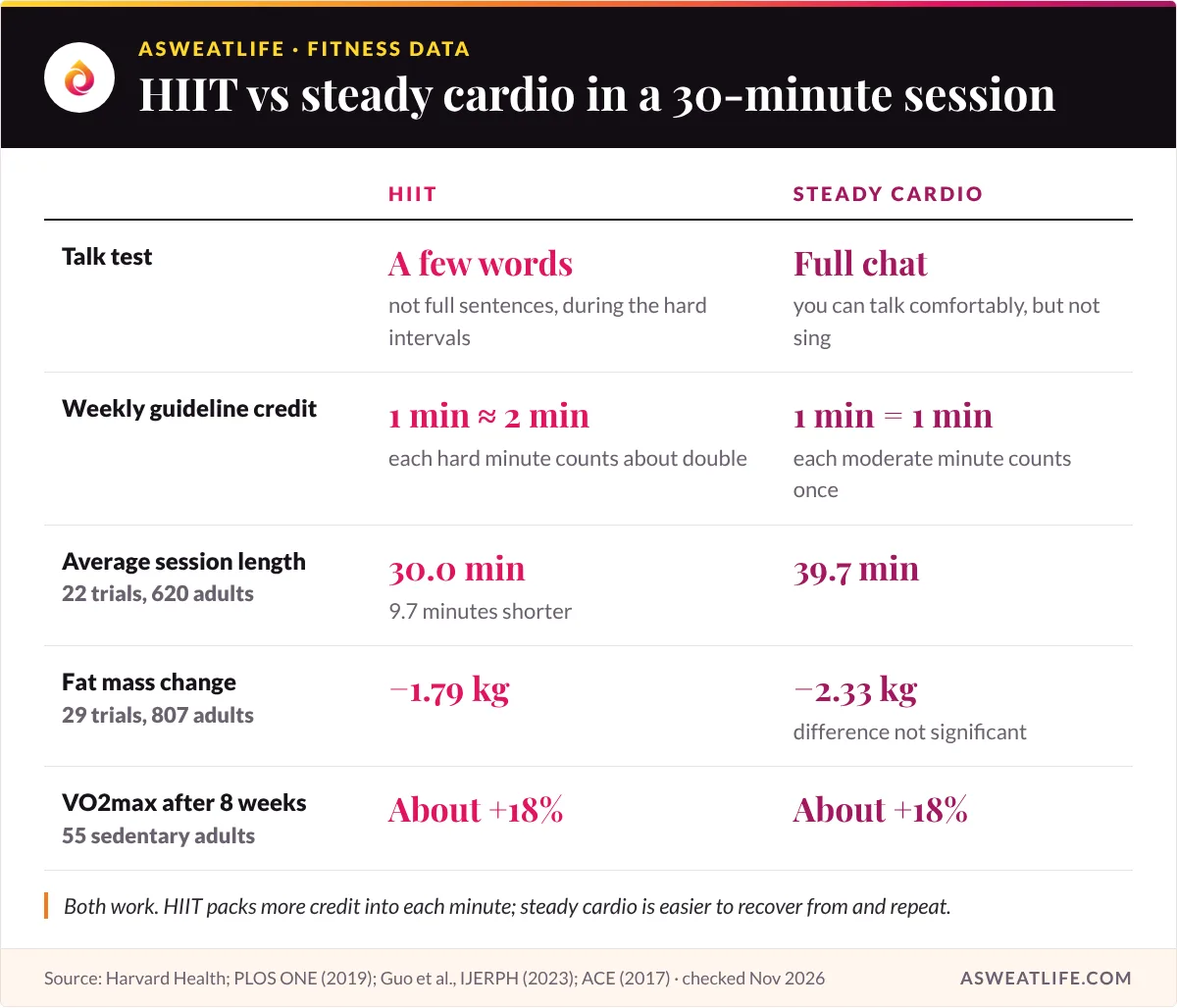
High-intensity interval training (HIIT) alternates short, hard efforts with easy recovery. Steady-state cardio holds one even, moderate effort for the whole workout: a brisk walk, an easy spin, a swim or a session on the elliptical. In a 30-minute block, that difference shapes everything from how you breathe to how you feel the next morning.
| HIIT | Steady cardio | |
|---|---|---|
| Effort | Hard intervals where you can say a few words, not full sentences, with easy recovery between | You can talk comfortably but not sing |
| How 30 minutes runs | Warm-up, a block of work intervals (one tested protocol used 13 efforts of 30 seconds), cool-down | Warm-up, about 20 minutes at an even pace, cool-down |
| Weekly guideline credit | Each hard minute counts as about two moderate minutes | Each minute counts once |
| Recovery cost | Higher; space sessions out | Lower; easy to repeat on back-to-back days |
| Examples | Bike sprints, treadmill intervals, Tabata | Brisk walking, easy cycling, swimming, elliptical |
The easiest way to tell which zone you’re in is the talk test. During moderate effort you can talk comfortably, but not sing; during vigorous effort you can get out a few words, but not full sentences. The same guidance treats one minute of intense activity as roughly equal to two minutes of moderate activity, and it counts all activity toward your weekly goal, even short bouts.
That’s the whole trade. HIIT packs more training credit into each minute, and asks more of you to get it. If intervals on a machine are your thing, our look at treadmill intervals with speed or incline breaks down the two main ways to make a treadmill interval hard.
What the Research Says About HIIT and Steady Cardio in Short Sessions
Three bodies of research are worth knowing, and they point the same way: HIIT is efficient, and its advantages are smaller than the hype.
- Young and middle-aged adults (29 trials, 807 people, 2023): Body fat percentage dropped 2.03 points with HIIT and 1.89 points with steady training, a 0.48-point gap in HIIT’s favor once the studies were pooled. Fat mass fell 1.79 kg (3.9 lb) with HIIT and 2.33 kg (5.1 lb) with steady training, and that difference was not significant. The authors, Guo and colleagues, called HIIT’s advantages for fat loss and fitness “limited,” but noted it gets there in less time.
- Adults with overweight or obesity (22 trials, 620 people, 2019): The two methods delivered similar changes in body composition and VO2max. The time savings were real but modest: HIIT sessions averaged 30.0 minutes against 39.7 minutes for steady training, 9.7 minutes less per workout.
- Sedentary young adults (55 people, eight weeks, 2017): Three groups trained three times a week. Steady cardio and moderate intervals each took about 30 minutes; Tabata took about 14. VO2max rose about 18% in all three groups, enjoyment slipped in every group, and the Tabata group enjoyed it least. Foster, who led the study, called the time efficiency of HIIT “a bit of an illusion,” because the Tabata group needed extra recovery.
An honest caveat: these trials are mostly small, and the HIIT protocols vary a lot from study to study. Read them as “both work, HIIT is a bit more efficient,” and you won’t go far wrong.
1. HIIT: Best for Fitness Gains on a Tight Schedule
HIIT earns its spot when time is the thing you have least of. Because each hard minute counts double toward the guidelines, 15 minutes of true hard work earns the same credit as a steady half hour, which leaves the rest of your session for warm-up, recovery or a strength finisher. And in the pooled trials, HIIT nudged aerobic fitness a little further than steady work.
The catch is the cost. Hard intervals feel hard (that’s the point), they take longer to bounce back from, and enjoyment tends to drop as the intensity climbs. A HIIT plan you dread is a plan you’ll skip. (And if you have a heart condition, are pregnant, or have another health concern, check with your doctor before you go all out.)
- Best for: intermediate exercisers, studio regulars who love a 30-minute class, anyone fitting cardio into a lunch break
- Watch out for: stacking HIIT on back-to-back days, skipping the warm-up, and joint-heavy moves if jumping bothers you
If impact is the issue, you can keep the intervals and drop the jumps. Our guide to choosing a low-impact HIIT workout for your level shows how.

2. Steady-State Cardio: Best for Beginners and Easy Recovery
Steady cardio is the one you can do on almost any day. The effort stays conversational, recovery is quick, and it builds fitness about as well as intervals when you’re starting out: in the eight-week study of sedentary adults, the steady group improved VO2max as much as both interval groups.
It also counts more than you might think. Brisk walking at about 2.5 mph or faster is moderate-intensity activity, and five 30-minute sessions hit the full weekly guideline on their own. Even a short, slow effort helps: a very slow 10-minute jog still gives your brain a lift.
- Best for: beginners, anyone coming back after a break, recovery days, runners building an aerobic base
- Watch out for: needing more sessions to reach the weekly guideline, and boredom (a new route or playlist helps)
Which Fits Your Goal: Fat Loss, Fitness or Beginners?
If Your Goal Is Fat Loss or Body Composition
Pick the one you’ll keep doing. In the largest pooled analysis, fat mass dropped by similar amounts with both methods, and HIIT’s edge on body fat percentage was less than half a point. Your body is not a scoreboard, either: the fitness gains show up whether or not anything changes on a scale. Consistency across months beats intensity in any single week.
If Your Goal Is Fitness
HIIT has a small advantage for VO2max, the measure of how well your body uses oxygen. Two or three interval sessions a week, with steady cardio on other days, gets you that edge without running yourself into the ground. If you train for races, keep most of your mileage easy and treat intervals as the spice.
If You’re a Beginner
Start with steady cardio for a few weeks, then add one interval session. New exercisers improve with almost any training, so you don’t need the hardest option to see progress, and the session you enjoy is the one you’ll repeat. When you’re ready, the at-home HIIT workout in our archive is a simple place to try intervals.
How Your 30-Minute Sessions Add Up Each Week
US guidelines call for 150 minutes of moderate activity or 75 minutes of vigorous activity a week, or an equivalent mix, plus at least two days of muscle strengthening. Using the one-vigorous-minute-equals-two-moderate rule, here’s how common 30-minute mixes add up. HIIT sessions count only the hard minutes, assumed here at 15 per session, with warm-up and recovery minutes left out. (That’s a generous guess: the 30-minute interval workout in the 2017 study had 13 efforts of 30 seconds, about 6.5 hard minutes.)
Pick how many steady and HIIT sessions you can fit in to see how your week stacks up against the 150-minute guideline.
| Weekly mix (30-minute sessions) | Moderate-equivalent minutes | Meets 150? |
|---|---|---|
| Five steady sessions | 150 | Yes |
| Three steady + two HIIT (15 hard minutes each) | 90 + 60 = 150 | Yes |
| Four steady + two HIIT | 120 + 60 = 180 | Yes, with room to spare |
| Three sessions fully at vigorous effort (for example, running) | 180 | Yes |
| Two steady + one HIIT | 60 + 30 = 90 | 60 minutes short |
The takeaway for a busy week: three steady sessions plus two short interval sessions get you to 150 in five workouts, and swapping a steady day for a run or a hard spin class gets you there in fewer. If your HIIT class keeps you breathless for more than 15 minutes, you’re earning more credit than this table shows. If it’s fewer (plenty of classes are), add a steady session to close the gap.
How To Mix HIIT and Steady Cardio Across a Week
The simplest rule: no HIIT on back-to-back days, and steady cardio or rest in between. Here are three weeks built from 30-minute blocks.
- Getting started (four sessions): Monday steady, Wednesday steady, Friday steady, Saturday a longer walk. After three or four weeks, swap Wednesday for an easy interval session.
- Busy studio regular (five sessions): Monday HIIT, Tuesday steady, Wednesday strength, Thursday HIIT, Saturday steady, plus a second strength day if you can fit it.
- Fitness focus (five or six sessions): two HIIT days, three steady days, two strength days doubled up with steady cardio, and one full rest day.
Leave room for real rest, too. Persistent soreness and dreading your workouts are both signs your body wants a break; our guide on signs it’s time to take a rest day covers what to look for. And if a week goes sideways, pick up with the next session. One missed workout doesn’t undo anything.
What a Good 30-Minute Session Looks Like
A 30-minute HIIT session usually looks like a few minutes of easy warm-up, a block of intervals, and a few minutes of cool-down. The moderate-interval protocol in the 2017 study packed 13 efforts of 30 seconds into about 30 minutes. A steady session is simpler: warm up for a few minutes, hold a conversational pace for about 20, then ease off.
Want something to follow? Try our Tabata workout for a short interval session, or the 20-minute bodyweight cardio workout when you want a full routine with no equipment.
How We Chose
We compared HIIT and steady cardio on the outcomes most people care about in a short session: aerobic fitness, body composition, time, recovery and enjoyment. The figures come from two meta-analyses of randomized trials (one in young and middle-aged adults, one in adults with overweight or obesity), one eight-week trial in sedentary young adults, and US physical activity guidance. The weekly table is our own calculation from the guideline’s two-for-one rule, with HIIT credited only for its hard minutes. Studies with one-off sessions or very small samples were left out of the picks.
HIIT vs Steady Cardio FAQ
Can I Do HIIT Every Day?
Hard intervals carry a higher recovery cost than steady cardio, so most weekly plans keep HIIT to two or three days, with steady cardio, strength or rest in between.
Does Walking Count as Steady-State Cardio?
Yes. Brisk walking at about 2.5 mph or faster counts as moderate-intensity activity, so five 30-minute brisk walks meet the 150-minute weekly guideline.
Is a 30-Minute HIIT Class All Vigorous Exercise?
Usually not. Warm-up, cool-down and recovery intervals are easier, so only the minutes where you can’t say more than a few words count as vigorous. Use the talk test during the class to judge.
Should I Do Cardio Before or After Strength Training?
On days you combine them, do the session you care most about first, while you’re fresh. A short steady cardio block makes an easy warm-up or finisher for a strength day.