Do You Tire Your Triceps Before Bench Press? New Research Says Women’s Muscles Respond Differently
A Swedish study of 30 trained lifters found that pre-exhausting the triceps raised chest activity in everyone during the bench press, but raised triceps activity only in women.

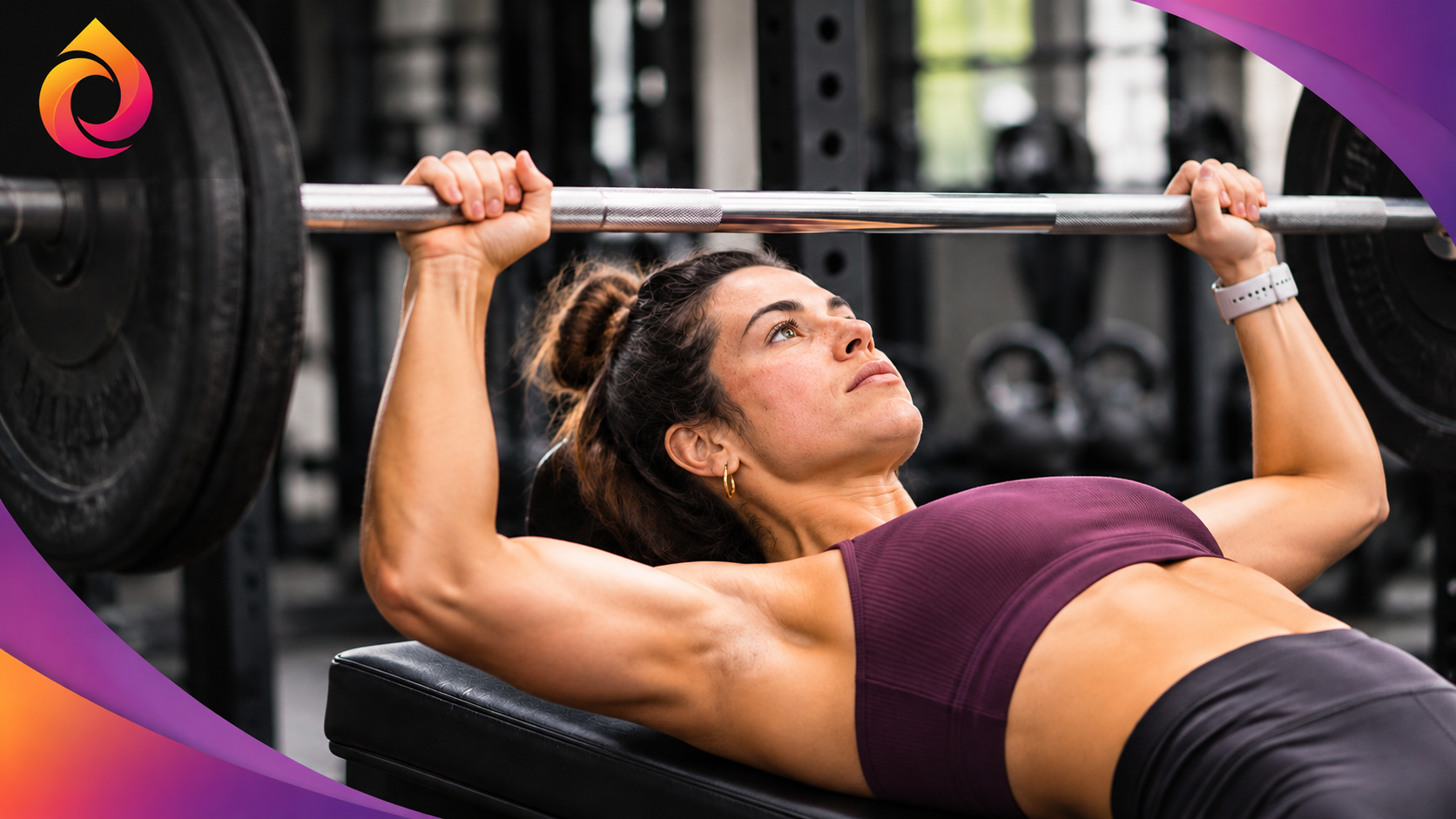
If you like to tire out your triceps before you bench press, new research suggests that the same workout technique may not work the same way for everyone. In a Swedish study of 15 women and 15 men who lift regularly, pre-exhausting the triceps raised triceps activity in women but not in men, while chest activity climbed in both groups during the bench press that followed.
The paper, from researchers at Halmstad University and Linnaeus University, appeared in the European Journal of Sport Science on November 7, 2026. Below, we break down what the team tested, what changed for women and men, what the findings can and can’t tell you yet, and how to try the method safely if it fits your strength goals.
What the Halmstad University Pre-Exhaustion Study Tested
Pre-exhaustion is an old bodybuilding method: you fatigue one muscle with a single-joint exercise, then move straight into a bigger compound lift. The goal is to push more of the work onto the muscles you didn’t tire out. Plenty of lifters use it, yet every earlier bench press study that measured muscle activity during pre-exhaustion had tested men only.
The Swedish team recruited 30 healthy adults aged 20 to 40, all with at least a year of resistance training, at least three sessions a week, and the bench press in their routine at least once a month. Here’s how the testing worked:
- Session 1: each person found their 10-rep max (10RM) on the bench press, the heaviest load they could lift exactly 10 times at a steady 2 seconds down and 2 seconds up.
- Session 2, one to two weeks later: everyone bench pressed that 10RM load to failure twice. One set came fresh. The other came right after standing overhead triceps extensions with a weight plate, taken to failure with a load chosen to hit failure at about 15 to 20 reps. Five minutes of rest separated the two bench sets, and the order was randomized.
- Measurement: surface electrodes on the chest (pectoralis major), triceps and front shoulder (anterior deltoid) recorded muscle activity, scaled to each person’s maximum isometric effort.
How Women’s and Men’s Muscles Responded to Pre-Exhaustion
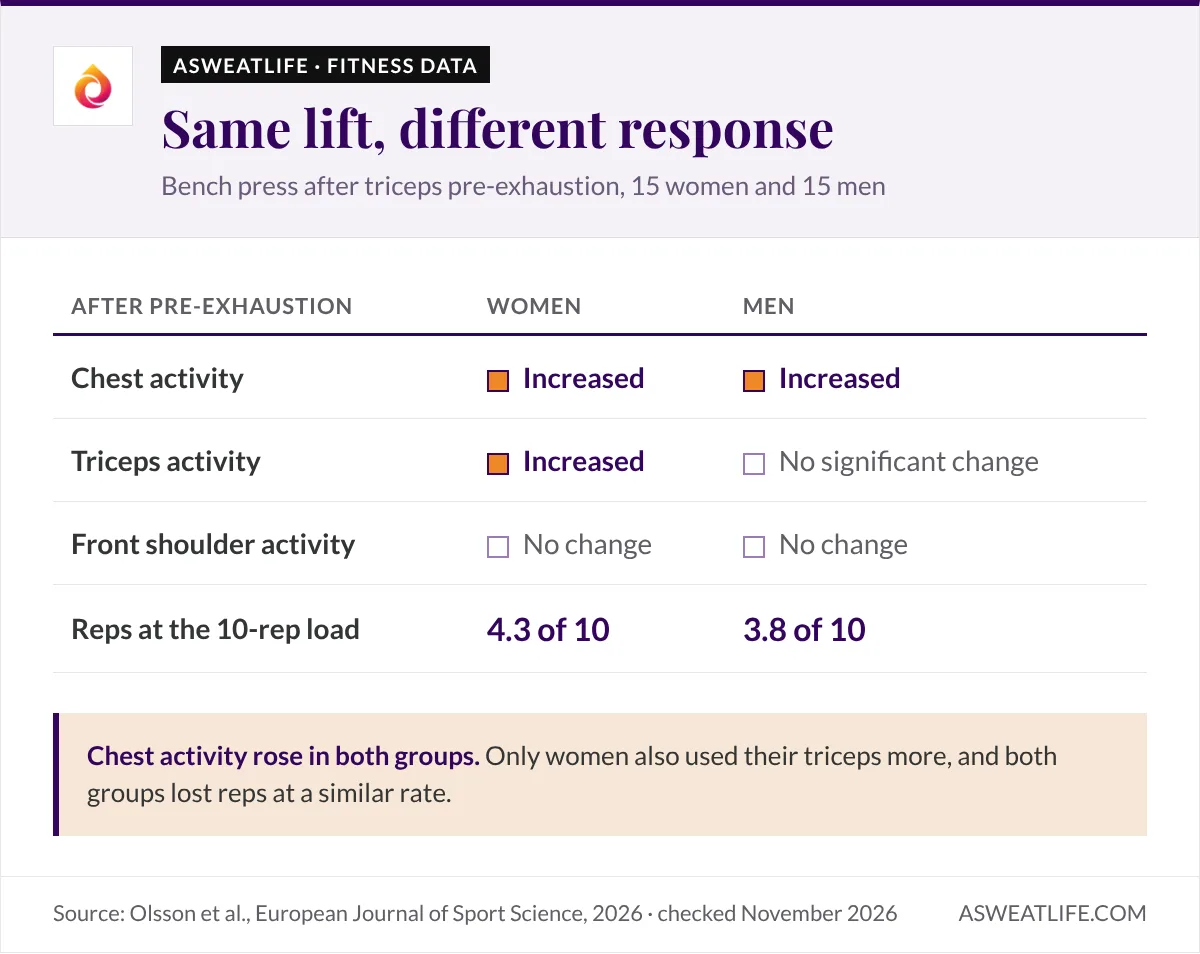
Tiring the triceps first cut everyone’s set short. Lifting a weight they could normally move 10 times, women averaged 4.3 reps and men 3.8 reps after the triceps extensions, a difference too small to be meaningful. The muscle activity results are where the sexes split.
| Muscle | Women after pre-exhaustion | Men after pre-exhaustion |
|---|---|---|
| Chest (pectoralis major) | Increased (p < 0.001) | Increased (p = 0.002) |
| Triceps | Increased (p = 0.020) | No significant change (p = 0.358) |
| Front shoulder (anterior deltoid) | No change | No change |
| Bench press reps at 10RM load | 10 fresh, 4.3 after | 10 fresh, 3.8 after |
Without pre-exhaustion, the researchers found no sex differences in muscle activity in any of the three muscles. Strength told a similar story once body composition was factored in. The average 10RM was 37.1 kg (about 82 pounds) for women and 64.0 kg (about 141 pounds) for men, yet relative to fat-free mass the two groups were nearly identical: 87.5% for women and 88.6% for men.
Why the Same Workout Technique May Not Work the Same Way for Everyone
The women’s result surprised the authors. Earlier work in men pointed the other way: when the triceps are fatigued, the chest picks up the slack and the triceps contribute the same or less. A 2016 study of 14 trained men, for example, used triceps pushdowns before the bench press and found the order cut the reps lifted without changing measures of neuromuscular fatigue.
Switch between views to see how each group’s muscles and reps changed after the triceps extensions.
The researchers suggest women may lean harder on helper muscles to keep a lift going when they’re tired, possibly because of differences in fatigue resistance or how muscle fibers are recruited. They’re careful about it, though. Women and men lost reps at the same rate, which doesn’t support the idea that women’s triceps tired differently, and the team says it’s still unclear whether the finding reflects a true sex difference or something specific to this task.
The authors’ practical read: pre-exhaustion can boost activity in the main pressing muscle for both sexes, and women may show more triceps compensation, so training volume and recovery may need tailoring. If your arms feel unusually cooked the day after a pre-exhaustion session, that’s useful body awareness, and a good reason to give your triceps a bit more recovery before the next push day.
What the Pre-Exhaustion Study Can’t Tell You Yet
This was a single-session study of muscle activity. It didn’t track muscle growth or strength over weeks, so it can’t show that pre-exhaustion builds more muscle than a standard workout. The bigger picture is modest: a 2022 narrative review concluded that current evidence doesn’t support a long-term advantage for pre-exhaustion over traditional training for strength, muscle growth or body composition.
The authors also list limits of their own:
- A smaller sample than planned. The power calculation called for 34 people, but recruiting resistance-trained women willing to have electrodes placed on the chest proved hard, so the study stopped at 30.
- Few reps to measure. Activity was averaged over reps two to four, so lifters who failed quickly after pre-exhaustion contributed only one or two reps of data.
- No strength matching. Participants weren’t paired by relative upper-body strength, which could shape how demanding the triceps exercise felt.
How to Try Pre-Exhaustion Before Your Next Bench Press
If you’ve hit a plateau and want to vary your pressing day, pre-exhaustion is worth trying now and then, as a change of pace rather than a proven plateau-breaker. A few guardrails, drawn from the study design and the researchers’ suggestions:
- Pick a triceps move you control well, such as overhead triceps extensions, and take it close to failure.
- Go straight to the bench with as little rest as you safely can. In the study, lifters stood next to the bench so they could start immediately.
- Plan to lower the weight and expect fewer reps. At their usual 10-rep load, participants managed roughly four. Use a spotter, and stop the set if your form slips.
- Use it for variety. Mix it into some sessions and keep your usual exercise order for the rest.
Building strength takes consistent training and solid recovery. Our guide to what to eat after a hard workout covers the fueling side, and if you’d like a full session to plug the method into, try this strength workout led by David Carson.
FAQ
What Is Pre-Exhaustion in Strength Training?
Pre-exhaustion means fatiguing a muscle with a single-joint exercise, such as triceps extensions, and then moving immediately into a multi-joint lift, such as the bench press, that uses the same muscle as a helper.
Does Pre-Exhaustion Build More Muscle?
There’s no clear evidence that it does. The 2026 Swedish study measured muscle activity in one session only, and a 2022 review found no long-term advantage over traditional training for strength or muscle growth.
Who Took Part in the Triceps Pre-Exhaustion Study?
The study included 15 women and 15 men aged 20 to 40 who had at least one year of resistance training experience and trained at least three times a week.
This article is for educational purposes and does not replace advice from a doctor, registered dietitian or qualified trainer.