Resistance Band Hotel Room Workout: 8 Moves and One Door Anchor
An eight-move resistance band hotel room workout for your legs, back, chest, core, and shoulders, with how to anchor the band to a hotel door and pick the right resistance to pack.

Tell me if this sounds familiar: You packed a resistance band, swore you’d use it, and it’s day three and the band hasn’t left your suitcase. Good news: if a resistance band lives in your carry-on, you already have what you need for a full-body strength session between the hotel bed and the desk. A resistance band hotel room workout covers your legs, hips, back, chest, core, shoulders, and arms with one band, the room’s door, and about 10 minutes per round. That list of muscle groups is the one the CDC says strength work should hit at least two days a week, and it names working with resistance bands as one way to do it.
Below you’ll find the eight-move routine (plus two optional arm moves), how to anchor a band safely in a hotel room with or without a door anchor, and how to pick a band that’s heavy enough to matter and light enough to pack.
How the Resistance Band Hotel Room Workout Works
The routine is a circuit: do each move for 10 to 15 reps, go straight to the next one, and rest for a minute after the last move. One round of the eight core moves takes about 10 minutes at roughly a minute per move, including the time it takes to step onto the band or clip it into the door. Two rounds make a solid 20-minute session, and three rounds fill 30 minutes.
Pick your time, tell the builder below whether you packed a door anchor, and it lays out your session.
How hard should each set feel? The CDC’s rule of thumb is to work to the point where it’s hard to do another repetition without help. If you can rattle off 15 reps and keep chatting, shorten your grip on the band or step farther from the anchor. If you can’t reach 10 with good form, give the band more slack.
Bands are a real strength tool, too. A 2019 review of eight randomized trials in SAGE Open Medicine found that training with elastic resistance provides similar strength gains to training with weight machines and free weights. (So no, your hotel workout isn’t a lesser version of leg day.) The moves are ordered so you alternate lower body, pulling, and pushing, which lets one area recover while you work the next.
Not sure how many rounds to plan? Two is a solid default for most hotel stays.
Which Band Moves Cover the Whole Body?
Eight moves cover every major muscle group, and three of them have a no-door swap so you can do the whole thing with the band under your feet. Here’s the lineup at a glance.
| Move | Main muscles | Anchor | No-door option |
|---|---|---|---|
| 1. Banded squat | Legs, hips | Under feet | Same |
| 2. Romanian deadlift | Hamstrings, glutes, lower back | Under feet | Same |
| 3. Door-anchored row | Upper back, biceps | Door, chest height | Seated row with band around feet |
| 4. Split squat | Quads, glutes | Under front foot | Same |
| 5. Chest press | Chest, triceps, shoulders | Door, chest height | Band wrapped around your upper back |
| 6. Overhead press | Shoulders, triceps | Under feet | Same |
| 7. Pallof press | Core (anti-rotation) | Door, chest height | Banded dead bug |
| 8. Band pull-apart | Upper back, rear shoulders | Your hands | Same |
| Bonus: Biceps curl | Biceps | Under feet | Same |
| Bonus: Overhead triceps extension | Triceps | Under feet | Same |
1. Banded Squat
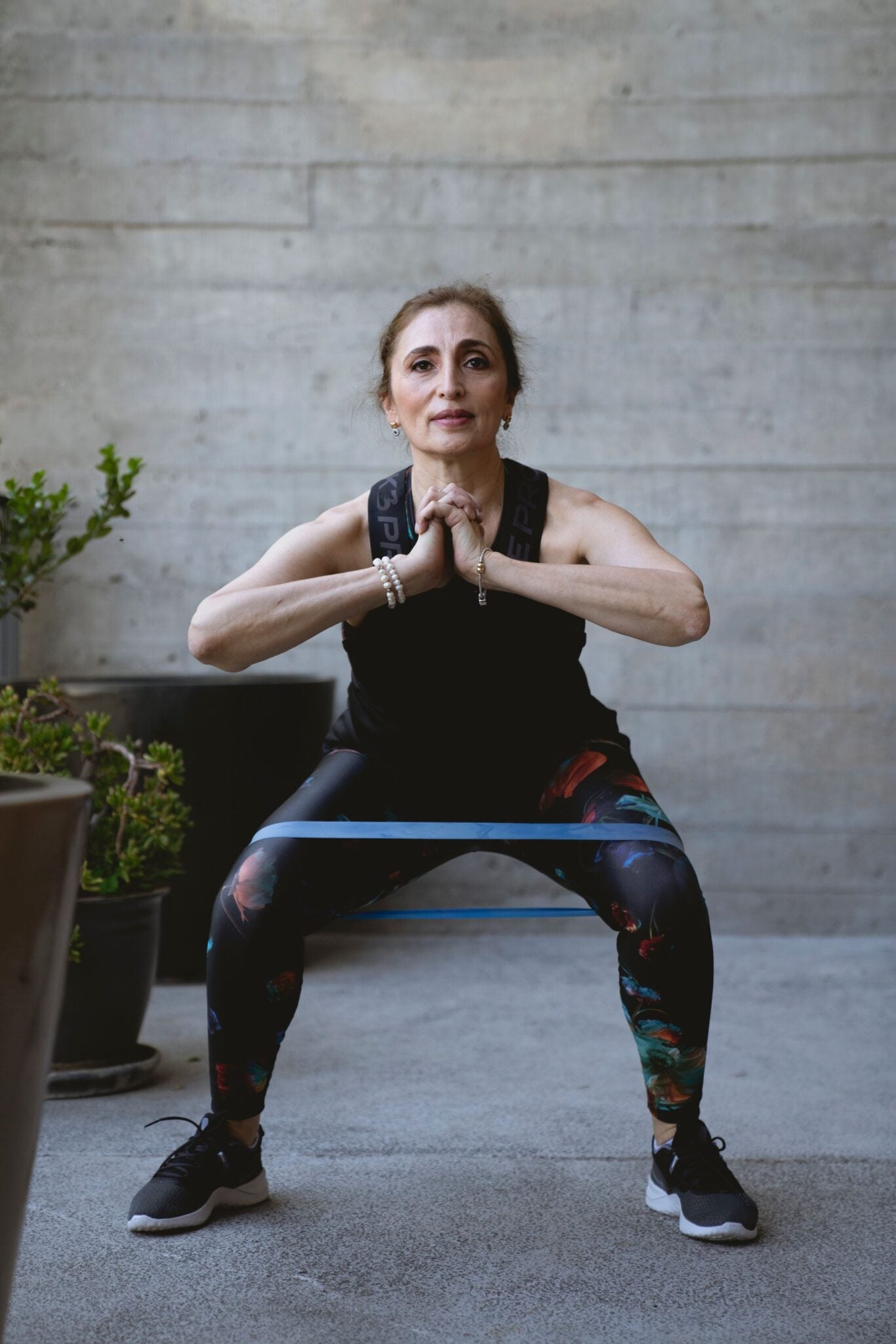
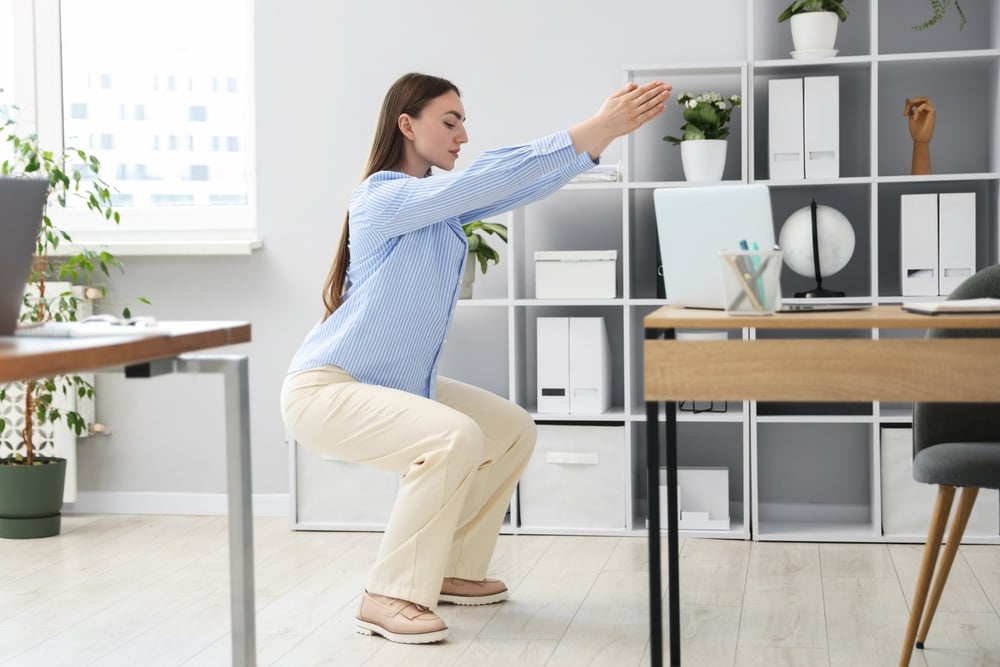
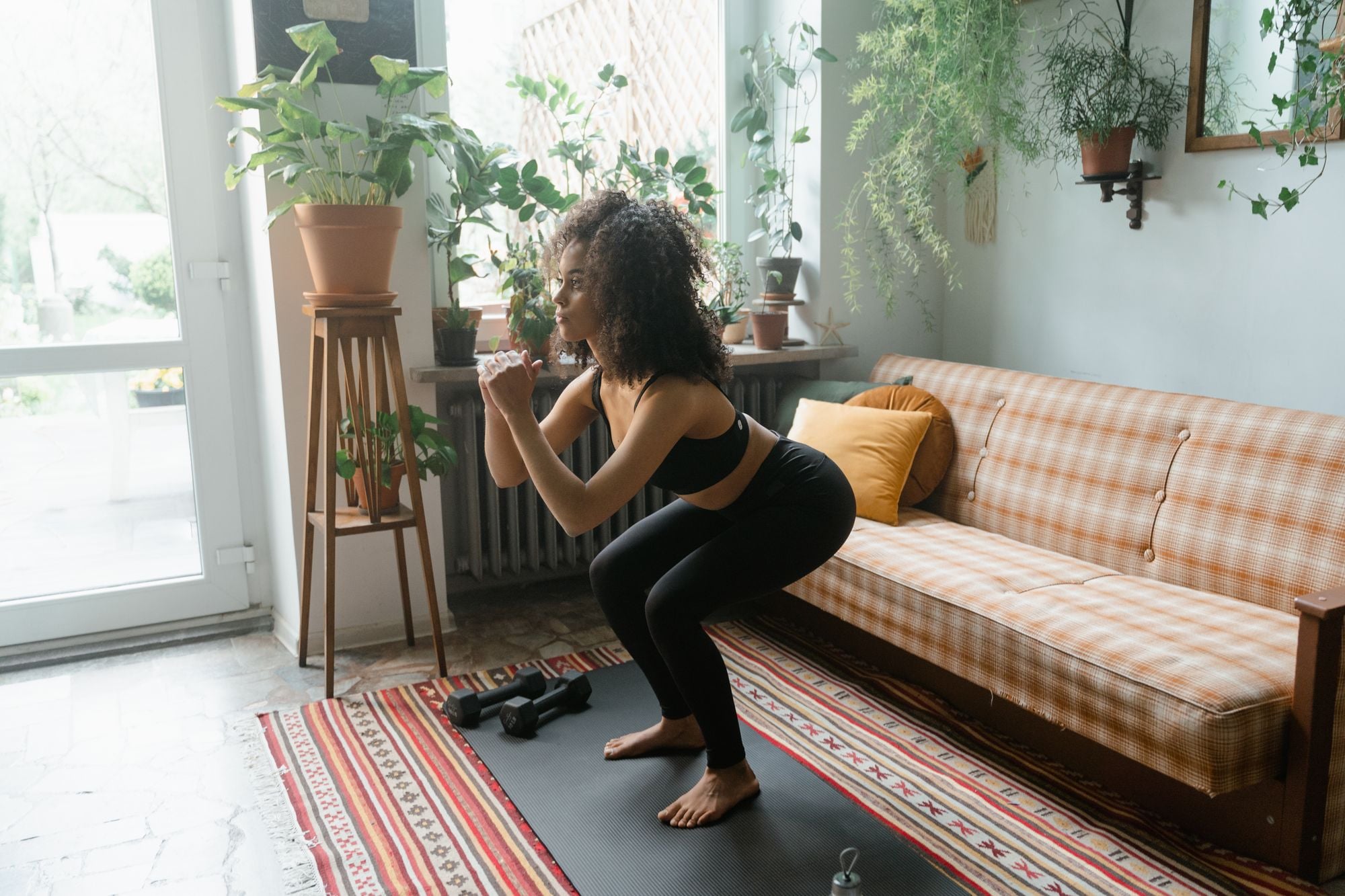
Stand on the middle of a long loop band or a tube band with your feet about hip-width apart, and bring the ends (or handles) up to your shoulders, palms facing forward. Sit your hips back and down until your thighs are about parallel to the floor, then drive through your whole foot to stand. The band gets tighter as you rise, so squeeze your glutes at the top where the resistance peaks.
Widen your stance to add tension or step one foot off the band to lighten it.
2. Romanian Deadlift
Keep the band under both feet and hold the ends at your thighs with straight arms. With a soft bend in your knees, push your hips back and lower your hands along your shins until you feel a stretch in your hamstrings, keeping your back flat. Stand tall by driving your hips forward. This is the move that gives your posterior chain (the hamstrings, glutes, and lower back that sitting on a plane all day ignores) some real work.
3. Door-Anchored Row
Clip the band into the door at chest height, face the door, and step back until the band is taut with your arms straight. Pull your elbows back past your ribs, squeeze your shoulder blades together for a beat, and return slowly. Stagger your stance if the band pulls you forward.
No door anchor? Sit on the floor with your legs straight, loop the band around the soles of your feet, and row toward your hips. Keep your shoes on and the band in the middle of your soles so it can’t slide off.
4. Split Squat
Take a long stride, place the band under your front foot, and hold the ends at your shoulders. Lower your back knee toward the carpet until both knees are bent to about 90 degrees, then press through your front heel to come up. Do all your reps on one side before switching. Hold the hotel desk with one hand if your balance wobbles; the goal is your legs, not a tightrope act.
5. Chest Press
With the band anchored at chest height, turn your back to the door, hold a handle in each hand at chest level, and step forward until there’s tension. Press your hands straight out in front of you, then let your elbows come back slowly. A staggered stance keeps you from tipping backward.
No door anchor? Wrap the band around your upper back, just under your shoulder blades, hold an end in each hand, and press forward. You can also do this move as a banded push-up, with the band across your back and the ends pinned under your palms.
6. Overhead Press
Stand on the band with your feet hip-width apart, bring your hands to your shoulders, and press straight overhead without arching your lower back. Lower with control. If the band is too strong at the top, use a split stance with just your front foot on it. Before you start, check that the band sits flat and centered under your shoes; this is the move where a band that slips would snap toward your face (more on that below).
7. Pallof Press
Anchor the band at chest height and stand side-on to the door, holding the band at your sternum with both hands. Step away until the band tries to twist you toward the door, brace your abs, and press your hands straight out, hold for two seconds, then bring them back. That resistance to twisting is the core work. Do all your reps facing one way, then turn around.
No door anchor? Do a banded dead bug: lie on your back, loop a long band around both feet, hold the ends in your hands with arms pointing to the ceiling, and slowly extend one leg at a time while keeping your lower back pressed into the floor.
8. Band Pull-Apart
Hold the band in front of you at shoulder height with straight arms and your hands about shoulder-width apart. Pull your hands out to the sides until the band touches your chest, squeezing your shoulder blades, then return slowly. It needs no anchor at all, so it’s the easiest move to sneak in between Zoom calls or while the coffee maker gurgles. Narrow your grip to make it harder.
Bonus Arm Moves: Biceps Curl and Overhead Triceps Extension
If you have three more minutes, add arms. For curls, stand on the band and curl the ends toward your shoulders with your elbows pinned at your sides. For the triceps extension, stand on one end with your back foot, hold the other end behind your head with both hands, and straighten your arms overhead. Ten to 15 reps of each is plenty after the circuit.
How To Anchor a Resistance Band in a Hotel Room
Every move above uses one of three anchors: your feet, the door, or your own hands. Most of the routine runs on the first, and the door handles the pulls and presses that need a fixed point in front of or behind you.
Under Your Feet
Standing on the band is the simplest anchor in any room, and it’s also the one to respect. Exercise bands that slip off a foot can snap back into the face, and Dr. Troy Madsen, an emergency physician at University of Utah Health, points to a report on 11 patients (14 eyes) with band-related eye injuries, and 82% of those patients had a hyphema (blood pooling behind the cornea). His advice is simple: wear glasses or consider goggles. Add your own checks: wear shoes with grippy soles, keep the band centered under the arch, and set it down slowly at the end of each set.
On the Door
A door anchor is a foam or fabric loop that you shut in the door gap so the band has a fixed point. The anchor goes on the hinged side of the door, and you pull in the same direction the door closes, so every rep presses the door more firmly shut. A sturdy door that closes firmly is all you need.
- Pick the right door. The room’s entry door is usually the heaviest. Lock it with the deadbolt or latch so nobody walks in mid-row. A flimsy closet or bathroom door that won’t latch is a no.
- Set the height for the move. Chest height (near the middle hinge) covers the row, chest press, and Pallof press in this routine. A high anchor above the top hinge works for pulldowns; a low one near the bottom hinge works for leg moves.
- Test it first. Give the band a gentle pull and lean back before your first full rep. If anything shifts, reset the anchor.
What Not To Anchor To
Skip door handles (they turn), anything with wheels, curtain rods, towel bars, and furniture you can’t see the base of. If the bed sits on a solid base, there’s nothing to wrap a band around, and a desk chair will happily roll across the room after you. When nothing in the room is solid, use the no-door swaps above; the whole routine works with the band under your feet and in your hands.
How To Pick Band Resistance for Travel
Band colors are not a standard: each brand sets its own scale, so read the chart from the maker of your band. The idea behind every scale is the same, though. A band pulls harder the farther you stretch it, which is why stepping back from the door or shortening your grip makes a move harder.
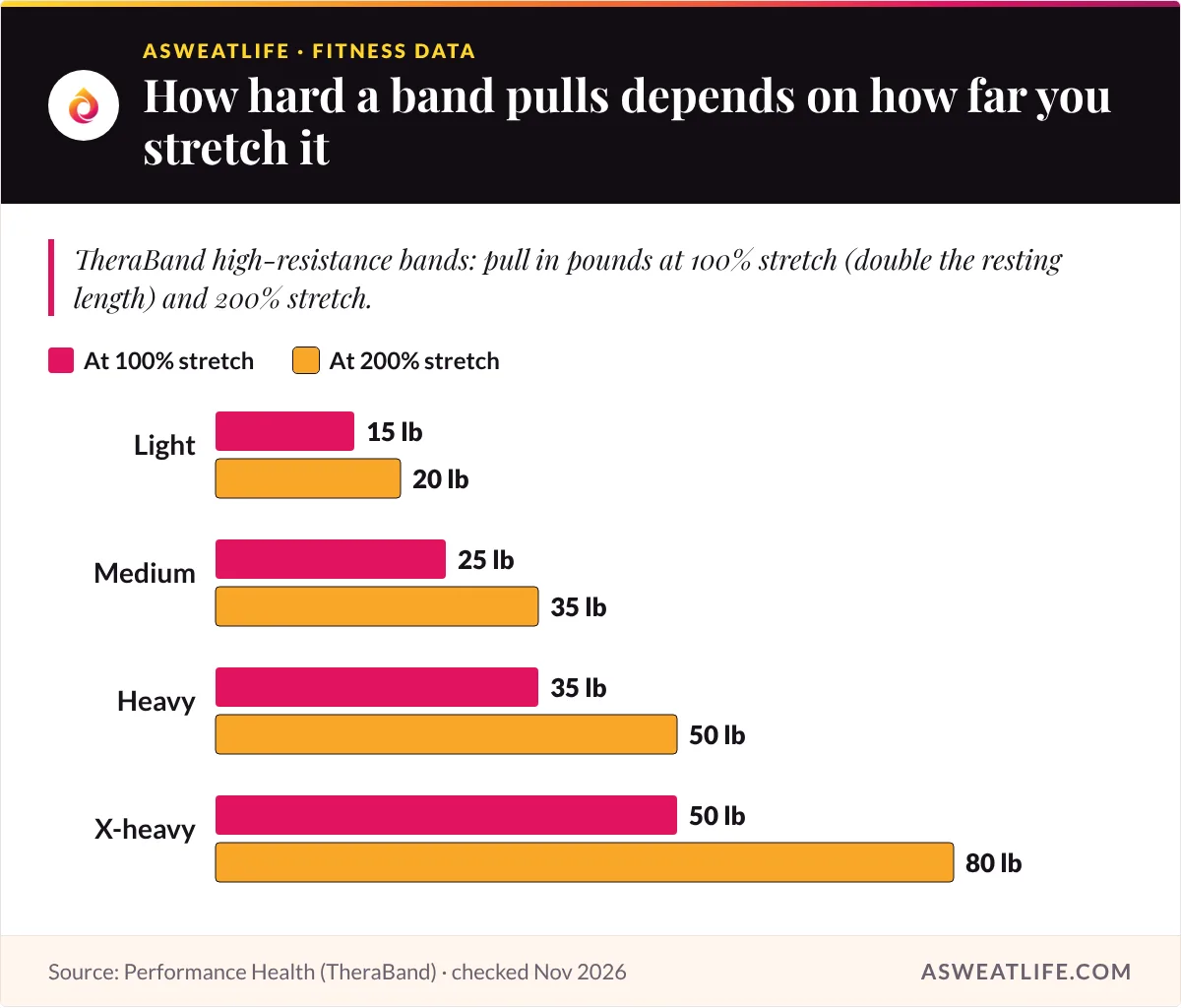
TheraBand’s own figures show how much stretch matters. Its high-resistance bands pull 15 pounds at 100% elongation for the light level and 50 pounds for x-heavy, and the numbers climb further when you stretch them to twice their length.
| TheraBand high-resistance level | Pull at 100% stretch | Pull at 200% stretch |
|---|---|---|
| Light | 15 lb | 20 lb |
| Medium | 25 lb | 35 lb |
| Heavy | 35 lb | 50 lb |
| X-heavy | 50 lb | 80 lb |
A 100% stretch means the band is pulled to double its resting length. Standard flat therapy bands are far lighter: in the standard TheraBand color line, resistance rises roughly 20% to 30% with each step up in color, with a green band at about 5 pounds at 100% stretch. That’s useful for pull-aparts and shoulder work but too light for squats if you already strength train.
For this routine, pack based on the moves:
- One heavier band for the lower body. Squats, Romanian deadlifts, and split squats need the most resistance. Choose the band that makes rep 12 to 15 of a squat hard.
- One lighter band for the upper body. Pull-aparts, overhead presses, and Pallof presses need far less. If one band has to do everything, pick the lighter one and make lower-body moves harder by widening your stance or doubling the band.
- Handles and a door anchor if you want rows and presses. A tube set with clip-on handles lets you stack tubes for heavier moves and unclip them for lighter ones, and the door anchor weighs next to nothing.
Not sure which style you own? Our guide to the different types of resistance bands and how to work out with them breaks down loop, tube, mini, and fabric bands. Before you pack, run your hands along the band and check for nicks, tears, or sticky spots, especially near the handles, and leave any damaged band at home.
No Band? Bodyweight Moves That Work in a Hotel Room
Left the band at home? It happens (usually on the trip where you swore you’d work out every day). You can still train most of the same muscles. Squats, split squats, push-ups, glute bridges, and planks cover your legs, chest, and core with bodyweight alone. If your hotel has a small gym, our aSweatLife hotel workout pairs 10 minutes of cardio with dumbbell moves you can do there. Your luggage can work as a weight, too: this sweaty workout with just a suitcase turns a packed carry-on into a kettlebell stand-in.
If the hotel has a fitness center, here’s how to make the most out of an apartment or hotel gym. Packing a mini loop band as a backup is also smart: our full-body mini band workout runs seven moves on a band that fits in a sock.
Resistance Band Hotel Room Workout FAQs
How Many Times a Week Should I Do This Workout While Traveling?
Aim for at least two sessions a week, which matches the CDC’s minimum for muscle-strengthening activity that works all the major muscle groups. On a longer trip, space them a day or so apart so the same muscles get time to recover.
Can I Do This Routine If I’m New to Strength Training?
Yes. Start with one round using a light band, focus on slow, controlled reps, and add a second round once the moves feel familiar. If you want a structured plan for home, our simple four-week beginner workout plan builds the habit over a month.
Will the Workout Bother the People in the Next Room?
The routine has no jumping, and bands make no noise, so it’s one of the quietest ways to work out in a hotel room. The only sound to watch is the door: close it gently on the anchor and avoid letting the band snap it against the frame.
Do I Need a Yoga Mat?
No. Every standing move works on hotel carpet, and a folded bath towel is enough padding for the dead bug or seated row. Shoes with grippy soles matter more than a mat, since they keep the band from sliding out from under your feet.
Your next step: before your next trip, tuck the band and a door anchor into your shoe, and plan your first session for the evening you arrive, before the trip schedule fills up. Two rounds take about 20 minutes, and that’s one of your two strength days for the week already in the bag.