
Swap 15 Minutes of Sitting for a Real Sweat? A Big Student Survey Links It to Slightly Better Mood
A survey of 2,636 University of Milan students links more moderate-to-vigorous activity with slightly fewer depressive symptoms and better self-rated health, and more sitting with slightly more. The effects are small, and the design can't show cause.


If your weekdays involve a lot more sitting than sweating, a new study from Italy is worth a look. A survey of more than 2,600 students at the University of Milan in Italy found that those who spent a bigger share of their waking time in moderate-to-vigorous physical activity reported slightly fewer depressive symptoms and rated their own health slightly better. Students who spent more of the day sitting reported slightly more depressive symptoms and slightly worse health.
The paper, by Flavia Pennisi and six colleagues, was published online in Depression and Anxiety on September 3, 2026. The word to hold onto is “slightly”: the links were consistent but small, and a one-time survey can’t show that moving more caused the better mood. Here’s what the researchers measured, how big the effects were, and what you can take from it if your calendar is already packed.
What the University of Milan Survey Found
Pennisi’s team sent an anonymous online survey to students through the university’s official mailing system. The final analysis included 2,636 students. About 71% were women, 53% were 18 to 23 years old, 32% were 24 to 29, and the rest were 30 or older.
Students recalled their past week of movement on the short form of the International Physical Activity Questionnaire. Depressive symptoms were scored with the PHQ-9, a nine-question screener that runs from 0 to 27. Health was a single self-rating, and eating disorder symptoms came from the SCOFF, a five-question screener.
Three patterns stood out:
- More moderate-to-vigorous activity as a share of the day went with slightly fewer depressive symptoms and slightly better self-rated health.
- More sitting as a share of the day went with slightly more depressive symptoms and slightly worse self-rated health.
- Walking, which the researchers counted as light activity, showed no link with depressive symptoms or self-rated health.
The authors concluded that giving more of the day to moderate-to-vigorous activity, at the expense of sitting, is associated with modestly better mental and perceived health in university students. In plain words: the harder-sweat minutes lined up with feeling a little better, and the extra sitting minutes with feeling a little worse.
How the Milan Students Spent Their Day
On an average day, the students reported 41 minutes of moderate-to-vigorous activity, 58 minutes of walking, and 321 minutes of sitting. That sitting total is five hours and 21 minutes, close to eight times the time they spent in harder movement.
Curious how your own day stacks up? Plug in your minutes and see.
Do the math and 41 minutes a day works out to 287 minutes over a seven-day week. The World Health Organization’s floor for adults is at least 150 minutes of moderate-intensity physical activity per week, so the average student here cleared it on paper. The same WHO guidance says every age group should limit time spent sedentary and that physical activity reduces symptoms of depression and anxiety. Averages hide a lot, though (some students move far more, some far less), and the study’s real interest was the balance between activities.
What Swapping 15 Minutes of Sitting Changed
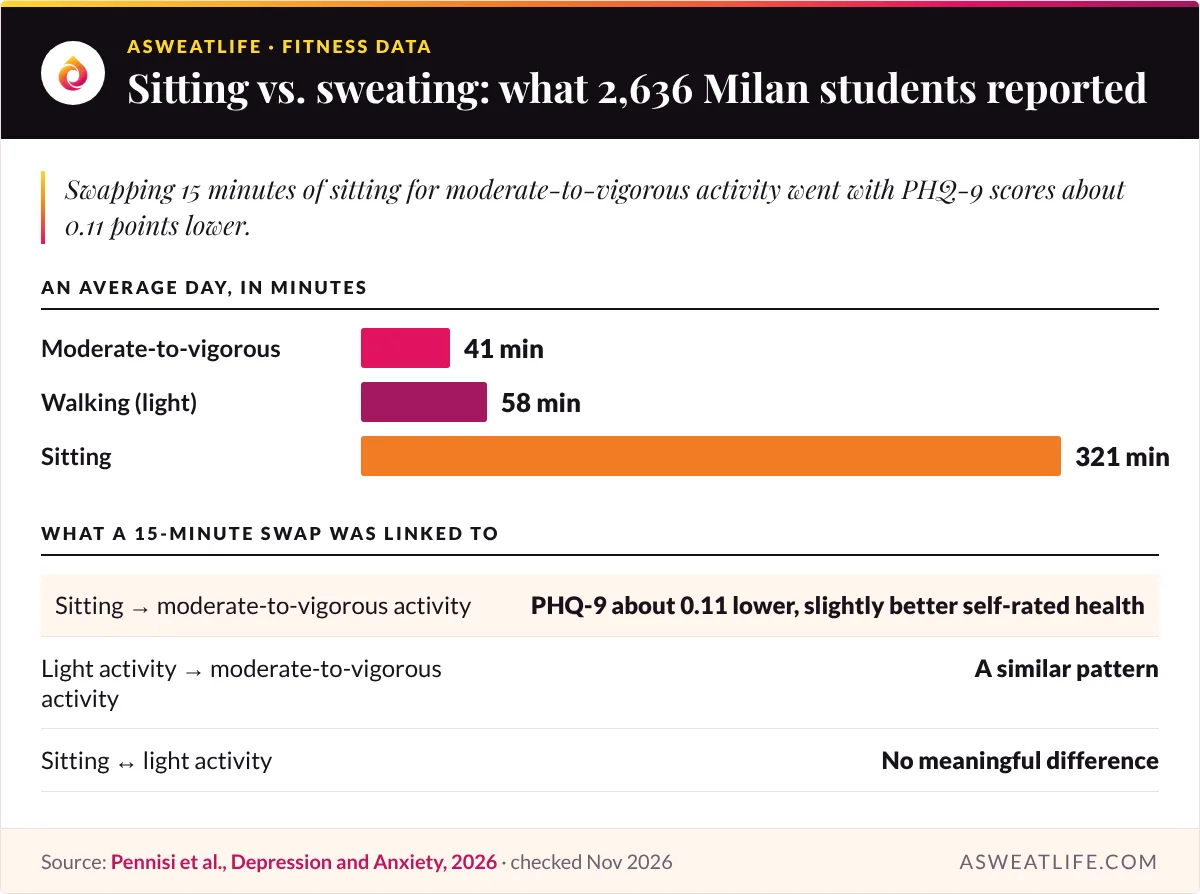
Your day only has so many waking minutes, so 15 more minutes of exercise means 15 fewer minutes of something else. Pennisi’s team used a method called compositional isotemporal substitution to model exactly that kind of trade, treating moderate-to-vigorous activity, light activity, and sitting as parts of one fixed day.
- Sitting to moderate-to-vigorous activity: replacing 15 minutes of sitting was associated with PHQ-9 scores about 0.11 points lower, plus slightly higher self-rated health.
- Light activity to moderate-to-vigorous activity: a similar pattern.
- Sitting to light activity, or the reverse: no meaningful difference.
Put 0.11 next to a scale that tops out at 27 and you can see why the researchers kept the word “modest” close. No single student would see that as a change in their own score. The value is in the direction: across thousands of students, time that went to harder movement lined up with slightly better mood, while time that went to sitting lined up with slightly worse.
The Eating Disorder Signal in the Data
One result points the other way. A larger share of moderate-to-vigorous activity was associated with slightly higher SCOFF scores, the eating disorder screener, and a larger share of sitting with slightly lower ones. Both associations were very small.
The survey can’t say why, so read it as a reminder that more exercise isn’t automatically a healthier choice for everyone. Movement that feels compulsive, or that comes bundled with food rules, deserves a conversation with a doctor or therapist. Movement you pick because you like it is a different story, and our piece on how to find movement that brings you joy walks through choosing activities for enjoyment and connection.
What the Study Can’t Tell You
Before you overhaul your whole calendar, here’s the fine print (and it matters as much as the findings):
- Small effects, big sample. The associations were very small and showed up mainly because more than 2,600 students took part.
- Self-reported data. Everyone recalled their own activity and symptoms, which leaves room for memory and reporting bias.
- A single snapshot. The design is cross-sectional, so cause and effect could run backward: students with more depressive symptoms may simply move less.
- Missing pieces. Sleep, diet, and socioeconomic status weren’t accounted for.
- One campus. Every student came from a single Italian university, which may limit how far the results travel.
Why Student Mental Health in Italy Is on Researchers’ Radar
University students carry a heavy load. A review of studies conducted in Italy estimated that 46% of university students experienced depressive symptoms, 65% experienced anxiety symptoms, and 85% experienced significant stress. Those estimates varied widely from study to study, and some were collected during the COVID-19 pandemic.
Many students also move very little and sit for long stretches. (Sound like your last finals week, or your last quarter at work?) That combination is why the Milan team looked at the whole day as a budget of minutes, and why its answer, small as it is, centers on where those minutes go.
How To Trade Sitting for Movement on a Busy Schedule
The study can’t prove that moving more will lift your mood, but the swap it modeled is a realistic one: 15 minutes of sitting traded for something that gets your heart rate up. If you want to try it, here are a few ways to fit that into a full day:
- Climb something. Stair climbing is a free, low-impact way to work harder in a short window, and there are plenty of reasons to take the stairs more often.
- Go slow and short. Researchers in a separate study found that a very slow 10-minute jog still gave the brain a lift, so a short run between classes or meetings is still worth it (just know the Milan link showed up for harder movement, not for walking, so nudge the pace when you can).
- Book it like a meeting. A midday workout can set boundaries when you work from home, and it carves a block out of your longest sitting stretch.
- Bring a friend. Everything is better with friends, and a recurring sweat date with a friend is easier to keep than a solo plan you’ll talk yourself out of.
And if a week goes sideways, give yourself grace. The Milan data describes the overall balance of students’ days, and one off week is just that.
When To Talk to Someone
Exercise is one tool among several. If low mood is sticking around or getting in the way of daily life, talk to a doctor or a mental health professional. If you or someone you know is in crisis, call or text the 988 Suicide & Crisis Lifeline at 988, and in a life-threatening situation, call 911.
FAQ
Does Walking Count in the University of Milan Study?
In the University of Milan survey, walking was treated as light activity and showed no link with depressive symptoms or self-rated health. The associations appeared for moderate-to-vigorous physical activity and for sitting.
Who Led the Study on Physical Activity and Depressive Symptoms in Milan Students?
Flavia Pennisi led the paper with Antonio Pinto, Marco Colizzi, Carlo Signorelli, Andrea Cozza, Vincenzo Baldo, and Vincenza Gianfredi. It appeared in the journal Depression and Anxiety.
Does This Study Show That Exercise Prevents Depression?
No. The University of Milan study was a cross-sectional survey, so it shows small associations between how students spent their time and their symptoms, and it cannot show cause and effect.