Four-Week Strength Plan for Stronger Bones in Women, Week by Week
A week-by-week strength and impact plan for stronger bones, built on the UK bone exercise consensus and the first month of the LIFTMOR trial, with tweaks for osteoporosis.

If you want stronger bones, spend the next four weeks learning to squat, hinge, press, and land well, then start adding load and impact. That’s how the LIFTMOR trial in Australia began: women with low bone mass spent their first month on bodyweight and low-load versions of the lifts before moving to heavy sets, and after eight months of twice-weekly, 30-minute sessions their lumbar spine bone density rose 2.9% while the low-intensity group’s fell 1.2%.
This four-week strength plan for stronger bones in women gives you that same on-ramp. You’ll do two to three strength sessions a week, short bursts of impact on most days, and a few minutes of balance and back work, with the dose for each week spelled out in a table. It builds toward the targets in the UK consensus on exercise for bone health, and there’s a section on what to change if you already have osteopenia or osteoporosis.
Why Strength and Impact Training Build Bone
Bone is living tissue that remodels in response to the loads you put through it. As Dr. Raliat Bashua, an ob-gyn at Penn State Health, puts it: “Strength training puts stress on your bones and leads to more bone remodeling, which increases bone density.” Bashua also points out that estrogen helps you build bone, so when levels start to fluctuate around menopause, you don’t maintain as much bone mass. Most people reach peak bone mass between 25 and 30, and bone mass slowly declines after 40.
The numbers explain why this matters for women in particular. In US data from 2017 to 2018, 19.6% of women 50 and older had osteoporosis, compared with 4.4% of men, and the rate among women rose to 27.1% at 65 and over. The good news is that the research on lifting for women has caught up, too: the new NSCA guidelines on how women respond to strength training say you adapt to it much like men do.
What Four Weeks Can (and Can’t) Do for Your Bones
Let’s be honest about the timeline. A bone remodeling cycle takes roughly four months, and there’s a further lag before new bone shows up on a DXA scan, which is why the LIFTMOR researchers (Watson, Beck and colleagues at Griffith University in Australia) ran their trial for eight months. Four weeks won’t move your scan.
What four weeks will do is teach your body the movement patterns, get your joints and tendons used to landing and lifting, and lock in a routine you can keep for the months that do change bone. That’s exactly what the first month of the trial was for.
How Much Exercise Your Bones Need
The UK’s “Strong, Steady and Straight” consensus, written by bone and exercise specialists, gives the clearest doses for bone. Here’s what it recommends:
- Muscle strengthening on two or three days a week, using the maximum you can lift 8 to 12 times and building up to three sets per exercise, with lower loads and good technique first.
- Moderate impact on most days, aiming for about 50 impacts per session, such as five sets of 10, with something gentler like walking between sets. Examples include stamping, jogging, low-level jumping, hopping, and jumping rope.
- Balance work at least twice a week, such as tai chi, dance, yoga, or Pilates.
- Back-strengthening exercises at least twice a week, repeating each one three to five times and holding for three to five seconds, to support posture.
That lines up with the US baseline for every adult: muscle-strengthening activity on at least two days a week, plus 150 to 300 minutes of moderate aerobic activity such as brisk walking.
What the LIFTMOR Trial Did Differently
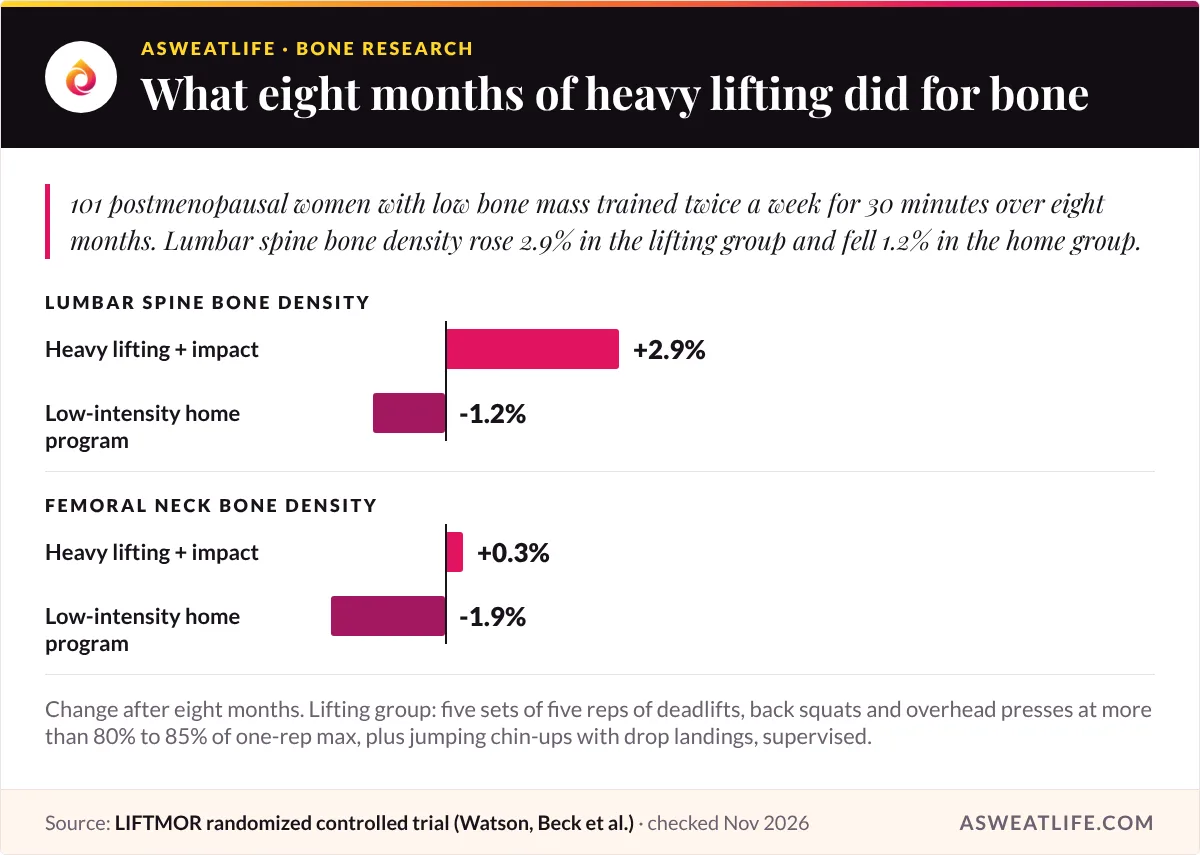
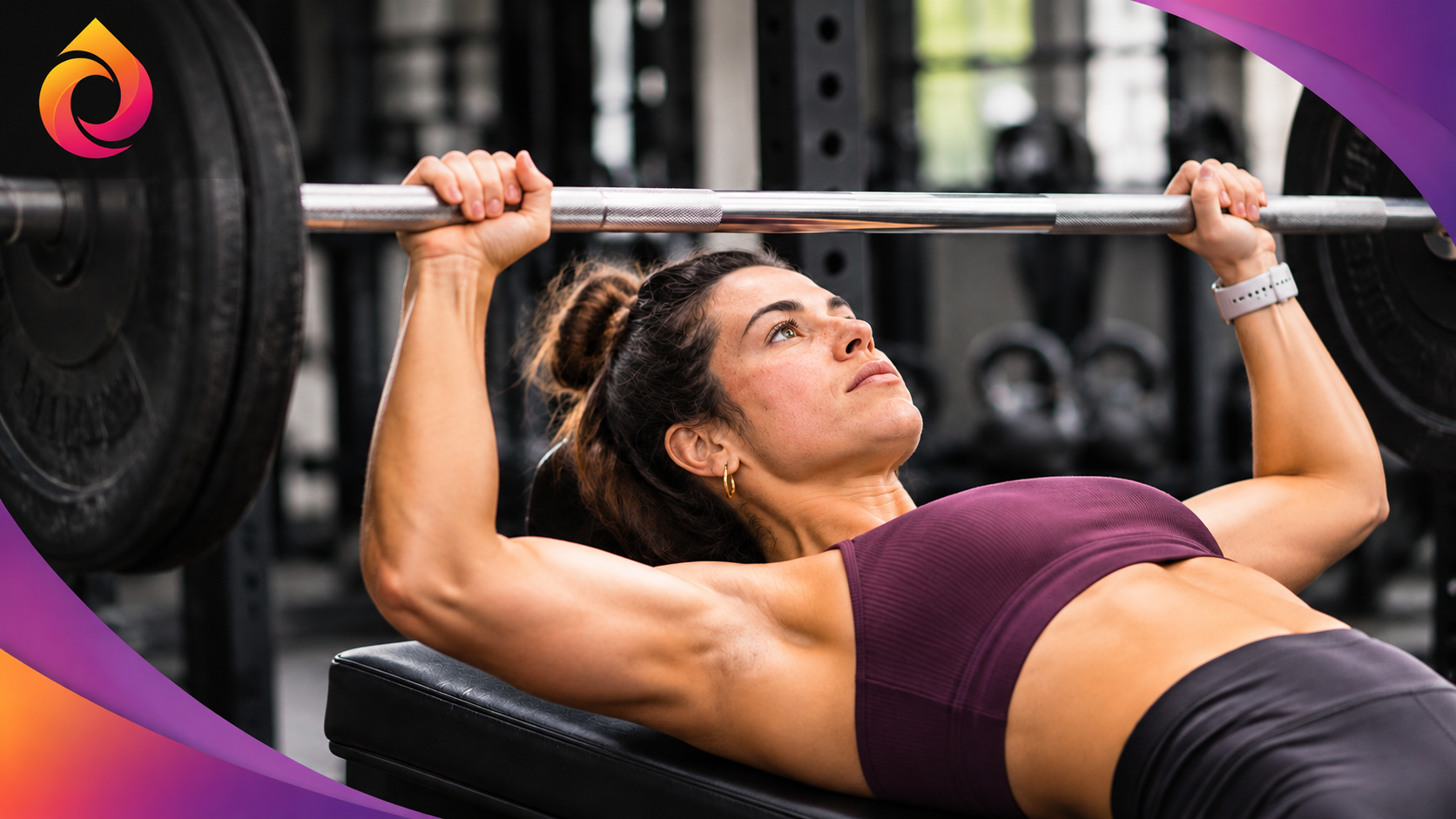
LIFTMOR pushed well past the usual advice. Its 101 participants, postmenopausal women with low bone mass and an average age of 65, did deadlifts, back squats and overhead presses for five sets of five reps at more than 80% to 85% of their one-rep max, plus jumping chin-ups with drop landings. Compared with the home-based, low-intensity group, femoral neck bone density changed by 0.3% versus minus 1.9%, and the lifters gained a little height while the other group lost some.
Two details matter if you’re tempted to copy it. Every session was supervised in small groups of up to eight women per instructor, who was an exercise scientist and physiotherapist, and participants were screened first. Under those conditions, there was only one adverse event: a minor lower back spasm. The plan below uses dumbbell versions of the same movement patterns, so you can build the base on your own and decide later whether heavier, coached lifting is your next step.
The Eight Moves in This Bone-Building Plan
You need a pair of dumbbells (or a single heavier one for squats), a mat, and a bench or sturdy chair. Each move trains a pattern the trial or the consensus uses.
1. Goblet Squat
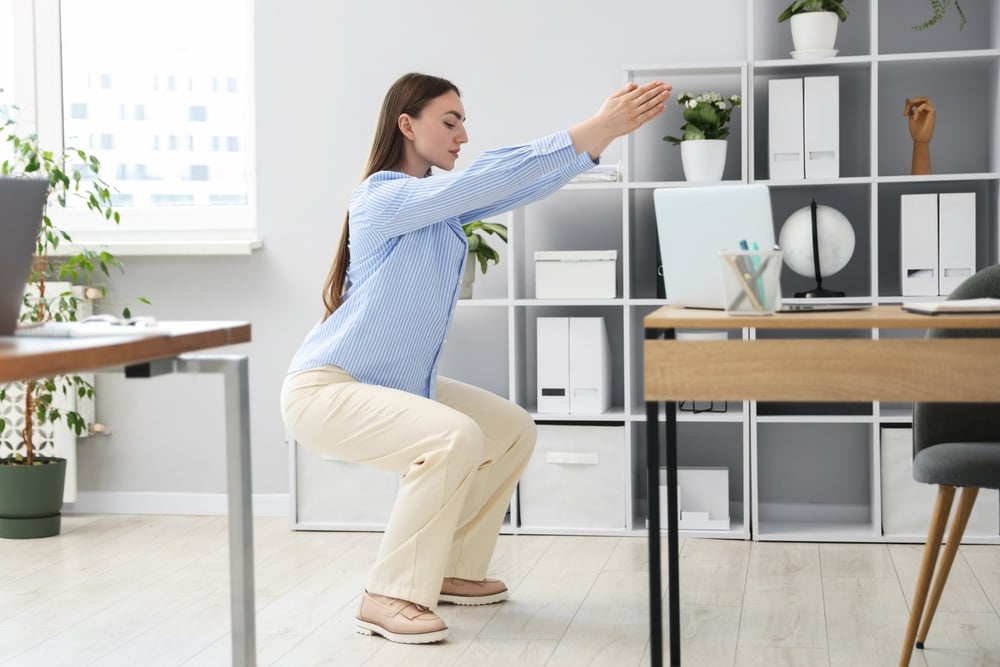
Hold one dumbbell vertically at your chest, feet about shoulder-width apart. Sit your hips back and down until your thighs are near parallel, keeping your chest tall, then drive through your whole foot to stand. This is your stand-in for the back squat, and it loads the hips and spine without a bar on your back.
2. Dumbbell Romanian Deadlift
Hold the dumbbells in front of your thighs. With a soft bend in your knees, push your hips back and slide the weights down your legs, keeping a straight upper back and your neck in line with your spine. Stop when you feel your hamstrings stretch, then squeeze your glutes to stand. This hip hinge is the same pattern the consensus recommends for any bending and lifting you do in daily life.
3. Reverse Lunge
Step one foot back, lower until both knees bend to about 90 degrees, then push through the front foot to return. Alternate legs. Weighted lunges are one of the strengthening exercises the consensus lists, and the single-leg stance doubles as balance practice.
4. Standing Overhead Press
Hold the dumbbells at shoulder height, brace your core and press straight up without leaning back. If standing feels wobbly, sit on a bench with your back supported. If you’ve been diagnosed with osteoporosis, keep this one light (more on that below).
5. Supported One-Arm Row
Place one hand and knee on a bench, keep your back flat, and pull the dumbbell toward your hip. Supporting your torso keeps your spine neutral while you strengthen the upper back muscles that help you stand tall.
6. Prone Back Extension
Lie face down with your arms by your sides. Lift your chest a few inches off the mat, hold for three to five seconds, and lower. Do three to five reps. This is the “Straight” part of the consensus: back extensor strength supports posture and helps protect your spine.
7. Impact Set
Count every landing. Pick one or mix them: heel drops (rise onto your toes and drop onto your heels), stamping, small two-footed jumps, hops, jumping rope, or short bursts of jogging. Land with control through your whole foot, rest with a short walk between sets of 10, and progress to bigger jumps only when the smaller ones feel easy.
8. Balance Finisher
Stand on one leg for 30 seconds per side near a wall or counter, then walk heel-to-toe for 10 steps. Make it harder by turning your head slowly or closing your eyes for a few seconds, as long as you have something to hold.
Your Four-Week Strength Plan for Stronger Bones
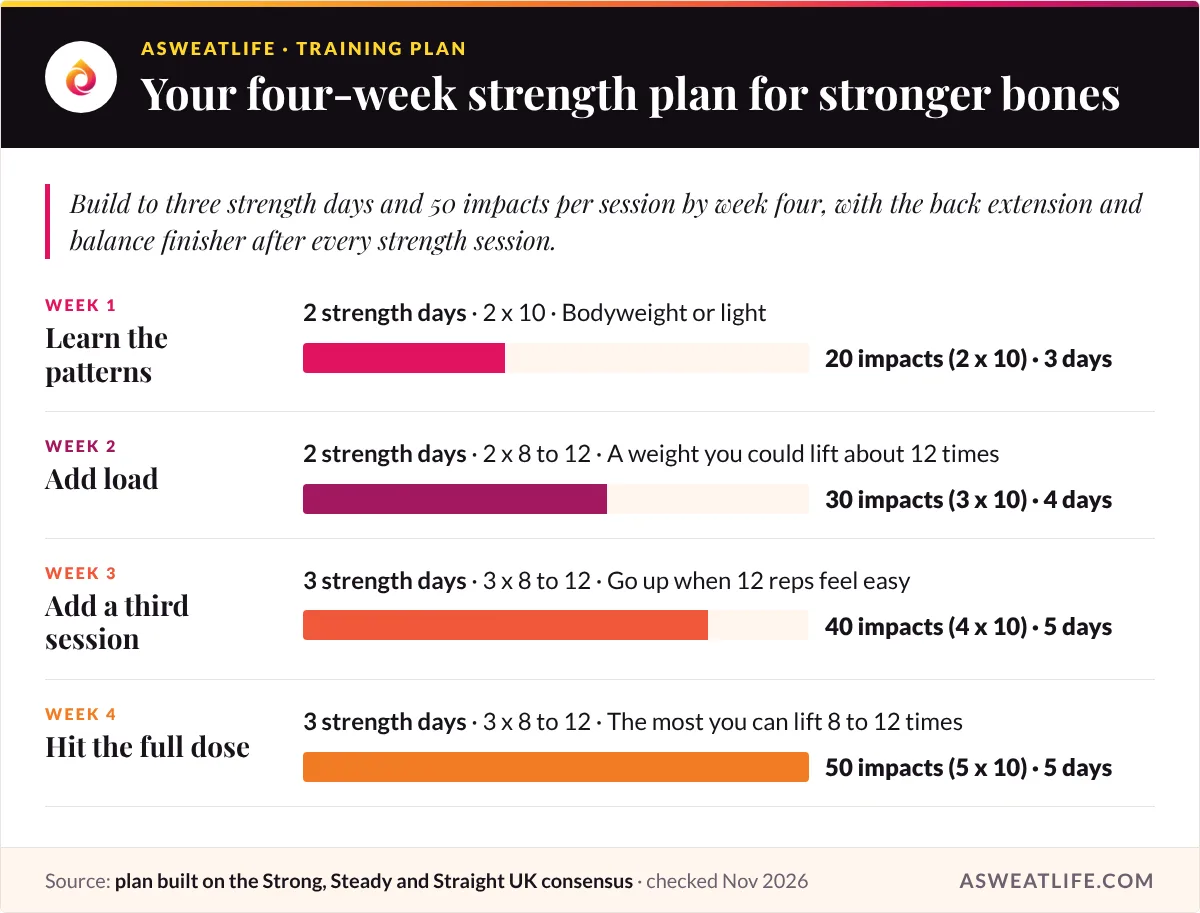
Each strength session takes about 30 minutes: a five-minute brisk walk to warm up, the impact set while your legs are fresh, moves 1 through 5 as a circuit, then the back extension and balance finisher. On impact-only days, the impact set plus a walk takes about 10 to 15 minutes.
Pick a week to see its strength days, sets, load and impact target.
| Week | Strength days | Sets x reps | Load | Impact days | Impacts per session |
|---|---|---|---|---|---|
| Week 1 | 2 | 2 x 10 | Bodyweight or light | 3 | 20 (2 x 10) |
| Week 2 | 2 | 2 x 8 to 12 | A weight you could lift about 12 times | 4 | 30 (3 x 10) |
| Week 3 | 3 | 3 x 8 to 12 | Go up when 12 reps feel easy | 5 | 40 (4 x 10) |
| Week 4 | 3 | 3 x 8 to 12 | The most you can lift 8 to 12 times with good form | 5 | 50 (5 x 10) |
The back extension and balance finisher close every strength session, so you hit the twice-a-week target from the first week.
Week 1: Learn the Patterns
Do two strength sessions on nonconsecutive days (say, Monday and Thursday) using bodyweight or your lightest dumbbells, and add a third day with only the impact set. Your job this week is form: film a set of squats and hinges on your phone and check that your back stays straight. Twenty impacts may feel almost too easy, which is the point. Your tendons need time to catch up with your enthusiasm.
Week 2: Add Load
Keep two strength days, but pick a weight you could lift about 12 times before your form slips. Impact goes up to 30 landings on four days. If you’re sore for more than a couple of days, repeat Week 1’s impact count before moving on.
Week 3: Add a Third Session
Move to three strength days (Monday, Wednesday, and Friday works well) with three sets of each move. Once you can finish all 12 reps of a set with good form, go up to the next dumbbell. Impact now happens on five days, at 40 landings.
Week 4: Hit the Full Dose
This is the full consensus dose: three strength days with three sets at a load you can lift only 8 to 12 times, and 50 impacts on five days a week. If you have to choose, protect the strength sessions and do your impacts during a walk on the days you’re short on time. If you miss a day, pick up where you left off: one skipped session doesn’t undo a month of work.
If You Have Osteopenia or Osteoporosis
A diagnosis is a reason to train smart, with a few changes. The consensus authors found little evidence that physical activity causes significant harm for people with osteoporosis and concluded that the benefits generally outweigh the risks. A few adjustments keep your spine safe:
- Skip loaded or repeated rounding of your spine. Movements that involve sustained, repeated or end-range forward bending, such as weighted crunches or toe touches, should be modified or avoided. Hinge from the hips for every pickup.
- Keep overhead lifts light and twists smooth. With osteoporosis, avoid strenuous overhead lifts and full trunk rotations, like the end of a golf swing. Smooth, comfortable twisting is fine.
- If you’ve had a vertebral fracture, cap impact at brisk walking and aim for 150 minutes over the week (about 20 minutes a day), and get individual advice from a physiotherapist when you start a new program.
- If you’re at risk of falling, start with balance. The consensus says people at risk of falls should start with targeted strength and balance training, putting the “Steady” exercises first and build up to bone strengthening gradually.
If you’re not sure where you stand, ask about a scan. Bone density testing is recommended for all women 65 and older and for postmenopausal women younger than 65 at increased fracture risk. Talk with your doctor before starting impact work if you’ve had a fracture from a minor fall, take medication that affects bone, or have heart, joint or pelvic floor concerns.
What Comes After Week Four
Keep going. The consensus dose of two to three strength days and impact on most days is something to maintain for good, and bone changes take months to show. From here, add weight whenever 12 reps feel easy, and swap in harder impacts such as jump squats once 50 small jumps feel routine.
If you’re newer to lifting and want more structure around the habit itself, our simple four-week beginner workout plan pairs two full-body workouts with walking, and these tips on how to start a strength training routine cover form, recovery, and keeping it simple. If you’d like your impact to feel more like play, a recent review linking soccer and handball to stronger bone-building signals makes a good case for a rec league, and a 30-minute jump rope workout knocks out your landings fast.
And if heavier barbell lifts like the ones in LIFTMOR appeal to you, book a few sessions with a qualified coach or physical therapist to get there safely. Your next step today: put your two Week 1 strength sessions on the calendar.
FAQ
Can I Do This Bone-Strengthening Plan at Home?
Yes. The plan needs only a pair of dumbbells, a mat and a bench or sturdy chair, and every impact option works in a living room or driveway. Heavier barbell lifts like those in the LIFTMOR trial are best learned with a coach.
How Long Does It Take for Strength Training to Improve Bone Density?
It takes months. A bone remodeling cycle lasts about four months, and the LIFTMOR trial ran for eight months so that changes would show up on a DXA scan.
How Much Calcium and Vitamin D Do Women Need for Bone Health?
Women in their 40s need about 1,000 mg of calcium and 600 IU of vitamin D a day. After 50, the calcium figure rises to 1,200 mg, and after 70, vitamin D rises to 800 IU. Ask your doctor before starting supplements.
Is This Plan Safe During Perimenopause and Menopause?
For most healthy women, yes, and this is when bone loss speeds up as estrogen levels fluctuate. Check with your doctor first if you have a bone density diagnosis, a past fracture or another health condition.