How to Choose a Low-Impact HIIT Workout for Your Level

You have a little time to exercise, enough space to move the coffee table and absolutely no interest in another round of jump squats. A low-impact HIIT workout sounds promising. But once you start browsing, “low impact” can mean anything from gentle marching to a bike session that leaves you checking how many seconds are left.
The trick is finding a workout that gives you the challenge you want, with movements you can control. You might want a quieter apartment workout, a return to exercise after a break or a demanding session without repeated jumping and landing. Those are different starting points, and the same video will not suit everyone.
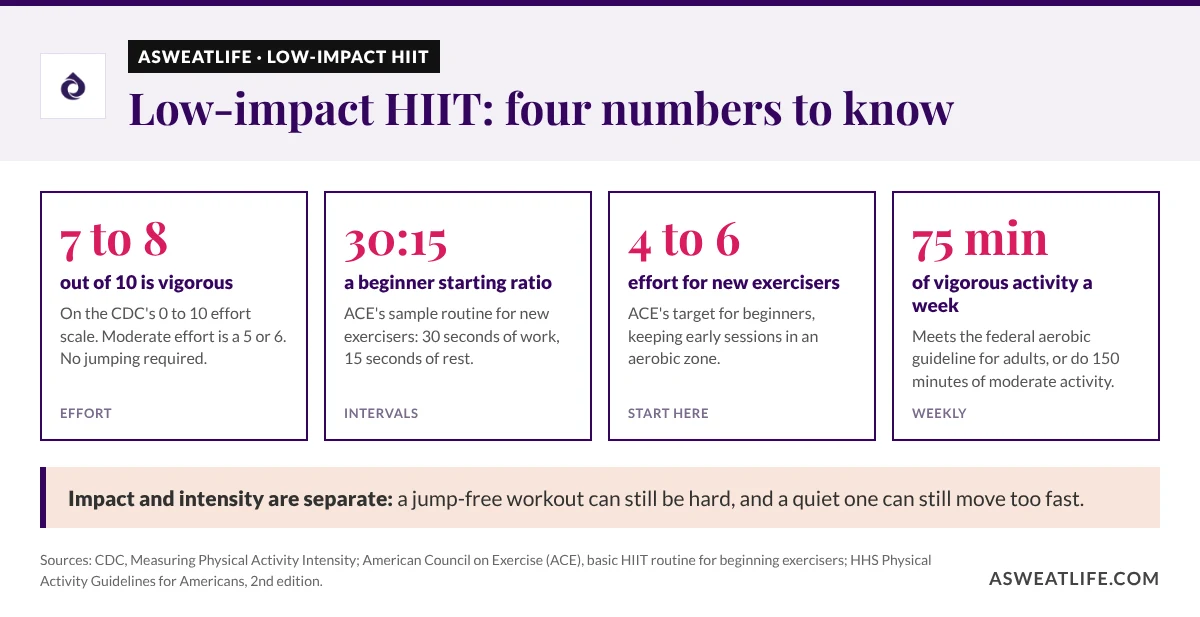
A good low-impact HIIT workout combines harder efforts with recovery, offers clear exercise options and lets you adjust the pace. On the CDC’s effort guidance, breathing is a useful clue: vigorous activity makes it difficult to say more than a few words without pausing for breath. You can reach that kind of effort on a bike or rower without jumping.
Here is how to choose a session that fits your current fitness, spot the difference between low impact and low intensity, and make the intervals work for you. There is also a workout finder below to help narrow down the format.
Where Should You Start With Low-Impact HIIT?
This article is for general education and does not replace advice from a doctor, physical therapist or qualified trainer.
Start with what you do now. The fitness level you hope to reach can wait. Someone who walks most days but has never lifted needs different instruction from an experienced lifter who wants a quieter home session.
It helps to separate three things: your stamina, your familiarity with the exercises and your comfort moving between positions. You might be able to walk briskly for an hour but still need time to learn a hip hinge. You might know your way around dumbbells but prefer to avoid repeated trips down to the floor.
Before you choose a workout, ask yourself:
- What am I already doing comfortably? Think about your recent routine rather than your best-ever fitness.
- Which movements do I recognize? Learning several unfamiliar exercises while a timer counts down can make a simple session feel frantic.
- What do I want from this session? A first workout back, a challenging cardio session and a quiet lunchtime break do not need the same format.
- What would make it easier to come back? Clear instruction, manageable transitions and a convenient length are useful features, not extras.
Read the exercise list or watch a preview before you commit. Are the moves familiar? Can you follow the transitions without rushing? A beginner-friendly session teaches setup and technique instead of assuming you already know what a hinge, squat or row looks like.
If you are returning after a break, give yourself room to reassess. Knowing how a workout used to feel does not tell you exactly how it will feel today. Starting with an easier version gives you useful information for the next session.
Low impact does not make a workout right for every injury or health condition. If pain, a recent injury or a medical concern is behind your search, a health professional can help you choose appropriate activities. The federal Physical Activity Guidelines include recommendations for people with chronic conditions and disabilities, with activity adapted to their abilities.

What Is the Difference Between Impact and Intensity?
Impact describes the loading involved in movements such as jumping and landing. Intensity describes how hard you are working. Cycling intervals can be very demanding without a single foot strike on the floor.
Low impact also does not mean there is no load on your joints or muscles. Squats, lunges and rowing still ask your body to produce and control force. Removing the jump changes the movement, but it does not automatically make every exercise comfortable or appropriate.
That distinction matters when you compare programs. A jump-free video can still move too fast for someone learning the exercises, while a controlled session with adjustable resistance can challenge someone with years of training.
The CDC describes moderate effort as roughly 5 or 6 on a 0 to 10 scale, with vigorous effort beginning around 7 or 8. Its talk test offers another check: moderate activity allows conversation but makes singing difficult; vigorous activity leaves room for only a few words between breaths.
| Example | Impact | Intensity can be | Worth knowing |
|---|---|---|---|
| Stationary bike intervals | Low | Easy to very hard | Resistance and cadence let you adjust the challenge |
| Rowing intervals | Low | Easy to very hard | Learn the movement sequence before chasing speed |
| Controlled step-back lunges and squats | Low | Light to hard | Balance, range of motion, pace and resistance affect difficulty |
| Marching or step-touch intervals | Low | Light to moderate for many people | A useful option for learning an interval format |
| Jump squats and burpees with jumps | High | Moderate to very hard | Repeated landings; burpees also involve floor transitions |
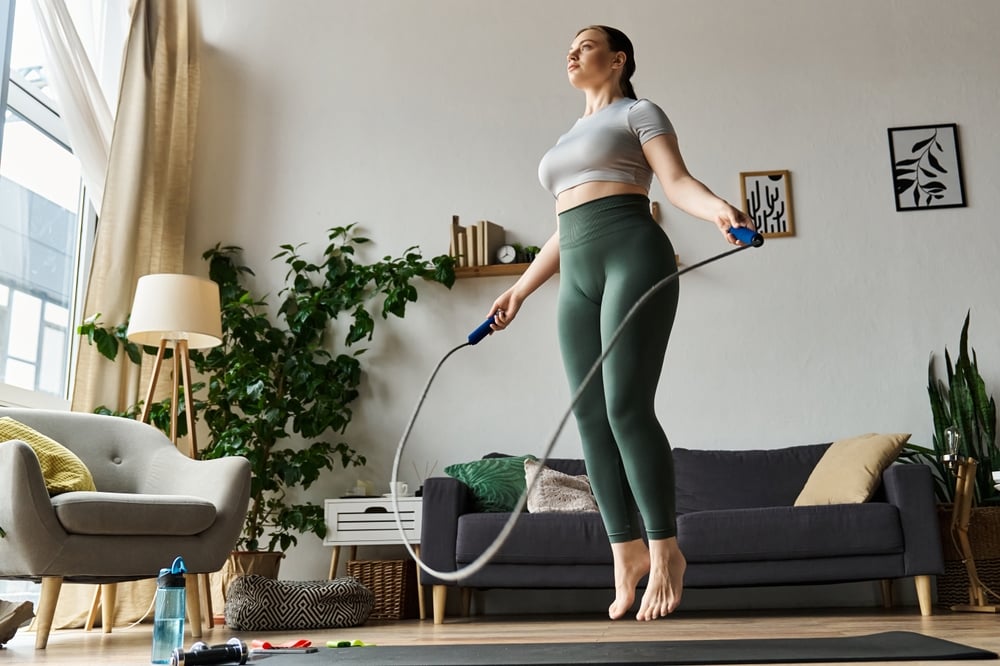
| Jumping rope | High | Often vigorous | Repeated jumping makes it a different choice from a jump-free session |
A timer alone does not make a workout HIIT. If the work periods stay at a comfortable or moderate effort, you are doing interval training without necessarily reaching high intensity. That can be a useful place to start. You do not need to force a vigorous effort just because “HIIT” appears in the video title.
When you browse explanations of low-impact HIIT workouts, look past the exercise names. Notice how effort and recovery are set up, what equipment the format uses, and whether it explains how to make each move easier. If you want more background on why this style has caught on, our look at why low-impact workouts are trending covers the bigger picture.
How Long Should the Work and Rest Intervals Be?
Two workouts of the same length can feel completely different. One might give you generous recovery between efforts, while another packs in quick transitions and almost no downtime. Total duration on its own tells you very little about difficulty.
For new exercisers, the American Council on Exercise’s basic HIIT routine for beginners offers a 30-second work period followed by 15 seconds of rest, keeping effort around 4 to 6 out of 10. This is a gentler introduction to intervals rather than a requirement to work at vigorous intensity.
Treat that ratio as one example, not a test you have to pass. Fifteen seconds can disappear quickly if you need to put down weights, change position and watch the next demonstration. Take longer recovery when you need it, or choose a session with more time built in.
Recovery should give you a chance to ease your breathing and prepare for another controlled effort. Depending on the activity, that might mean pedaling gently, walking slowly or resting. It should feel noticeably easier than the work interval.
Look for a format that lets you make these adjustments:
- Shorten the work: stop the interval before the timer if you are losing control of the movement.
- Extend the recovery: pause the video or timer until you are ready to set up properly.
- Reduce the demand: use an easier variation or less resistance instead of rushing through the original move.
- Finish with fewer rounds: completing part of a session well is a reasonable first step.
Also check whether the instructor separates demonstration time from recovery. Spending the whole rest period decoding the next exercise is a very different experience from knowing what comes next and having time to breathe.
Which Low-Impact Moves Match Your Comfort Level?
A low-impact label covers a lot of ground. Standing moves, floor exercises, single-leg work and equipment intervals each ask for different skills. Taking out the jumps does not take out the need for balance, coordination or strength.
Pay attention to transitions as well as the moves themselves. A routine that keeps sending you from standing to the floor and back can be awkward even when each exercise feels fine on its own. If those transitions are difficult, look for a standing-only format or a session organized into separate standing and floor blocks.
Look for easier versions demonstrated before the interval begins, so you are not trying to catch a cue while everyone is already moving. “Modify if you need to” is much more useful when the instructor shows you how.
Common Jump-Free Alternatives to Look For
These are examples of substitutions you may see in a class or video. They change the demands of the exercise and will not suit every body or condition. Choose the version you can perform comfortably and ask for help when you are unsure.
| If the workout includes | A jump-free option to look for | What still needs attention |
|---|---|---|
| Jumping jacks | Alternating step jacks | Foot placement and a comfortable arm range |
| Jump squats | Controlled body-weight squats | A depth and pace you can manage without losing balance |
| Running high knees | Marching with alternating knee lifts | Staying upright and placing each foot with control |
| Skater jumps | Side steps without the jump | Enough clear space and a manageable step width |
| Burpees with a jump | A coached step-back variation without the jump | Floor transitions and wrist loading remain; a standing exercise may fit better |
| Fast floor mountain climbers | A slower version with hands on a secure elevated surface | Upper-body loading remains; the support must be stable |
You do not have to preserve every exercise in a routine. If a burpee variation still feels awkward, a different standing movement may be a better choice than trying to make the burpee work. In a coached session, ask the instructor for an alternative that fits the purpose of that interval.
Equipment can simplify things, too. A bike session keeps you in one place and lets you adjust resistance without learning a new exercise every minute. A rower offers a different option, but technique instruction matters before you start pushing the pace.
Answer four quick questions to narrow down a format and see an example interval structure. These are general comparison examples, not a personalized training plan. Choose an easier effort, take longer recovery or finish sooner whenever needed.
Format to look for
Check before you commit
Should You Choose a Recorded Workout or a Coached Class?
Recorded workouts are convenient, and you can pause or replay a demo as often as you like. They work well for moves you already know, but the instructor cannot see your technique or step in when something feels wrong.
For a first attempt, watch the opening demonstrations before starting the workout. Put your equipment within reach, check the volume and make sure you can see the screen from the positions you will use. Twisting around to watch a demonstration during a plank makes following along unnecessarily awkward.
Live coaching gives you a different kind of support. Before you book, ask whether the instructor helps newcomers with setup and offers alternatives during class. Group size and teaching style matter as much as whether the class is online or in a studio.
| Format | Best for | Watch out for |
|---|---|---|
| Recorded video | Familiar moves, tight schedules, pausing and replaying | No one checks your form; demonstrations may happen during recovery |
| App program | Structure across several weeks and tracking sessions | Timers and progressions may not adapt to your needs |
| Live online class | Real-time instruction from home | Camera position and group size can limit individual feedback |
| Small-group studio class | Setup help, equipment access and opportunities for form checks | The pace may be set by the room; travel and cost add to the commitment |
| Intro or one-on-one session | Learning equipment and asking detailed technique questions | Often costs more per session; ask what the appointment includes |
If you are unsure about equipment or technique, an intro session can be a useful first step before joining a fast circuit. You can ask how to adjust the bike, what a row should feel like or which alternative to use when a movement is uncomfortable.
Useful questions before booking include: “Can I stay standing for the whole class?”, “Are modifications shown before each interval?” and “Can I take extra recovery without disrupting the session?” Clear answers will tell you more than a promise that the class is suitable for all levels.
What Should You Check Before You Commit?
A workout that fits your ability still has to fit your space. Look at the full equipment list, including anything that only appears later in the session, and make sure you have clear room for every move and a safe spot for weights or bands. Our guide to setting up a home gym can help if you are building out a corner of your apartment.
- Noise: low impact is not the same as silent. Think about dropped weights, fast footwork, machine vibration and hard floors as well as jumping.
- Real length: check whether the listed time includes a warm-up and cool-down or just the main interval block.
- Surface and space: use a stable, clear area. A mat should stay in place, and equipment should not block your next movement.
- A trial run: start with a preview or free trial when one is available. Check renewal terms before signing up for a paid program.
- Your reaction afterward: were the instructions clear, were the easier versions easy to follow, and could you complete the movements without rushing?
Leave Time for the Warm-Up and Cool-Down
A short workout still needs a gradual start and finish. The American Heart Association recommends warming up for 5 to 10 minutes, using an easier version of the activity you plan to do, and easing down afterward.
For bike intervals, that can mean easy pedaling before adding resistance. For a standing circuit, look for a warm-up that introduces the movements at a comfortable pace. If the video begins with a countdown straight into the first hard effort, allow your own preparation time before pressing play.
If you feel sharp pain, dizziness or other worrying symptoms, stop and seek appropriate help. Do not treat them as a target to push through. Symptoms such as chest pain or fainting need urgent medical attention.
Because harder intervals are demanding, leave room for recovery in your week. Our ideas for staying active on rest days can help you plan easier movement between challenging sessions.
How Can You Progress Without Adding Jumps?
You do not have to graduate to jump squats for a low-impact workout to keep challenging you. Progress can mean better control, more consistent effort or needing fewer pauses during a familiar routine.
Once a session feels manageable and you can maintain your technique, consider changing one thing at a time. For example, you might add a small amount of bike resistance, complete another round or choose a slightly longer work interval. Those changes all affect the session, so there is no need to introduce them together.
Do not make shorter recovery your automatic next step. Enough rest can help you perform the next effort well. If cutting the break means rushing your setup or losing control halfway through the following interval, keep the recovery and adjust something else.
A simple note after each workout can help: record the format, the effort you felt and any movements that were difficult to follow. “Paused twice to learn the row” is more useful for choosing your next session than judging the workout by how sweaty you were.
The right pick is a session you can understand, adjust and fit into your life. Some days that will be a challenging equipment workout. Other days it will be a shorter, gentler circuit. Having both options makes it easier to keep showing up.
Low-Impact HIIT FAQs
Is low-impact HIIT still a hard workout?
It can be. Low impact describes the movement demands, while intensity describes your effort. Bike or rowing intervals can be vigorous without jumping. A jump-free label does not tell you how difficult the session will feel.
What is a good work-to-rest ratio for beginners?
ACE provides a beginner example of 30 seconds of work and 15 seconds of rest at an effort of about 4 to 6 out of 10. It is one starting structure, not a universal rule. Choose longer recovery or shorter work periods when needed to maintain controlled movement.
How often should I do low-impact HIIT?
There is no single right number for everyone. Consider how demanding the sessions are, your other exercise and how well you recover. Federal guidelines recommend 150 to 300 minutes of moderate or 75 to 150 minutes of vigorous aerobic activity weekly, plus muscle-strengthening work on at least two days. That does not mean all of your aerobic activity should be HIIT.
Does a 20-minute HIIT workout count as 20 minutes of vigorous activity?
Not automatically. A session may include a warm-up, demonstrations, easier recovery and a cool-down. Count activity according to the effort you are actually doing rather than assuming the entire video is vigorous because of its title.
Is low-impact HIIT good for apartments?
It can be a practical choice, especially when the routine uses controlled steps and avoids jumping. Check for fast footwork, dropped weights and equipment vibration. A suitable mat may help with some noise, but it will not make every workout silent.
Can I do low-impact intervals without equipment?
Yes. Step jacks, marching, side steps and controlled body-weight exercises can be organized into intervals. Whether the session reaches high intensity depends on your effort and fitness. A moderate session is still useful even if it never becomes HIIT.
Is low-impact HIIT safe if I have an injury?
Not automatically. An exercise can be jump-free and still load an injured area or involve an uncomfortable position. Ask a doctor or physical therapist which movements and effort levels are appropriate for your situation before using a general workout as a return-to-exercise plan.