Group Fitness Class Etiquette: 15 Unwritten Rules for Beginners
Where to set up your mat or bike, what to do with your phone, how much space to give, and how to leave your spot when class ends: 15 group fitness etiquette rules for beginners.

If you’re nervous about your first class, here’s the good news: group fitness class etiquette comes down to a handful of habits you can learn before you walk in. Show up early, set up where you have room, keep your phone out of sight, give your neighbors space, and leave your spot cleaner than you found it. That’s most of it.
The rest is studio-specific, and some studios are strict about it. At SoulCycle, your bike may be released if you haven’t checked in four minutes before class, and riders more than 10 minutes late don’t get in. Below are 15 unwritten rules, grouped the way your class actually unfolds (before, during, and after), plus what to wear and a few quick answers for first-timers.
When To Arrive and What Happens If You’re Late
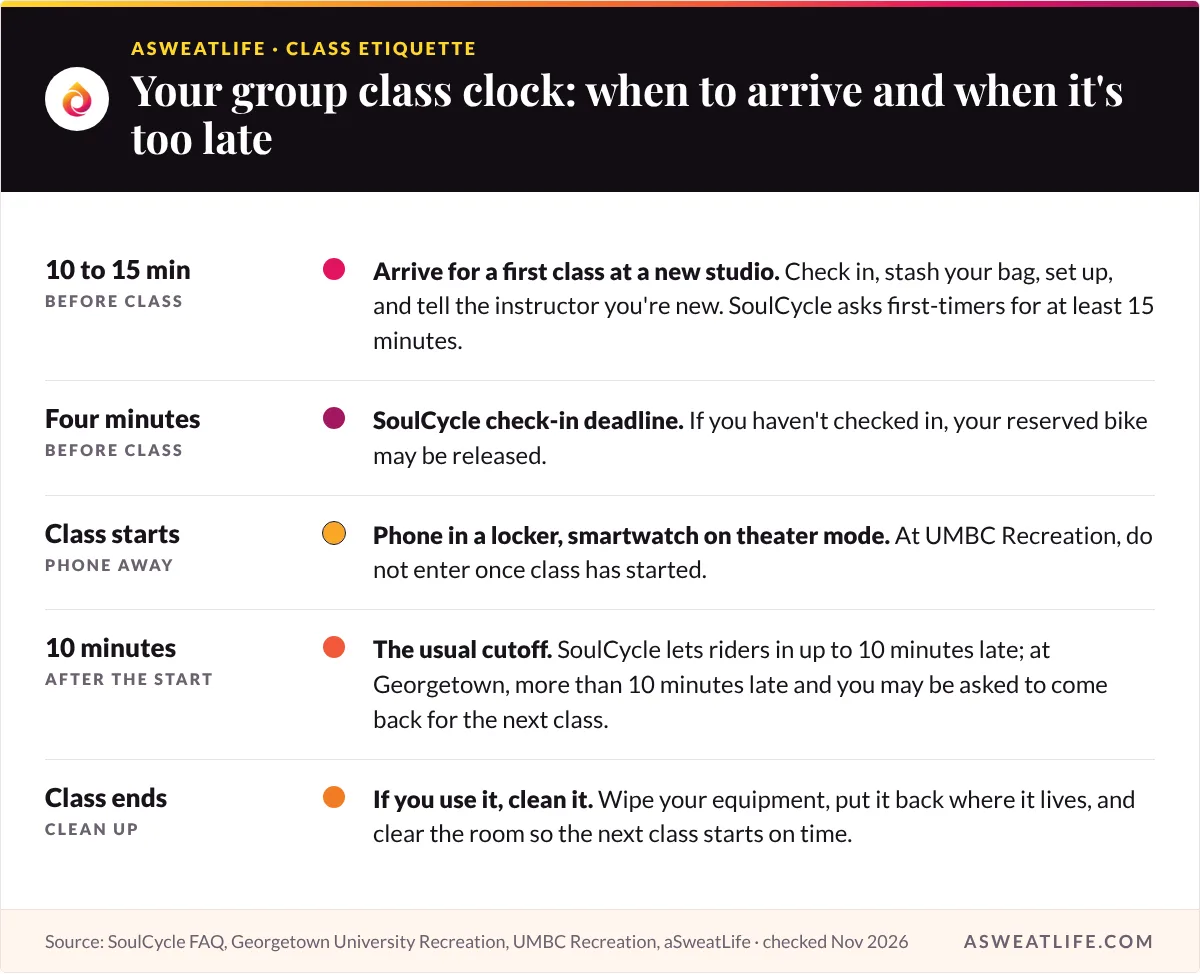
Every studio sets its own clock, so check the booking page before you go. Here’s how a few real policies compare, which shows why “on time” usually means early:
| Studio or gym | Arrive by | If you’re late |
|---|---|---|
| SoulCycle (indoor cycling) | At least 15 minutes early for your first ride; checked in four minutes before class | Let in up to 10 minutes late; after that, no entry |
| Georgetown University Recreation | A few minutes early to set up and talk to the instructor | More than 10 minutes late and you may be asked to come back for the next class |
| UMBC Recreation | On time, after the previous class has left the studio | Do not enter once class has started |
| CorePower Yoga | Before class begins | Late arrivals disrupt focus and can be unsafe |
1. Show Up 10 to 15 Minutes Early
For a class you’ve never taken, aim for 10 to 15 minutes before a first class at a new studio. That buys you time to check in, stash your bag, set up your equipment, and introduce yourself to the instructor. SoulCycle asks first-timers for at least 15 minutes, and that’s a good rule anywhere you need to rent shoes or adjust a bike.
Early arrival also gets you a better spot. At studios that release reserved bikes or spaces close to start time, showing up late can mean losing the place you booked.
2. If You’re Late, Slip In Quietly (or Catch the Next One)
Running behind happens. The issue is the warm-up you miss: a late arrival misses the safety talk and muscle preparation, which is why Georgetown University Recreation may ask anyone more than 10 minutes late to come back for the next class. At CorePower Yoga, arriving late can disrupt everyone’s focus and drop you into postures your body isn’t ready for.
If the studio does let you in, keep setup quiet, don’t talk over the instructor, and avoid walking in front of anyone who’s already moving. If the room is full, ask where to go with a quick gesture to the instructor.
Where To Set Up Your Mat or Bike in a Group Class
This is the question that makes most beginners freeze in the doorway. The short answer: pick a spot where you can see the instructor and move freely without crowding anyone.
Pick your class type to see where to set up, what to do with your phone, and how to leave your spot.
3. As a Beginner, Start Near the Back or Side
The American Council on Exercise suggests newcomers stand near the back of the room and let the experienced group work out near the front, especially in classes with detailed choreography. You get to watch the regulars, and nobody behind you is trying to follow your moves.
That said, the front row isn’t off-limits. If you need to hear the cues or see the instructor’s form up close, take it. Just keep your movements controlled near mirrors.
4. Line Your Mat Up With Everyone Else’s
In yoga, Pilates, and mat-based classes, mats go in rows. CorePower Yoga asks students to arrange mats in a neat row so there’s room for people in front and behind. When the room is tight, angling your mat slightly can help, but never place it so your feet end up near someone’s head when you lie down.
5. Adjust Your Own Bike or Station (and Ask for Help)
On a bike, rower, or reformer, set up only your own equipment. Never move someone else’s seat, handlebars, or straps, and ask before class if you’re unsure how something works.
For indoor cycling, the seat should sit roughly level with your hip when you stand beside the bike, with the handlebars slightly higher. Instructors are happy to help you fit the bike, and a good fit saves you from shifting around uncomfortably for 45 minutes (and from seat pain after a spin class).
6. Don’t Save Spots for Friends
Draping a towel over the bike next to you for a friend who’s running late is a classic faux pas. Some gyms now assign spots specifically to stop people from holding space. (If your friend really wants that bike, the move is to book it and show up early, too.)
Is It Okay To Use Your Phone During Class?
7. Put the Phone Away (Smartwatch Included)
Mostly, no. The cleanest option is leaving your phone in a locker or cubby. SoulCycle asks riders to leave phones in a locker or with the studio crew and set smartwatches to theater mode. In a dim cycling room, a lit screen is a spotlight, and a dark room plus a lit phone screen equals unhappy neighbors.
If you truly need to be reachable (a sitter, an on-call shift), Georgetown recommends telling the instructor before class that you’ll keep your phone nearby. Keep it on silent, set up near the door, and step out to answer. Checking texts between sets still counts as using your phone, for the record.
How Much Space Should You Give Other People in a Group Class?
8. Use the Arms-Out, Lunge, Lie-Down Test
Before class starts, run a quick check. Look for a spot where you can extend your arms without hitting anyone, lunge without entering another person’s space, and lie down without your feet landing in another station. If you can do all three, you’re good.
- Bring only what you need. UMBC Recreation asks members to keep personal belongings along the perimeter of the studio, and closeable, unbreakable water bottles at the edge of the room.
- Leave extra room for punching and kicking. In boxing or kickboxing formats, give yourself more clearance in front, or pick an edge spot.
- Move with traffic. During circuits, follow the direction the instructor sets and walk around stations; never cut through someone’s set.
- Grab weights and go. Pick up what you need efficiently and don’t linger in front of the rack while others wait.
Packed rooms make all of this harder. If you’re shoulder to shoulder, it’s fine to politely ask the person next to you to scoot over a few inches, and our guide to making the most of a crowded group fitness class covers how to improvise when the weights you wanted are gone.
Group Fitness Class Etiquette During the Workout
9. Follow the Instructor’s Plan (Modifications Welcome)
A group class is designed as a whole, so stick with the routine. Modifying for your fitness level or an injury is smart; doing your own workout in the middle of the room is not. “The energy of the group gets severed when you veer so far from what the instructor’s doing,” studio owner Ellen Barrett told Experience Life. Staying close to the instructor’s moves also helps the people behind you, who may be following you.
Taking a break is not breaking the rules. Ease off, grab water, and rejoin when you’re ready, ideally at your own station so you aren’t standing in a walkway.
10. Save the Catch-Up for After Class
A quick “hi” is friendly. A full conversation during the workout isn’t. “Talking over the instructor during the class is rude, as well as distracting,” etiquette expert Diane Gottsman, founder of the Protocol School of Texas, told HuffPost. The same goes for asking the instructor long personal questions mid-class; form and injury questions are fair game, but save the chit-chat for afterward.
11. Mention Injuries and First-Timer Status Before Class
The minutes before class are the time to tell the instructor you’re new or recovering from an injury. The warm-up is often when instructors ask about injuries, so the info lets them offer you options from the start. Keep requests short and specific, like a lower-impact jump or a starting weight. Instructors can suggest modifications, but they aren’t a substitute for medical advice.
12. If You Need To Leave Early, Plan for It
Tell the instructor before class starts and set up near the door so you can slip out without a parade past everyone’s mats. In yoga, CorePower asks students to avoid leaving during Savasana, the quiet resting pose at the end. Try to stay through the cool-down in any class: stopping abruptly after hard exercise can cause blood pooling, which may leave you lightheaded.
What Should You Do With Your Gear When Class Ends?
13. Wipe Down Everything You Sweat On
Georgetown’s guiding rule is simple: if you use it, clean it, with the wipes the studio provides. That means the bike, the mat, the bench, and the handles of your weights. CorePower also asks students to wipe stray drops of sweat from the floor around their spot, which keeps the next person from slipping.
14. Put Equipment Back Where It Lives
Return weights, bands, blocks, and steps to their labeled spots so the next class can find them fast. Restacking your weights is a small kindness to the next person (and you’ll love it when someone does the same for you). Then grab your belongings and clear the room promptly so the next class can start on time. If you want to chat with a new class friend (and you should), take it to the lobby.
Scent, Hygiene, and When To Skip Class
15. Come Clean, Skip the Perfume, and Stay Home When You’re Sick
Warm, crowded studios amplify everything. Wear clean workout clothes, bring a towel, and go easy on fragrance: CorePower asks students to avoid heavy cologne or perfume because some people are allergic.
When you’re under the weather, Mayo Clinic’s guidance is a useful filter. Exercise is usually okay if your symptoms are all above the neck, like a runny nose or a minor sore throat. Skip it with chest congestion, a hacking cough, an upset stomach, or a fever. In a group class, add one more filter: if you’d be coughing and sneezing next to a dozen people, take the rest day and cancel your booking so someone on the waitlist gets the spot.
What To Wear to Your First Group Fitness Class
Most studios simply ask for appropriate exercise clothes and shoes. A few practical notes:
- Fabric: Sweat-wicking materials like polyester or nylon dry faster than cotton, which matters most in heated classes (our guide to practicing hot yoga safely explains why).
- Shoes: Cycling studios usually require clip-in shoes. SoulCycle rents them in all sizes for $4 in the US, so there’s no need to buy a pair before your first ride.
- Class-specific gear: Boxing, barre, and yoga each have their own quirks; see what to wear to a boxing class for one example.
- Slogans: Skip shirts with images or messages that could offend the people sweating next to you.
Locker Room Etiquette Before and After Class
The etiquette doesn’t stop at the studio door. The short version: lock your locker, don’t crowd the person next to you when there’s open space, keep showers quick at busy times, and toss used towels in the bin. Our locker room etiquette tips cover the rest.
And if this list feels like a lot, remember that every regular in that room was once the new person hovering by the door. Instructors who care about a more inclusive group fitness environment want you there. Book the class, show up 15 minutes early, tell the instructor it’s your first time, and let the rest happen. You’ll know the drill by week two.
Group Fitness Etiquette FAQ
Is It Rude To Stand in the Front Row as a Beginner?
No. The front and back rows are both fine for beginners, though the back is easier if you want to watch others learn the moves. Choose the front when you need to hear cues or see the instructor’s form clearly.
Can I Bring a Water Bottle Into a Group Fitness Class?
Yes, most studios encourage hydration, but many ask for a closeable, unbreakable bottle kept at the edge of the room. At a shared water station, fill only what you’ll drink during class so the line keeps moving.
Should I Cancel if I Can’t Make a Class I Booked?
Yes, and as early as you can. Studios set their own cancellation windows, so check the policy when you book; canceling early also frees your spot for someone on the waitlist.
Is It Okay To Take Photos or Videos During Class?
Only with permission. Filming captures other people who didn’t agree to be on camera, so ask the instructor first and keep your phone stored the rest of the time.