
How to Build a Wellness Routine With Small Habits That Last

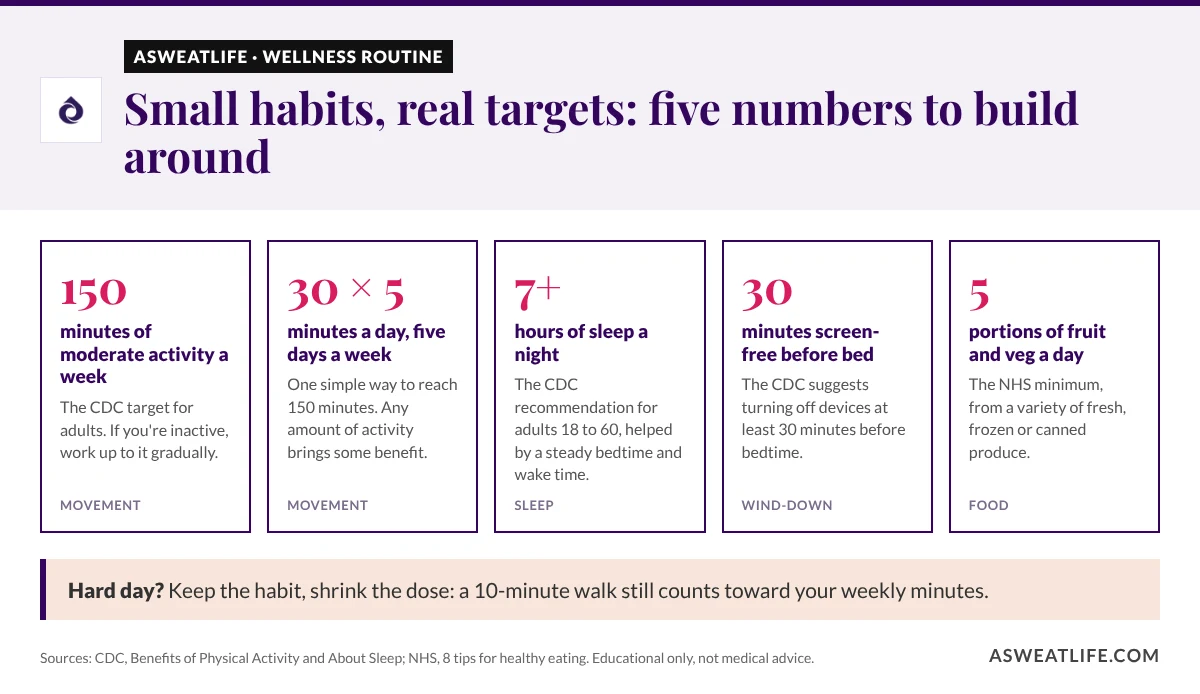
Building a wellness routine sounds simple until work runs late, a kid gets sick or your energy dips by 3 p.m. The targets themselves are modest: the CDC recommends 7 or more hours of sleep a night for adults 18 to 60, and most of us can get closer with a few small changes.
Below, we cover how to make healthy choices easier, what to track, how to fit habits into your day, how to eat and move without overhauling your life, and how to scale everything down on hard days. There’s also a four-week starter plan if you want a place to begin.
How Do You Start a Wellness Routine That Sticks?
This article is for general education and doesn’t replace advice from your doctor or another qualified professional.
Start by removing friction before you rely on motivation. Motivation helps you begin, but it’s an unreliable daily strategy. Small obstacles explain why good intentions disappear: if your water bottle is never nearby, you forget to drink, and if a workout needs a long commute and a full bag, it’s the first thing to go on a busy day.
Make the preferred choice the easy one:
- Keep a refillable bottle on your desk or in your work bag.
- Prep a few simple snacks at the start of the week.
- Leave your walking shoes by the door.
- Save a short home workout for days when time is tight.
- Charge your phone outside the bedroom if late-night scrolling keeps you up.
Each of these cuts the number of decisions you have to make when you’re tired, which is when routines usually fall apart.
Pair New Habits With Ones You Already Have
The easiest place to hang a new habit is on something you already do every day. Link the two with a simple “after I…, I will…” plan:
- After I start the coffee maker, I fill my water bottle.
- After I close my laptop for lunch, I walk around the block.
- After I brush my teeth at night, I plug my phone in outside the bedroom.
The existing habit becomes the cue, so you don’t have to remember the new one from scratch. Keep the cue specific. “In the morning” is vague, while “after I start the coffee” happens at the same point every day.

Start With One or Two Habits
Trying to change sleep, food, exercise and screen time in the same week is the fastest route to quitting all four. Pick the habit that would make the biggest difference to how you feel day to day, or the one that’s easiest to start, and give it a few weeks before adding another. Sleep is often a good first choice, because a better night makes everything else easier the next day.

What Should You Track in a Wellness Routine?
You don’t need to monitor dozens of health metrics to know whether a routine is working. Start with a handful of everyday observations and look for patterns over a week or two.
| What to notice | A quick note to jot down | A pattern it can reveal |
|---|---|---|
| Sleep quality | Bedtime, wake time and how rested you feel | Late caffeine or screen time pushing sleep later |
| Daytime energy | When you feel a slump | Skipped lunch leaving you flat in the afternoon |
| Mood | A word or two at the end of the day | Walks or time outside lifting your mood |
| Concentration | How focused you felt at work | Notifications breaking up deep work |
| After activity | How your body feels the next day | Back-to-back hard sessions leaving you sore |
A simple weekly note in your phone or a notebook is enough. You’ll also see plenty of products marketed to help. Consumer wellness brands, including The Wellness Company, are part of a wider marketplace built around everyday health products and routines. Whatever tools you come across, judge them by whether they change something on your list above, and give any new habit a few weeks before deciding if it’s worth keeping.
How Long Before a Habit Feels Automatic?
Longer than the popular “21 days.” In a study led by Phillippa Lally at University College London, it took participants an average of 66 days to form a new habit, with individual times ranging from 18 to 254 days depending on the person and the behavior. The same research found that missing one opportunity didn’t materially affect how the habit formed.
Two practical takeaways: judge a new habit over two months or so, and treat a missed day as a blip. What matters is getting back to it the next day.
How Do You Match Habits to the Rhythm of Your Day?
A routine works better when each habit fits the time of day it lands in. Here’s one way to split it, with a smaller fallback for each slot.
| Time of day | Habits to try | Smaller fallback |
|---|---|---|
| Morning | Natural daylight, a glass of water, breakfast and a few minutes of movement | Water and two minutes outside |
| Midday | A short walk, a balanced lunch and time away from screens | A five-minute walk around the block |
| Afternoon | Cut off caffeine if it affects your sleep | Switch to decaf or water |
| Evening | Lower stimulation, a lighter dinner if late meals bother you, a regular wind-down | Lights low and phone across the room |
The CDC’s sleep guidance backs up the evening slot: it suggests going to bed and getting up at the same time every day, avoiding caffeine in the afternoon or evening, and turning off devices at least 30 minutes before bed. It also recommends keeping your bedroom quiet, relaxing and cool, and avoiding large meals and alcohol before bedtime. You don’t need an elaborate schedule. Choose two or three habits, repeat them, and adjust based on how your body responds.
Plan for Weekends and Shift Work
Routines often unravel on Saturday, when there’s no commute or meeting to anchor the day. Keep one or two anchors in place, such as your wake time and a morning walk, and let the rest flex. If you work shifts, build the routine around your sleep window instead of the clock: the “morning” habits happen when you wake up, whenever that is.
How Can You Make Healthy Eating Practical?
Nutrition gets harder when every meal feels like a test. Instead of chasing a flawless diet, build a few repeatable meals that suit your tastes, budget and schedule, and include vegetables or fruit, protein, whole grains or other fiber-rich foods, and healthy fats across the day.
- Breakfast: eggs and fruit, yogurt with oats, or whole-grain toast with nut butter.
- Lunch: build around beans, lentils, tofu, fish, chicken or another protein you enjoy.
- Backups: keep a few convenient options on hand so a missed meal doesn’t leave you grabbing whatever is closest later.
For a simple framework, the NHS guide to healthy eating recommends basing meals on higher-fiber starchy foods, eating at least five portions of a variety of fruit and vegetables a day, and drinking 6 to 8 glasses of fluid daily. It counts a portion as 80g of fresh, canned or frozen produce, suggests at least two portions of fish a week (one of them oily), and caps salt at 6g a day for adults, about a teaspoon. Individual needs differ, so talk to a doctor or registered dietitian if you have a medical condition or specific dietary requirements.

A 30-Minute Weekly Prep Routine
You don’t need a full Sunday of batch cooking. Half an hour once a week covers the basics:
- Cook one batch of a whole grain, such as brown rice, quinoa or farro.
- Roast a tray of vegetables while the grain cooks.
- Prepare one protein: hard-boiled eggs, a pot of lentils or a few chicken breasts.
- Wash and cut fruit so it’s ready to grab.
- Stock two or three backup meals, like canned beans, frozen vegetables and microwave rice.
Mix and match those through the week and most lunches take five minutes to assemble.
How Much Movement Does a Wellness Routine Need?
The CDC’s physical activity guidelines for adults call for 150 minutes of moderate-intensity activity a week, such as brisk walking, or 75 minutes of vigorous activity, plus at least 2 days of muscle-strengthening activity. You don’t have to do it all at once: the guidelines say you can spread activity across the week in smaller chunks.
Here are three ways the same target can fit very different weeks. Treat them as examples to adapt.
| Your week | Aerobic activity | Strength |
|---|---|---|
| Office days, little free time | Brisk 10-minute walks three times a day, five days a week (150 minutes) | Two 20-minute bodyweight sessions at home |
| You like the gym | Three 25-minute runs or bike sessions (75 vigorous minutes) | Two full-body weight sessions |
| Busy weekdays, free weekends | Two 15-minute walks midweek, plus a 60-minute hike Saturday and Sunday | One weeknight session, one weekend session |
If you’re not active now, begin well below these numbers and build up. Every walk counts toward the total.
Why Is Recovery Part of a Wellness Routine?
Exercise is only one piece of staying active. Sleep, rest, hydration, enough food and manageable stress all affect how well you recover. If you feel unusually sore, irritable or exhausted after several workouts in a row, look at your overall workload before adding more.
Build movement gradually and plan easier days. A short walk or gentle stretching can be more realistic than an intense session when your energy is low. Consistency doesn’t mean pushing through pain or training while ill, and persistent symptoms or injuries deserve a professional opinion.
The CDC lays out the benefits of physical activity, noting that it helps you feel better, function better and sleep better right away, and that regular activity can lower your risk of depression and anxiety. If you’re not active now, work up to the weekly target gradually. Our guide to exercise and mental health goes deeper on the mood side.
Signs You Need More Recovery
- You’re still sore from a session two or three days ago.
- Workouts that usually feel easy suddenly feel hard.
- You’re sleeping badly despite being tired.
- You feel irritable or dread sessions you normally enjoy.
If two or more sound familiar, swap the next hard session for an easy walk or a rest day and check that you’re eating and sleeping enough.

How Do You Protect Your Attention and Sleep?
Digital habits quietly shape the rest of your routine. Notifications and endless scrolling interrupt concentration, push bedtime later and make breaks feel less restful. Rather than relying on willpower every evening, set a few boundaries that make switching off automatic:
- Turn off nonessential notifications.
- Keep devices away from the bed.
- Choose one screen-free activity before sleep, such as reading or stretching.
- Keep your bedtime and wake time consistent, including most weekends.
During the day, try batching email and messages into a few set check-ins, and take breaks away from your screen. A walk or a few minutes outside resets your focus better than switching to your phone.
Habits can only do so much for sleep. The CDC lists trouble falling asleep, waking repeatedly during the night and feeling tired even after enough sleep as signs of poor sleep quality, and it recommends talking to your healthcare provider if you have ongoing problems sleeping.
How Do You Keep a Routine Going on Hard Days?
The routines that last have room for imperfect days. Decide in advance what the smallest useful version of each habit looks like:
- A full workout becomes a ten-minute walk.
- A cooked meal becomes protein, fruit and a convenient whole grain.
- A longer relaxation practice becomes five quiet minutes.
These minimums keep the routine connected to real life. During travel, busy work stretches, family demands or illness, shrink the plan and keep it going. When things settle, build back up to the fuller version. If you like the idea of tiny daily wins, our list of 60-second resolutions to do every day has a few to borrow.
Use the tool below to set your full, short and minimum versions before a hard day arrives.
Pick your usual habit in each area and how today is going. You’ll get the version of each habit to aim for today, plus one thing to check at your weekly review.
1. Movement
2. Food
3. Sleep
4. Today feels
| Area | Aim for today |
|---|
At your weekly review
A Four-Week Plan to Start Your Wellness Routine
If you want structure, this plan adds one layer a week. Each step builds on the last, and you can stretch any week to two if it doesn’t feel settled yet.
| Week | Focus | What to do |
|---|---|---|
| 1 | Sleep | Pick a fixed wake time and a screens-off time 30 minutes before bed. Jot down how rested you feel each morning. |
| 2 | Movement | Add a daily walk, even 10 minutes, attached to a cue like lunch or the end of the workday. |
| 3 | Food | Do one 30-minute prep session and plan three repeatable breakfasts or lunches. |
| 4 | Review | Look back at your notes. Keep what helped, cut what didn’t, and write down your minimum version for each habit. |
Common Mistakes That Derail a Wellness Routine
- Changing everything on Monday. Big overhauls feel exciting for a week, then collapse under real life.
- Relying on willpower. If a habit depends on remembering and feeling motivated, it won’t survive a busy week.
- All-or-nothing thinking. Skipping a whole workout because you only have 15 minutes throws away 15 useful minutes.
- Copying someone else’s routine. A 5 a.m. workout suits early risers and wrecks night owls.
- Buying first, building later. New gear and apps don’t create habits. Start with what you have.
How Often Should You Review Your Wellness Routine?
Review it every few weeks. A routine should change as your needs and circumstances do. Ask yourself three questions:
- Which habits feel useful?
- Which ones are hard to keep up?
- What obstacle keeps showing up?
Drop steps that add effort without a clear benefit, and avoid measuring success by how many boxes you tick. A useful routine supports your health and still leaves room for relationships, work and fun. If things start to feel stale, these signs you’re in a fitness rut can help you spot when to shake things up. Start with one or two manageable changes, repeat them, and build from there. The routine worth keeping is the one you can return to after an unsettled week.
Big life changes, like a new job, a move, a new baby or an injury, are a good moment for a full reset. Go back to your minimum versions, then rebuild one habit at a time.
Wellness Routine FAQ
How many habits should I start with?
One or two. Starting small makes it easier to repeat them, and you can add more once they feel automatic.
How long does it take to build a habit?
It varies. In the UCL study, it took an average of 66 days for a new behavior to feel automatic, with a range of 18 to 254 days. Missing a single day didn’t derail the process.
How much exercise do adults need each week?
The CDC recommends working up to 150 minutes of moderate-intensity activity a week, such as 30 minutes on five days, plus at least 2 days of muscle-strengthening activity. Any amount of movement brings some health benefit.
How much sleep should adults get?
The CDC recommends 7 or more hours a night for adults 18 to 60, 7 to 9 hours for ages 61 to 64, and 7 to 8 hours for adults 65 and older.
Is a morning or evening routine better?
Neither is better across the board. Put each habit where it fits your schedule and energy. The best time is the one you can repeat most days.
What should I do when I miss a few days?
Pick up the minimum version of your habits the next day. Missing days is normal, and returning to a smaller version is usually easier than restarting the full routine.
Do I need special products or apps to build a routine?
No. A notebook or a notes app is enough to track sleep, energy and mood. Use any product or app only if it helps you stick to a habit you’ve already chosen.