How To Eat 100 Grams of Protein a Day: Three Sample Days for Muscle
What 100 grams of protein a day looks like in real meals, whether it's enough for your body weight, and 14 everyday foods ranked by protein per 100 calories.

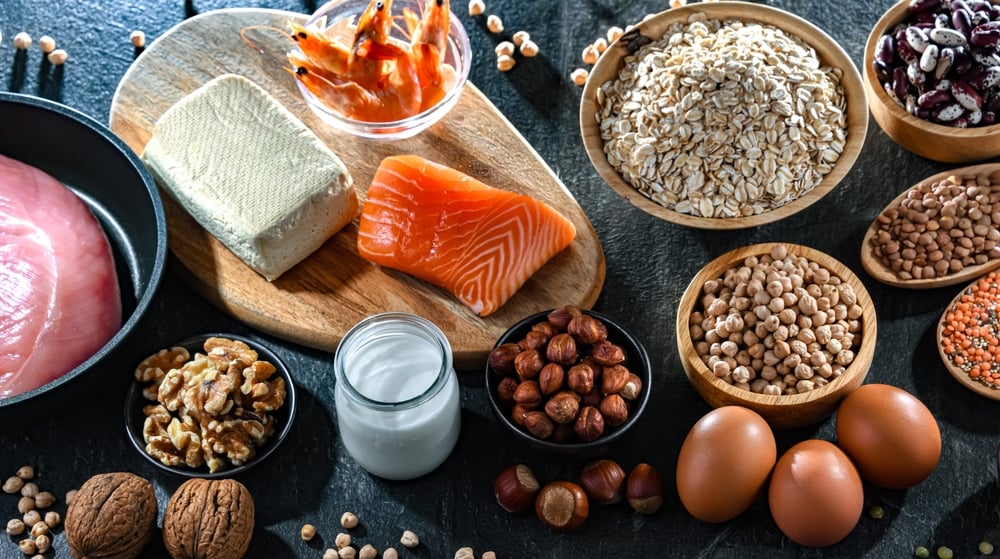
Tell me if this sounds familiar: You’ve started lifting, and everyone from your coach to your group chat keeps saying you should eat 100 grams of protein a day to build muscle. Now you’re wondering two things: is that the right number for you, and what does it look like on an actual plate? Good news on the second one: Greek yogurt with oats, a tuna salad with two eggs, cottage cheese with almonds, and a 3-ounce chicken breast add up to 105.8 grams of protein, using USDA food composition figures.
Whether 100 grams is enough depends mostly on your body weight. The sports nutrition research puts muscle-building intakes at roughly 1.4 to 2.0 grams per kilogram of body weight, so 100 grams lands right in that window for a lot of people and a little short for others. Below, you’ll find the math for your weight, how to split the grams across your day, a table of everyday foods by serving and per 100 calories, and three sample days you can copy.
Is 100 Grams of Protein a Day Enough To Build Muscle?
For many active women, yes. The International Society of Sports Nutrition (ISSN) position stand, led by Jäger, says a daily intake of 1.4 to 2.0 grams of protein per kilogram of body weight is enough for most people who exercise. A 2018 meta-analysis by Morton, pooling 49 resistance training trials, found that protein beyond 1.62 grams per kilogram a day brought no further gains in fat-free mass. For comparison, the RDA is 0.8 grams per kilogram, or 0.36 grams per pound, which is the floor for avoiding deficiency.
Type in your weight to see where 100 grams lands against each guideline.
Here’s the quick conversion: divide your weight in pounds by 2.2 to get kilograms, then divide 100 by that number. 100 grams hits Morton’s 1.6 mark at about 138 pounds, sits at 1.4 at about 157 pounds, and reaches 2.0 at about 110 pounds.
| Body weight | 100 g of protein equals | Where that sits |
|---|---|---|
| 120 lb | 1.84 g/kg | Inside the ISSN range, above Morton’s plateau |
| 130 lb | 1.7 g/kg | Inside the ISSN range, above Morton’s plateau |
| 140 lb | 1.57 g/kg | Inside the ISSN range, just under 1.6 |
| 150 lb | 1.47 g/kg | Inside the ISSN range |
| 160 lb | 1.38 g/kg | Just under the ISSN range |
| 171.8 lb | 1.28 g/kg | Below the ISSN range |
| 180 lb | 1.22 g/kg | Below the ISSN range |
| 200 lb | 1.1 g/kg | Below the ISSN range |
That 171.8-pound row isn’t random: it’s the average weight of US women 20 and older in the CDC’s 2021 to 2023 measurements. So if you weigh around the national average, 100 grams is a solid start that lands a bit under the research range, and aiming closer to 110 to 125 grams (1.4 to 1.6 grams per kilogram) gets you into it. If you weigh about 157 pounds or less, 100 grams already lands inside the ISSN range, and at about 138 pounds or less it reaches Morton’s 1.6 mark. (Your weight here is only an input for the math.)
One more thing the research is clear on: protein works alongside training. Every trial in Morton’s analysis paired protein with at least six weeks of resistance training. If you want a refresher on why the muscle is worth building in the first place, these ways muscle can impact your health go well beyond the gym.
How To Split 100 Grams of Protein Across Your Day
Spreading it out makes 100 grams feel a lot less daunting. The ISSN recommends 0.25 grams per kilogram per dose, or 20 to 40 grams, spread evenly every three to four hours. For a 150-pound person, 0.25 grams per kilogram works out to about 17 grams per meal, so four eating occasions of roughly 25 grams each covers both the per-meal dose and the daily 100.
- Four meals of about 25 grams: breakfast, lunch, an afternoon snack, and dinner. This is the easiest split if your day has a natural snack window.
- Three meals of about 33 grams: works if you’d rather skip snacking, though dinner and lunch have to carry more.
- Front-load breakfast: if you eat light in the morning and heavy at night, moving 20 or more grams into breakfast is the single swap that makes the rest of the day easier.
Protein in Common Foods, by Serving and per 100 Calories
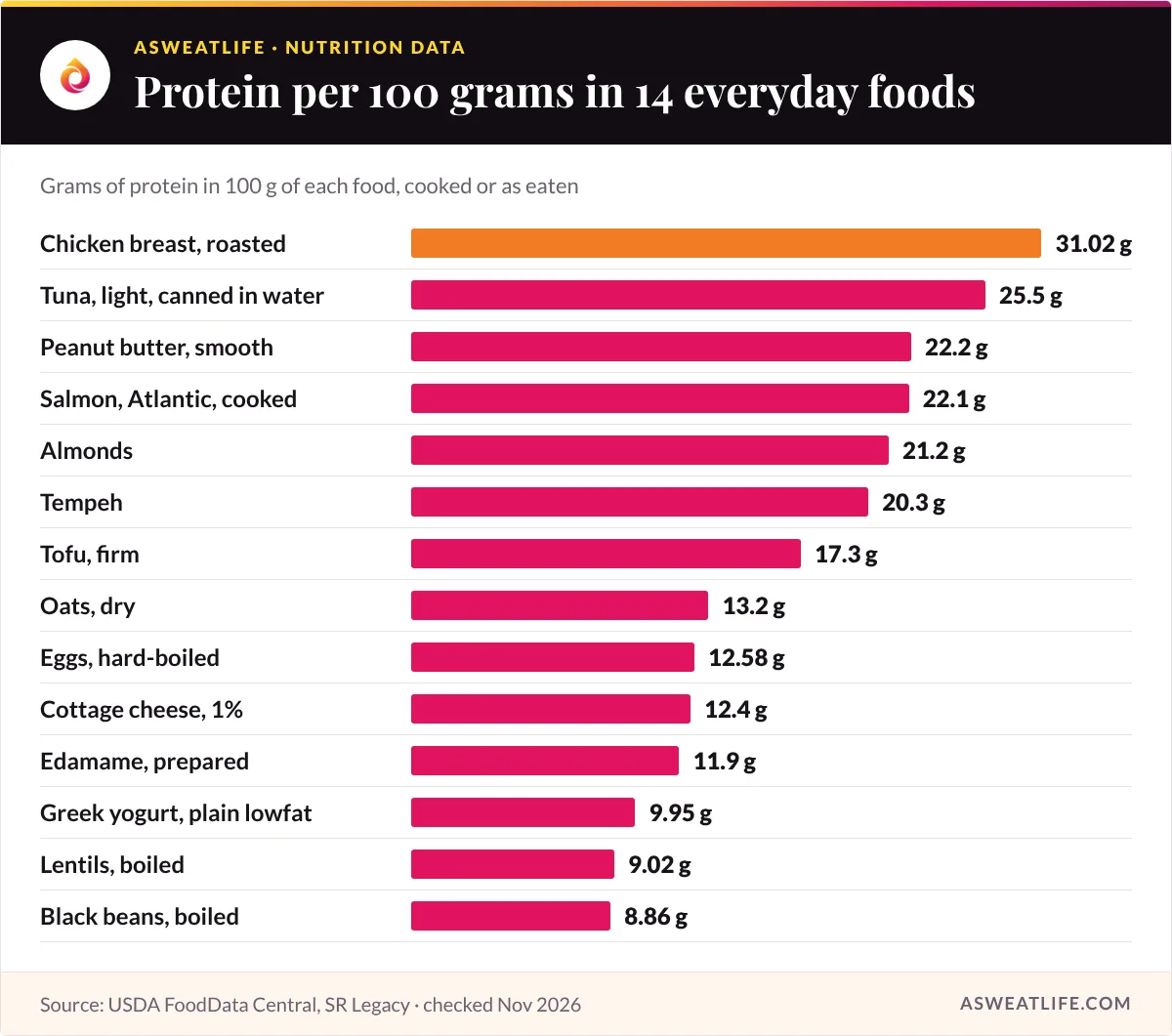
The table below uses USDA FoodData Central figures (SR Legacy) for 14 everyday foods, cooked or as you’d eat them. The last column, grams of protein per 100 calories, is the one most food lists skip: it shows which foods give you the most protein for the energy they bring, which helps when you’re trying to fit 100 grams into meals that still have room for carbs, fats, and the foods you love.
| Food | Protein per 100 g | Serving | Protein per serving | Calories per serving | Protein per 100 calories |
|---|---|---|---|---|---|
| Tuna, light, canned in water, drained | 25.5 g | 3 oz (85 g) | 21.7 g | 99 | 22.0 g |
| Chicken breast, roasted, no skin | 31.02 g | 3 oz (85 g) | 26.4 g | 140 | 18.8 g |
| Cottage cheese, 1% milkfat | 12.4 g | 4 oz (113 g) | 14.0 g | 81 | 17.2 g |
| Greek yogurt, plain, lowfat | 9.95 g | 7 oz container (200 g) | 19.9 g | 146 | 13.6 g |
| Tofu, firm | 17.3 g | 4 oz (113 g) | 19.5 g | 163 | 12.0 g |
| Salmon, Atlantic, farmed, cooked | 22.1 g | 3 oz (85 g) | 18.8 g | 175 | 10.7 g |
| Tempeh | 20.3 g | 3 oz (85 g) | 17.3 g | 163 | 10.6 g |
| Edamame, prepared | 11.9 g | 150 g | 17.9 g | 182 | 9.8 g |
| Eggs, hard-boiled | 12.58 g | 2 large (100 g) | 12.6 g | 155 | 8.1 g |
| Lentils, boiled | 9.02 g | 200 g | 18.0 g | 232 | 7.8 g |
| Black beans, boiled | 8.86 g | 200 g | 17.7 g | 264 | 6.7 g |
| Peanut butter, smooth | 22.2 g | 32 g | 7.1 g | 191 | 3.7 g |
| Almonds | 21.2 g | 1 oz (28 g) | 5.9 g | 162 | 3.7 g |
| Oats, dry | 13.2 g | 40 g | 5.3 g | 152 | 3.5 g |
A few patterns jump out. Canned tuna, chicken breast, and cottage cheese all deliver more than 17 grams of protein per 100 calories, so they’re the heavy lifters when you need a big protein bump in a small meal. Lentils and black beans land lower per calorie because they also bring carbs and fiber, and those carbs are useful fuel on a training day. Nuts, peanut butter, and oats are worth eating for plenty of reasons, but at under 4 grams per 100 calories they top up a meal’s protein more than they carry it.
Labels for branded foods vary, so check the package for yogurt, cottage cheese, and tofu in particular: a high-protein yogurt or an extra-firm tofu can beat the generic figures here.
Three Sample Days That Hit 100 Grams of Protein
Each day below uses only foods and serving sizes from the table, so you can swap within it freely. Treat these as templates: your portions, hunger, and training load decide the rest of the plate.
Day 1: With Fish and Chicken (105.8 Grams)
- Breakfast (25.2 g): a 7-ounce container of plain lowfat Greek yogurt (19.9 g) stirred into 40 grams of oats (5.3 g).
- Lunch (34.3 g): 3 ounces of canned light tuna (21.7 g) over greens with two hard-boiled eggs (12.6 g).
- Snack (19.9 g): 4 ounces of 1% cottage cheese (14.0 g) and an ounce of almonds (5.9 g).
- Dinner (26.4 g): 3 ounces of roasted chicken breast (26.4 g) with whatever grains and vegetables you like.
Day 2: Vegetarian, With Eggs and Dairy (100.3 Grams)
- Breakfast (25.2 g): the same Greek yogurt and oats bowl.
- Lunch (30.6 g): 200 grams of boiled lentils (18.0 g) with two hard-boiled eggs (12.6 g), an easy grain-bowl base.
- Snack (17.9 g): 150 grams of edamame (17.9 g).
- Dinner (26.6 g): 4 ounces of firm tofu (19.5 g) stir-fried with a peanut sauce made from 32 grams of peanut butter (7.1 g).
Day 3: Fully Plant-Based (91.0 Grams)
- Breakfast (12.4 g): 40 grams of oats (5.3 g) with 32 grams of peanut butter (7.1 g).
- Lunch (35.9 g): 200 grams of lentils (18.0 g) with 150 grams of edamame (17.9 g).
- Snack (5.9 g): an ounce of almonds (5.9 g).
- Dinner (36.8 g): 4 ounces of firm tofu (19.5 g) and 3 ounces of tempeh (17.3 g).
Day 3 is the honest one: even with soy at two meals, a vegan day built from these whole foods lands at 91.0 grams. Breakfast is the gap. A soy milk or a scoop of plant protein powder (check the label, since grams per scoop vary by brand) closes it. If you eat plant-based, it also helps to mix your sources across the day; here’s how to make a complete protein from plant foods.
Do You Need Protein Powder To Reach 100 Grams?
No, as Days 1 and 2 show. The ISSN suggests focusing on whole food sources that contain all the essential amino acids, while also calling supplements a practical way to get enough protein when food alone is tough. Powder earns its spot on busy days, after a workout when you’re not hungry, or on plant-based days like Day 3.
If you go that route, start with how to find the right protein powder for you, then use it in a shake that also carries carbs and fat. This guide to building a balanced protein shake walks through the formula.
Tips for Eating 100 Grams of Protein a Day
- Pick one anchor food per meal. Choose a food from the top half of the table for each meal and build the rest of the plate around it. Most anchors land at 14 to 26 grams on their own.
- Batch cook two proteins on Sunday. A tray of chicken or tofu and a pot of lentils covers four or five lunches and dinners. If you eat most meals at your desk, this plan for meal prepping when you eat every meal at the office is a good template.
- Keep shelf-stable backups. Canned tuna, canned beans, and a bag of frozen edamame mean there’s always a high-protein meal in the cupboard on the nights you didn’t plan.
- Upgrade the snack you already eat. Trading a handful of almonds alone (5.9 g) for cottage cheese plus almonds (19.9 g) adds 14 grams without adding a meal.
- Track for three days, then stop. Logging a few typical days shows you where your gaps are (often breakfast). Once you know your pattern, you can eyeball it.
And if a day comes in at 80 grams because life happened? That’s fine. Muscle is built over weeks of training and eating well, and one light day doesn’t undo it. Pick it back up at your next meal.
Still Wondering? A Few Quick Answers
Will Eating 100 Grams of Protein Build Muscle on Its Own?
Probably not much. In Morton’s 2018 meta-analysis, every trial combined protein with at least six weeks of resistance training, so the gains it measured came from protein plus lifting. Pair your 100 grams with regular strength sessions to give it something to work with.
Does Age Change How Much Protein You Need for Muscle?
The effect of extra protein on fat-free mass got smaller with age in Morton’s analysis, and the same study found larger gains in people who were already resistance-trained. If you’re older or newer to lifting, a registered dietitian can help you set a target for your situation.
Should You Eat Protein Before Bed?
It can help. The ISSN position stand says 30 to 40 grams of casein protein before sleep raises overnight muscle protein synthesis. If you already like an evening snack, making it one of your protein doses is an easy way to reach 100 grams.
When To Talk to a Doctor Before Eating More Protein
If you have kidney disease, talk to your doctor or a registered dietitian before raising your protein. Calle, a Cleveland Clinic nephrologist, says that with kidney disease you may want to stay at the lower end of the guidelines or even below them, because more protein puts more load on the kidneys. The same goes if you have high blood pressure or another chronic condition. For the bigger picture on upper limits, here’s whether it’s possible to eat too much protein.
Your next step: do the weight math above, then pick one of the three sample days and try it this week. If 100 grams feels like a stretch, start with breakfast. Get 20 grams there and the rest of the day gets a lot easier.