
Airbnb Hosts and Cleaners Say Remade Beds, Leftover Groceries and Unreported Damage Leave Them With More Work After Guests Check Out
Making the bed, leaving groceries behind and keeping quiet about a broken plate all feel considerate. Hosts say they can create extra work, and Airbnb's own rules point guests another way.

You make the bed, leave the spare groceries for the next guest and never message your host about the wonky showerhead. It all feels like the way to leave a good impression on your Airbnb host. Hosts and cleaners say three well-intentioned checkout habits can actually annoy them: remaking the bed, leaving food behind and keeping quiet when something breaks or doesn’t work.
Each habit comes from a kind place. Each one can also slow down a tight turnover, send food straight to the trash or hand the next guest a problem nobody fixed. Here’s what hosts, etiquette experts and Airbnb’s own rules point to, so your next trip ends well on both sides of the door.
Why Making the Bed Can Make More Work for Airbnb Hosts
A made bed looks tidy, but in a short-term rental every bed gets stripped and washed after checkout anyway. One host wrote that after three guests stayed, they couldn’t tell which of the six beds had been slept in, so all six had to be stripped and remade. An Airbnb cleaner made the same point in a viral TikTok video: nobody sleeps in that bed after you leave, so stripping it for the laundry makes more sense.
Etiquette experts land in different places depending on where you’re staying. Etiquette expert and author Elaine Swann told Today that stripping the bed is an outdated habit for houseguests at a friend’s or relative’s place. “Just make the bed up,” Swann said. She also pointed out that many short-term rentals leave instructions for guests on whether to strip the bed. Etiquette teacher Amy Rainer offered a middle option: loosely remake the bed so it’s clear it was used.
Your next step is simple. Check the house manual or checkout instructions, and if linens aren’t mentioned, send your host a quick message before you pack up.
Leftover Food at an Airbnb Usually Ends Up in the Trash
The half bottle of olive oil and the open box of crackers feel like a gift. California Airbnb host Heather Bull told Business Insider that leftover food is annoying because it has to be thrown out. Hosts can’t know how opened or half-eaten food was stored, so it usually goes straight in the trash.
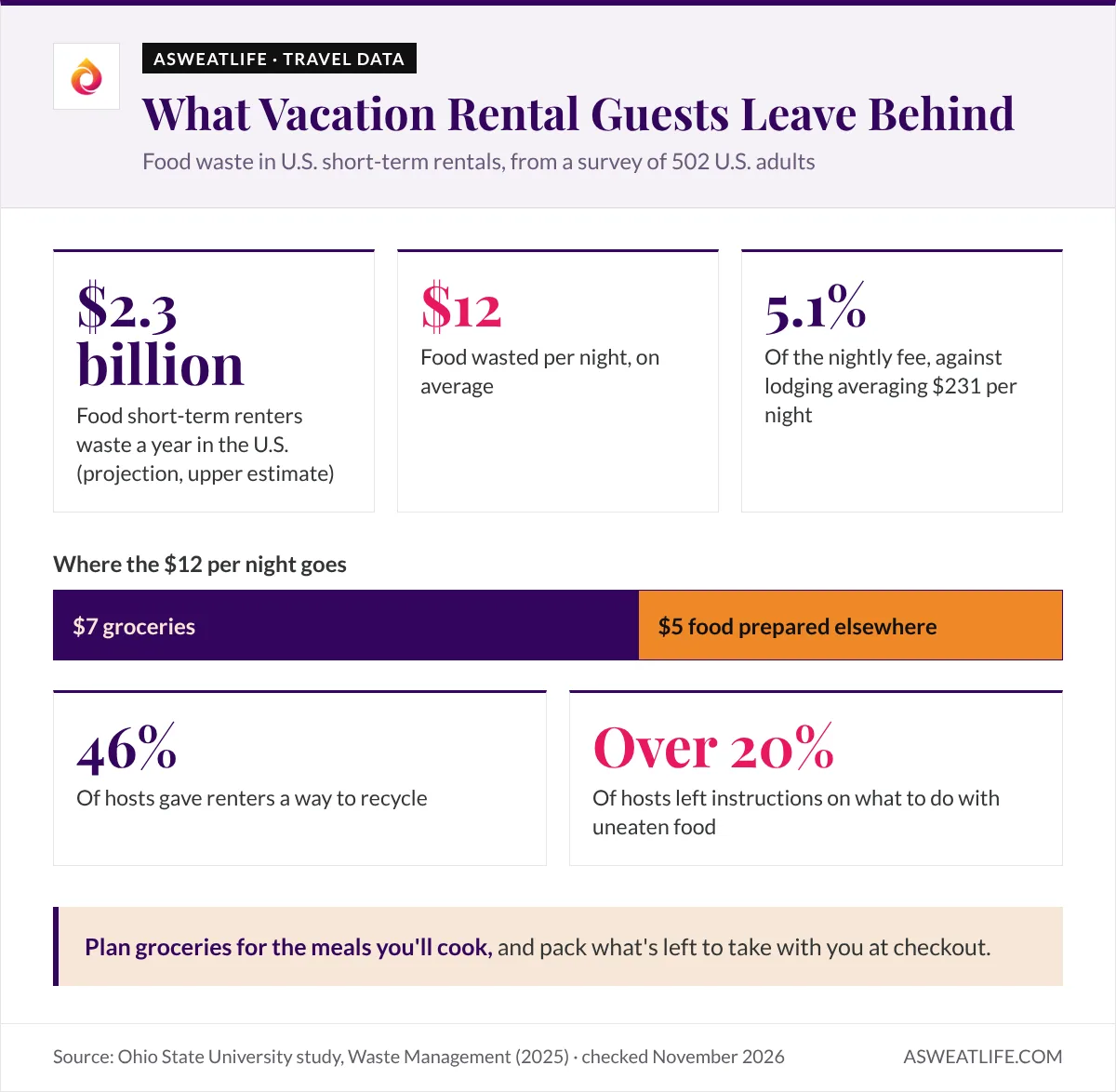
The waste adds up fast. An Ohio State University study published in the journal Waste Management in 2025 projected that U.S. short-term renters waste up to $2.3 billion worth of food a year. The researchers surveyed 502 U.S. adults about their most recent stay and found guests wasted about $12 of food per night: $7 in groceries and $5 in food prepared elsewhere. With lodging averaging $231 per night, that’s about 5.1% of the nightly fee. Lead author Brian Roe, a professor at Ohio State, said “uneaten food amounts to a 5% surcharge.”
Hosts are part of the fix, too. Renters in the same survey reported that 46% of hosts gave them a way to recycle, and over 20% left instructions on what to do with uneaten food.
Some hosts do pass food on, with firm limits. Reid Kennedy, an Airbnb host in St. Paul, Minnesota, turns guests’ leftovers into care packages for people facing food insecurity, a project he documents as AirBnB Leftovers. “I could turn this into something better than pouring (the leftovers) down the drain,” Kennedy told The Washington Post. Even he leaves out anything opened, partly eaten or made with alcohol.
Your next step: shop for the meals you’ll actually cook, and pack what’s left to take home or eat on the road.
Why Airbnb Hosts Want to Hear About Problems Right Away
Plenty of guests skip messaging the host so they seem easygoing. A burned-out lightbulb, a cleaning miss, a broken plate or a gate that won’t latch then lands on the next guest, and sometimes in a review.
Phillip Foxall, an Airbnb host in Rockport, Texas, told Business Insider he wants guests to flag issues right away so he can fix them. “Don’t report it five minutes before you leave and ask for a full refund,” Foxall said.
Airbnb asks the same. If you, someone you invited or a pet damages something, let your host know right away through the app or website. That message creates a record Airbnb’s Community Support can refer to later, photos help, and the host gets time to repair things before the next arrival. If the host later sends a reimbursement request through the Resolution Center, you have 24 hours to respond.
There’s a balance here. Questions the house manual already answers can test a host’s patience, while a real problem is always worth a message.
What Airbnb’s Ground Rules Ask of Guests at Checkout
Airbnb’s ground rules for home guests come down to treating the host’s home like your own and following the house rules. Good communication sits at the center of them.
Pick a habit below to see what feels polite and what your host would actually prefer.
- Leave the home in a condition that doesn’t need excessive or deep cleaning.
- Put trash in the designated bins, and don’t leave large amounts behind.
- Return the keys and finish checkout by the time on your reservation.
- Don’t leave belongings behind for storage or later pickup unless your host approves first.
- Tell your host about any damage as soon as possible and work with them on a reasonable solution.
Airbnb may contact a guest after a reported violation, and repeated or severe violations can lead to suspension or removal from the platform.
If travel is one of your goals this year, here’s your next step: read the checkout instructions the day you arrive. That way the bed, the fridge and anything that broke are all sorted before your final message to your host.