
Staying Active and Independent: Why Everyone Needs a Personal Safety Plan
A personal safety plan helps you stay active and independent. Here's who needs one, how to build it, how to choose a way to call for help, and how to make home safer.


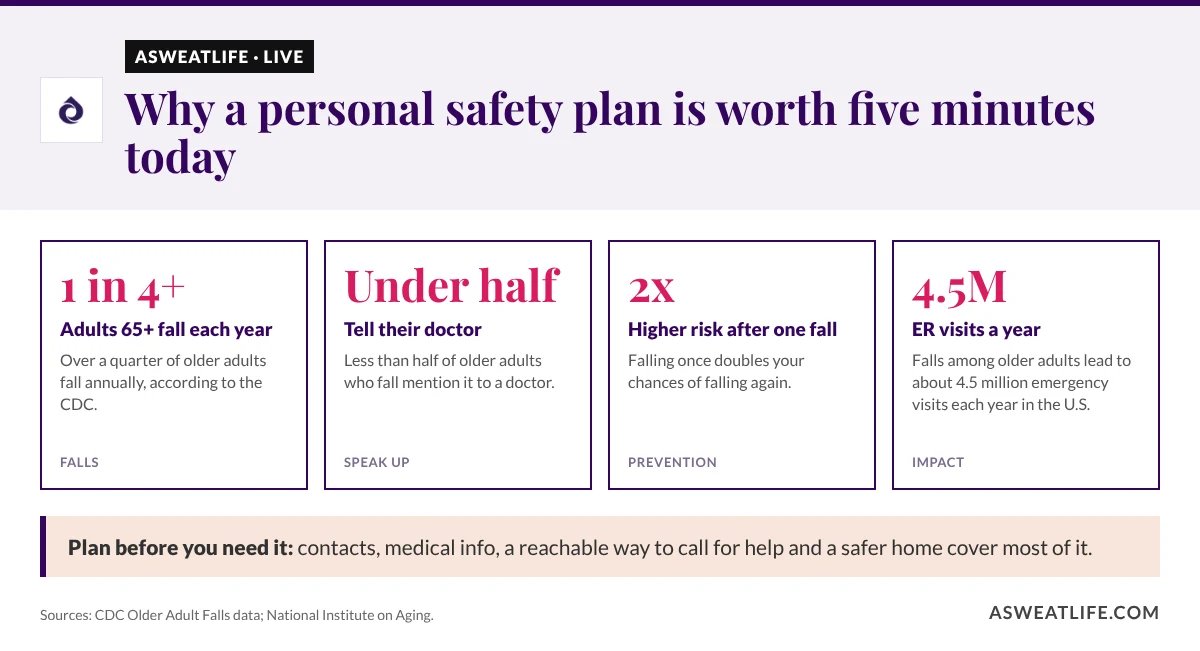
If you walk, run, garden or simply spend a lot of time on your own, a personal safety plan is one of the easiest ways to protect your independence. The CDC reports that over a quarter of adults 65+ fall each year, yet less than half tell their doctor.
Below, we cover who a plan is for, how to spot the riskier parts of your day, how to build a simple plan, how to choose a way to call for help, and how to make your home safer.
Who Needs a Personal Safety Plan?
This article is for general information and isn’t a substitute for advice from your doctor or another qualified health professional.
Not just older adults. Age matters less than your routine, health and how much time you spend alone. A 35-year-old recovering from knee surgery may need an easy way to call someone after using the stairs or shower. A 70-year-old who still hikes every weekend may want backup on the trail because balance isn’t quite what it was.
It’s worth putting a plan together, or reviewing the one you have, if any of these sound familiar:
- A recent fall, near-fall, or a bruise you can’t explain.
- More frequent dizziness, weakness or unsteadiness.
- Trouble getting up from a chair, out of bed or off the floor.
- Recovering from surgery, illness or a hospital stay.
- Long stretches alone during the day or overnight.
- Regular walks, runs, gardening or workouts without anyone nearby.
None of these means giving up independence. They’re signals to prepare a little better. Falls are worth taking seriously: the same CDC data shows that falling once doubles your chances of falling again, so a small slip is a good prompt to act.
Where Are the Riskier Moments in Your Day?
A quick walk through an ordinary day shows where a plan needs the most attention:
| Time of day | What to watch for | Simple fix |
|---|---|---|
| Getting out of bed | Dizziness or unsteadiness before walking across a dark room | Sit on the edge of the bed for a moment; keep a light within reach |
| Bathroom | Wet floors, bath mats and getting in or out of the shower | Grab bars and non-slip mats or strips |
| Cooking | Reaching, lifting, fatigue, hot surfaces and spills | Keep everyday items within easy reach; wipe spills straight away |
| Outdoor activity | Uneven paths, weather, distance from home and weak phone signal | Share your route and carry a charged phone or alert device |
| Night | Getting to the bathroom in the dark | Night lights and a phone or alert device within reach of the bed |

Strength and balance training help with several of these. Our guide to choosing a low-impact HIIT workout is a good place to start if jumping isn’t for you.
How Do You Build a Personal Safety Plan?
Keep it short enough for a family member, neighbor or first responder to understand in a minute. Print a copy, keep it somewhere obvious and share it with the people who might need it.
- List likely emergencies, such as a fall, chest pain, a breathing problem, a severe allergic reaction or sudden confusion.
- Choose your contacts: who should be called first, and who’s next if they don’t answer.
- Gather medical information: medications, allergies, conditions, your doctor and preferred hospital.
- Pick a way to call for help that you can reach easily, at home and when you’re out.
- Plan for the worst case: what happens if you can’t speak, unlock the door or reach a phone? A spare key with a trusted neighbor can help.
- Test it every few months, and after any change in health, medication or living situation.
Your phone can hold part of the plan. On an iPhone, a Medical ID in the Apple Health app can show your allergies, conditions and emergency contacts on the lock screen, and share them with emergency services when you call.
Use the builder below to see which basics you already have and which gaps to close first.
Tick what applies to your routine, then what’s already in place. The builder shows the gaps worth closing first and when to review your plan next.
Your routine
Already in place
Close these gaps first
How Should You Choose a Way to Call for Help?
The best option is the one you’ll actually have on you. The National Institute on Aging lists several, each with trade-offs:
| Option | Good for | Things to check |
|---|---|---|
| Mobile phone | Most people, at home and out | Only helps if it’s charged and within reach |
| Smartwatch with fall detection | Active people who already wear one | Fall detection may not catch every fall; check battery life |
| Smart speaker | Calling out for help at home | Only works within earshot, and only at home |
| Wearable alert button | Living alone, or people who don’t carry a phone | Monthly fees are usually not covered by insurance |
For some people, a life alert necklace or wrist button is the most practical part of the plan, because many are designed to be worn all day, and some are water-resistant enough for the shower. When comparing devices, look for:
- Easy activation: a button that’s simple to find and press.
- Two-way voice: some systems let you speak to a response center or contact.
- Fall detection: useful backup, but it may not recognize every fall, so press the button if you can.
- Water resistance: bathrooms are a common place to slip.
- Coverage and battery life: confirm where it works, especially in rural areas, and how often it needs charging.
- Comfort and privacy: it has to be comfortable enough to wear daily, and you should know what data it collects.
How Can You Make Your Home Safer?
Technology works best alongside a safer space. A room-by-room home safety review from the National Institute on Aging covers the basics: handrails on both sides of stairs, good lighting with switches at both ends, clear walkways, no loose throw rugs, grab bars in the bathroom, and frequently used items stored where you can reach them without a step stool.
After a fall or a big health change, ask your doctor whether a medication review, physical therapy, a vision check or a home safety visit could help. New dizziness, fainting, weakness or confusion should always get prompt medical attention.
Staying strong is part of staying safe, too. Our piece on bone health after 40 covers why strength training matters for active women.

How Do You Talk to a Family Member About Safety?
Lead with their goals. Ask what feels harder than it used to, what would make walks or time at home feel more comfortable, and how much privacy they want. Offer options instead of ultimatums, give them time to think, and agree on check-ins that feel supportive.
Common mistakes to avoid:
- Waiting until after a serious fall to make a plan.
- Choosing a device that’s uncomfortable, confusing or rarely charged.
- Assuming automatic fall detection will catch every incident.
- Never testing the system or updating contacts.
- Treating an alert device as a substitute for medical advice or home repairs.
Folding a few of these habits into your week makes them stick. Our guide to building a wellness routine with small habits shows how.
Personal Safety Plan FAQ
At what age should you get a medical alert device?
There’s no set age. Your health, balance, how much time you spend alone and your activities matter more than your birthday.
What should be in a personal emergency plan?
Your emergency contacts, a list of medications, allergies and conditions, your doctor and preferred hospital, and a reliable way to call for help at home and outdoors.
Do smartwatches detect falls?
Some can detect a hard fall and call for help automatically, but no system catches every fall. If you can, call or press the button yourself.
How often should you review a safety plan?
Every few months, and right away after a fall, a new medication, a hospital stay or a move.