How to Choose Workout Leggings: Fabric, Rise, and a Squat-Proof Test
Read the fiber label, pick the right rise for your workout, size so the fabric doesn't overstretch, and run a five-step squat test before a new pair goes to the gym.

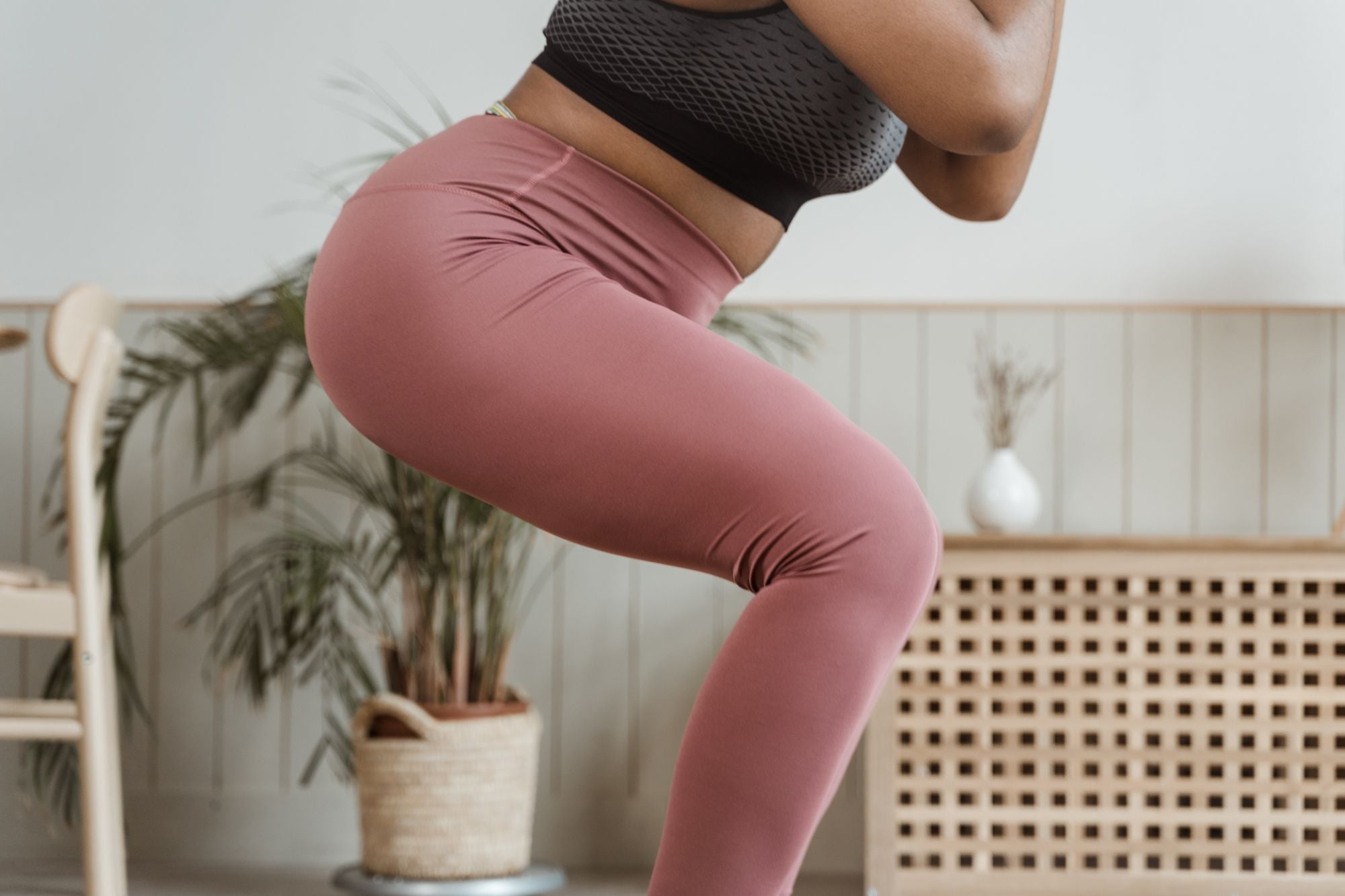
If you have ever caught your reflection mid-squat and wondered just how much the back row can see, you already know why choosing workout leggings takes more than picking a color. The pairs that hold up come down to three things: the fiber blend on the label, a rise that stays put for your kind of workout, and fabric that stays opaque when it stretches. Nike’s lab, for one, checks how much light passes through leggings at a squat (50% stretch) and a forward fold (60% stretch), and only calls a pair squat-proof when it scores four or higher on a five-point scale.
You don’t have a spectrophotometer at home (and neither do we), so this guide translates that kind of testing into checks you can do in a fitting room or your bedroom mirror. It covers how to match leggings to your workout, how to read a fiber label, which rise suits lifting, running, and yoga, how to size so the fabric doesn’t go sheer, and how to wash leggings so they last.
How to Choose Workout Leggings for Your Kind of Workout
Start with what you do most, because the best pair for a heavy squat day is a different pair from the one you want in a heated vinyasa class. For yoga or Pilates, softness and stretch matter more than compression; gym sessions call for compression and flexibility. Here’s how that plays out across the classes on your calendar:
| Workout | Fabric to look for | Rise | Extras that help |
|---|---|---|---|
| Lifting, HIIT, bootcamp | Nylon or polyester with spandex, tight knit, some compression | High | Crotch gusset, high waistband |
| Running | Lightweight, breathable, quick-drying synthetic | High | Secure pocket for keys and phone |
| Yoga, Pilates, barre | Soft, stretchy, less compression | High or mid | No back zipper or bulky pocket for reformer work |
| Hot yoga | Lightweight polyester or nylon, no cotton-spandex | High or mid | Lighter weight fabric |
| Walks, errands, rest days | Cotton blends are fine here | Your preference | Pockets |
A few notes on those rows. For strength days, you want fabric that stays opaque at the bottom of a squat and a waistband that doesn’t roll when you hinge. If you’re building a simple four-week beginner workout plan around squats and deadlifts, that’s the pair to invest in first.
For studio classes, the details change. A small zip pouch at the back can be a win for runners, but on a reformer you’re lying on it, so check where the pocket sits if you’re choosing a reformer fitness class as your regular workout. And in a heated room, instructor Megan Kearney’s advice in our guide to practicing hot yoga safely is to skip cotton-spandex blends, because cotton soaks up water and can push your core temperature up.
Shopping for a full studio kit? Pair this with our guide on sports bra support levels and sister sizes, since the same workout decides both.
How to Read a Leggings Fabric Label
The fiber label is the most honest spec sheet a pair of leggings has. Under US rules, the label must list generic fiber names and percentages by weight, so “78% nylon, 22% spandex” means exactly that. A few things help you decode it:
- Spandex and elastane are the same family of stretch fiber. US labels usually say spandex; the international (ISO) name is elastane, and brands may use either one.
- The first fiber does most of the work. The majority fiber decides how the fabric handles sweat, how it feels, and how it wears. The spandex share mostly decides stretch and snap-back.
- Tiny amounts can hide. In general, a fiber that makes up less than 5% of the weight can be listed as “other fiber,” so a “95% cotton, 5% other” label doesn’t tell you much about stretch.
- Brand fabric names are not fiber names. Names like Luon, Nulu, or Luxtreme describe a brand’s knit and finish. Our Luon vs. Luxtreme breakdown shows how one brand matches each of its fabrics to yoga, running, or HIIT, but the content label is still where you find the actual fibers.
Nylon vs. Polyester vs. Cotton vs. Spandex
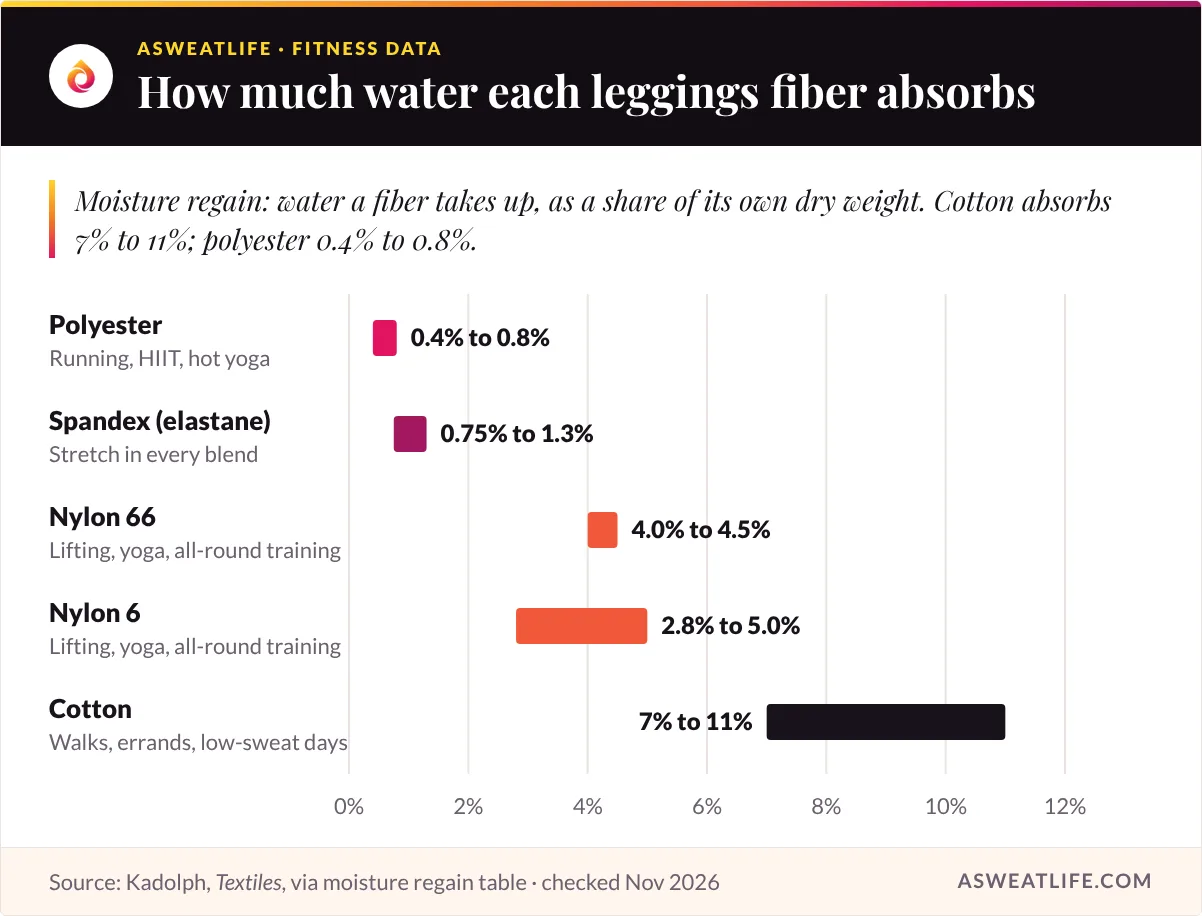
One useful number for comparing fibers is moisture regain: how much water a fiber absorbs relative to its own dry weight. Cotton absorbs 7% to 11% and polyester 0.4% to 0.8%, with nylon and spandex in between. The lower the number, the less water ends up inside the fiber itself, which is a big part of why synthetic leggings dry faster than cotton ones after a sweaty class.
| Fiber | Moisture regain | What it brings to leggings | Best for |
|---|---|---|---|
| Polyester | 0.4% to 0.8% | Absorbs the least water of the four; dries fast | Running, HIIT, hot yoga |
| Spandex (elastane) | 0.75% to 1.3% | Stretch and recovery; almost always a minority share | Every workout, in a blend |
| Nylon | 2.8% to 5.0% (nylon 6); 4.0% to 4.5% (nylon 66) | Absorbs more than polyester but far less than cotton; a common base fiber in training blends | Lifting, yoga, all-round training |
| Cotton | 7% to 11% | Soft and breathable, but holds sweat and dries slowly | Walks, errands, low-sweat days |
Cotton is not off-limits, it’s just better suited to low-sweat days. As Dr. Sal Nadkarni put it in our piece on what to wear to work out, “When choosing proper workout clothing, cotton is not the best choice,” since it dries slowly and can irritate skin when wet.
What Your Leggings Blend Actually Soaks Up
Labels give you percentages, and the table above gives you each fiber’s range, so you can do the math the label doesn’t: multiply each fiber’s share by its moisture regain and add them up. We used the full nylon range (2.8% to 5.0%) because labels rarely say which nylon is in the pair. The calculator below does that math for any label you copy in, and the table after it shows where four common combinations land.
Copy the percentages off your leggings label, or tap a common blend, to see where it lands.
| If your label reads | Blend moisture regain (estimate) | What that means for a sweaty class |
|---|---|---|
| 75% polyester / 25% spandex | 0.5% to 0.9% | Lowest absorption of the four; the quick-dry pick |
| 80% nylon / 20% spandex | 2.4% to 4.3% | Absorbs a little more, still a synthetic training fabric |
| 60% cotton / 35% polyester / 5% spandex | 4.4% to 6.9% | Middle ground; fine for lighter sessions |
| 90% cotton / 10% spandex | 6.4% to 10.0% | Holds the most sweat; save it for low-sweat days |
These are estimates built from fiber averages (not a lab result, and definitely not a promise), so treat them as a quick way to compare two labels side by side. The knit, the finish, and any wicking treatment also change how a pair feels when you’re dripping, which is the next thing to check.
Knit and Weight: Why Thick Leggings Can Still Go Sheer
Two pairs with the same fiber blend can pass or fail the squat test differently, because opacity depends on how the yarn is knitted. Emily Polkow, a lead product line manager for global apparel at Nike, lists yarn size (denier), gauge, knit tightness, and stretch as the factors behind squat-proof fabric, and says an interlock knit is usually safest.
- Interlock knit is made by knitting two fabrics together, so there’s a second layer covering any gaps when the fabric stretches.
- Spacer knit has two outer fabric layers connected by another layer of thread, which adds body and coverage.
Hold a pair up to a bright light and pull the seat fabric gently between your hands. If you can see light pattern through it while it’s stretched, picture that under gym lighting at the bottom of a squat.
High-Rise vs. Mid-Rise Leggings: Which Rise Should You Choose?
Rise is how far the waistband sits above the crotch seam. On leggings, high-rise sits at or above the navel and mid-rise sits at or just below it. Brands rarely publish a rise measurement in inches for leggings, so where the waistband lands on your body is the best guide.
- If you lift or do HIIT: go high-rise. High-rise styles give your midsection more support and stay in place better when you bend and twist through squats, deadlifts, and burpees.
- If you run: high-rise is the default for most running styles, and it gives a waistband pocket somewhere sturdy to sit.
- If you do yoga or Pilates: either works. Mid-rise leggings give your abdomen more mobility but less coverage, which some people prefer in twists and folds.
- If waistbands dig in when you sit or fold: try a mid-rise or a wider, flatter waistband in the same size before sizing up.
How to Do a Squat-Proof Test Before You Buy
A product page can promise “squat-proof,” but the verdict that counts is the one you see on your own body, so do the squat test at home before you take a new pair to the gym. Here’s a version that mirrors the lab’s stretch points:
- Find harsh light. Stand with a bright light behind or beside you; gym lighting is less forgiving than your living room.
- Wear what you’ll train in. Put on the underwear you’d actually wear to class, ideally a shade close to your skin tone.
- Squat deep and look back. Sink as low as you would in class, then check the seat and inner thighs in a mirror or with your phone camera. Those areas stretch the most.
- Fold forward. Touch your toes or come close, which stretches the fabric further than a squat in Nike’s testing (60% versus 50%).
- Check the seams. Look for a crotch gusset, the diamond or triangle panel between the legs. Leggings with one, often sold as squat-proof, tend to be more flexible and durable than pairs without.
If you can see skin or underwear at any step, the pair fails, however thick it felt on the hanger. Color matters too: lighter shades like pastel pinks, yellows, and pale blues can show more under strong gym lighting, and tonal underwear helps. Gymshark is refreshingly honest that no pair can promise to be 100% squat-proof for everyone, which is exactly why your own test matters.
How to Get the Size Right So Leggings Don’t Turn Sheer
Sizing down for a “snatched” fit is the fastest way to turn a good pair see-through. Leggings that are too tight overstretch the fabric, and an overstretched knit opens up and lets light through. For lighter shades, sizing up can add coverage.
Nike’s fit check is simple: you should be able to slide one finger between the leggings and your body at the waist and ankle. If more than one finger fits, try the next size down; if you can’t get one finger in, go up a size. Before you order online, measure your natural waist and the fullest part of your hips with a soft tape and compare them with that brand’s own size chart, since sizes vary from brand to brand.
Then check length. Full-length leggings sit at or just below the ankle, 7/8 leggings stop just above it (a versatile choice for training and everyday wear), and capris end partway down the calf, which is handy for warm weather and yoga.
How to Wash Workout Leggings So They Stay Opaque
Care is part of choosing well, because a squat-proof pair can lose its stretch and coverage in the wrong wash. Synthetic workout clothes do best when you wash in cold water on the gentle cycle and skip fabric softener, which can clog the fabric’s pores and reduce wicking.
- Turn leggings inside out so detergent reaches the sweat and skin oils on the inside.
- Measure detergent. Extra detergent can leave residue that traps odor.
- Air dry when you can. Dryer heat can set odors and stains, so rewash a smelly pair before it goes anywhere near the dryer, and use low heat if you do tumble dry.
- Read the care label. It’s required on clothing, and it’s the instruction the maker stands behind for that exact fabric.
For a deeper clean, our guide on how to clean gym bags and other workout gear covers the rest of your kit. And when a favorite pair starts failing the squat test it used to pass, check our advice on when to throw away your workout gear.
Your next step: pull out the pair you reach for most, read the label, and give it the five-step squat test. Whatever it tells you is the brief for your next pair.
Workout Leggings FAQ
Are Black Leggings Always Squat-Proof?
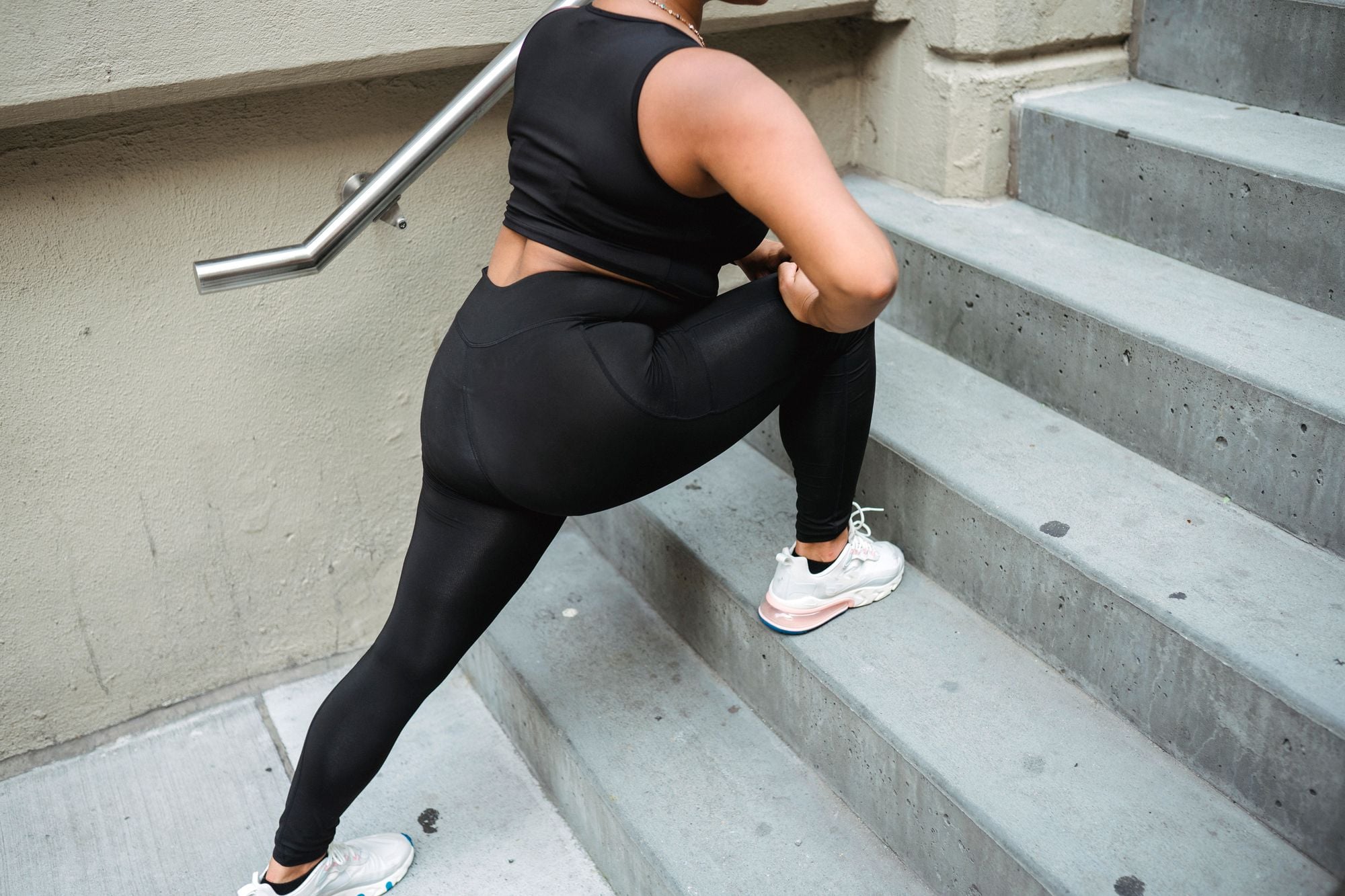
No. Black and other dark shades hide more than pastels, but a thin or loose knit can still go sheer in black when it’s stretched at the seat. Do the squat test on every pair, whatever the color.
Can You Work Out in Cotton Leggings?
Yes, for low-sweat sessions like walks, stretching, or gentle yoga. Cotton absorbs far more water than polyester or nylon and dries slowly, so for running, HIIT, or hot yoga a synthetic blend is the more comfortable choice.
How Much Spandex Should Workout Leggings Have?
There’s no single right number, but the spandex (or elastane) share is what gives leggings their stretch and snap-back, and it is almost always the smaller part of the blend. Compare the spandex percentage between two pairs you’re considering, then let the squat test and the one-finger fit check decide.