
Downsizing Before a Move: How to Declutter Without Burning Out
Moving is the perfect deadline to own less. Here's how to downsize before a move in short, manageable sessions, from the moving estimate to the open-first box.


If you’re packing up a Miami apartment and realizing you own far more than you need, downsizing before a move is the time to fix it. It’s also worth doing for your head: in a small study of 60 working parents, women who described their homes as cluttered had flatter daily cortisol patterns, a stress profile linked to worse health.
Here’s how to use your moving estimate and new floor plan to decide what goes, set up a sorting system that doesn’t wear you out, handle sentimental items, sell and donate on a deadline and pack for the home you’re moving into.
Why Does Downsizing Before a Move Feel So Draining?
Moving already stacks a lot onto your plate: money, logistics, work, maybe kids or pets. Decluttering adds hundreds of small decisions on top. Each one is minor, but together they’re tiring, which is why so many people start strong on a Saturday and end up shoving everything into boxes the night before the truck arrives.
The study behind that cortisol finding is worth reading carefully. It looked at 60 spouses in dual-income families, analyzed the words they used during self-guided home tours and tracked their stress hormone and mood over three weekdays. It shows an association, so it can’t prove that clutter causes stress, and the link appeared in the wives in the study rather than their husbands. Still, it lines up with what a lot of people feel: a home full of unfinished jobs is hard to switch off in.
The good news is that a move gives you a deadline and a fresh space. You don’t have to tackle everything at once. You just need a simple system and a realistic pace, which is what the rest of this guide sets out. If you’re also trying to protect your sleep and workouts during the move, our guide to keeping your health routine when moving pairs well with this one.

How Can Your Moving Estimate Show What You Really Need?
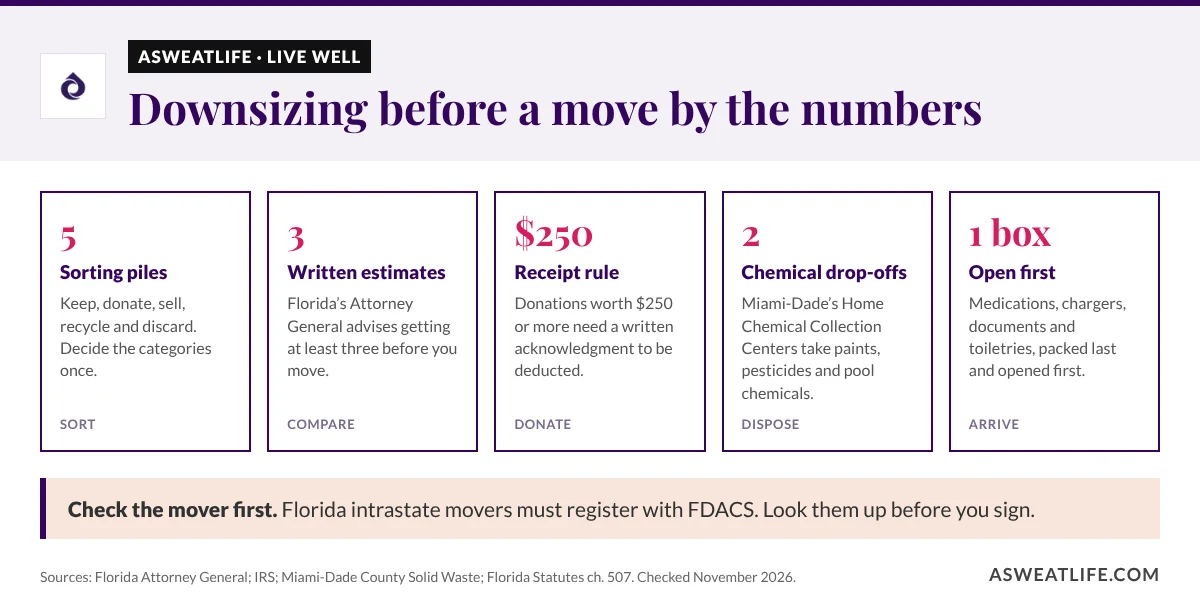
For example, let’s say you’re leaving a two-bedroom in Miami for a smaller apartment across town. Florida’s Attorney General notes that local moves are usually based on hourly charges and advises getting at least three written estimates, so a bigger load usually means a bigger bill.
In that scenario, the inventory you hand to local Miami movers works as your budget. A dresser you never liked or a bookcase that won’t fit the new living room still takes time to wrap, carry and load, and you pay for that time before you give it away at the other end. So before you ask for any quotes, walk through every room and list what you actually plan to take: large furniture, appliances, storage pieces and anything bulky or awkward. Then put the same questions to each mover:
| Question to ask | Why it matters |
|---|---|
| How would the estimate change if I left these large pieces behind? | Shows whether downsizing a specific item actually saves you money |
| Do packing, disassembly, materials or stairs cost extra? | Extras can add up faster than the base rate |
| Is there a minimum charge? | Removing a few small items may not change the price at all |
| What is your Florida registration number? | It should appear on the estimate and contract, and you can look it up |
That last point matters. Florida law requires that, before any moving work starts, the estimate and contract be in writing and signed by both you and the mover. The Attorney General’s office also notes that all movers and moving brokers now have to register with the state, and you can check a mover’s Florida registration before you sign anything.
A useful mindset: every item on the truck is something you’re paying to move. If you wouldn’t pay to carry it to your new door, it probably doesn’t need to come.
How Do You Use Your New Floor Plan as a Decluttering Filter?
Decisions get easier when they’re based on the space you’re moving into rather than the space you’re leaving. Measure each room in the new place, note the closets, cabinets and built-in storage, and compare it all with what you own.
- A big dining table that suited your old place may swallow a smaller dining area.
- Extra shelving units may be pointless if the new apartment has built-in storage.
- A sectional that fits through your current door may not make it up a narrower staircase or into a smaller elevator.
If you can get into the new place before moving day, use painter’s tape to mark out the footprint of your larger furniture on the floor. It takes ten minutes and shows you straight away whether there’s room to walk around it.
Change the question you’re asking. Instead of “Is this still usable?” ask “Does this have a clear place in my next home?”
How Do You Build a Sorting System That Doesn’t Burn You Out?
Decluttering stalls when every object needs a fresh debate. Decide your categories before you open the first drawer, then stick to them.
| Pile | What goes in it | When it leaves |
|---|---|---|
| Keep | Things you use and have space for | Packed by where it will live in the new home |
| Sell | Furniture, electronics and anything with real resale value | Listed early; unsold items move to donate by your deadline |
| Donate | Good-condition items that aren’t worth the time to sell | Booked pickup or drop-off the week before you move |
| Recycle | Paper, electronics and items your city’s programs accept | As you go, so they don’t pile up |
| Discard | Broken, expired or worn-out items | Bulk trash or regular collection before moving day |
| Sentimental review | Photos, letters, inherited pieces | Sorted in separate, shorter sessions |
A few habits keep the system moving:
- Work small. One drawer, one cabinet or one closet shelf per session. Bathroom cabinets, the linen closet and kitchen drawers are easy wins to start with.
- Set a timer. Short sessions of 30 to 60 minutes are easier to keep up than a marathon weekend, and you end each one with something finished.
- Don’t move undecided items between piles. If you’ve picked something up twice, make the call or put it in a single “decide by Friday” box.
- Use a simple test. If you haven’t used it in a year and can’t name when you’ll use it next, it’s a good candidate to go.
If you like a structured challenge, our declutter challenge for your mind, body and home breaks the job into small daily tasks.
Plan Your Downsizing Sessions
Use the planner below to turn your home size, move date and session length into a weekly pace, with sell and donate deadlines built in.
Tell the planner about your home and your move date. It splits the job into short sessions you can actually finish, sets your sell and donate deadlines and flags the things to sort out before the truck arrives.
Home you are leaving
How full is it?
Weeks until moving day
Minutes per session
Sentimental items to sort
Is the new place smaller?
Week by week
Before the truck comes
How Do You Downsize Sentimental Items Without Losing the Memories?
Family photos, children’s artwork, inherited furniture and meaningful gifts need a different approach from ordinary clutter. They can carry a lot of feeling even when they serve no practical purpose, and forcing quick decisions about them is where many people stall or end up regretting a choice.
- Collect them in one place and review them in their own sessions, separately from everyday sorting.
- Set a space limit, such as one or two boxes, and choose the pieces that best represent the people and moments that matter.
- Photograph bulky items before letting them go if the memory matters more than the object.
- Scan letters, artwork and photos into a digital archive, and keep at least one backup in a separate place.
- Offer inherited pieces to relatives before donating them. Someone else in the family may be glad to have them.
It’s normal for this part to feel emotional. Take breaks, involve someone you trust if it helps, and don’t save it all for the final, most stressful week. If you’re looking for a gentler way to think about owning less, one writer’s take on failing a minimalism challenge is a good reminder that this doesn’t have to be all or nothing.
Which Items Should Never Go on the Truck?
Some things are easier to deal with before you move than after. Expired pantry food, broken appliances, old paperwork and half-empty cleaning products are obvious places to start. Shred anything with personal information rather than tossing it whole.
Hazardous materials need more care. Movers commonly refuse flammable liquids and certain chemicals, so ask your mover for its prohibited-items list rather than guessing. In Miami-Dade, the county’s Home Chemical Collection Centers accept oil-based paints, pesticides, solvents and pool chemicals from residents, but not from businesses. Check the county’s site for current locations and hours before you go.
Pack an open-first box with what you’ll need the first night: prescription medications, phone chargers, important documents, toiletries, a change of clothes, basic kitchen supplies and a few cleaning basics. Keep it with you rather than on the truck.
How Do You Sell and Donate Before the Deadline?
Selling and donating both take longer than most people expect, so it pays to start several weeks out. Unwanted belongings can raise a little money or help someone else, as long as they leave the house before moving week. Put it off until the last few days and most of it ends up at the curb.
- List valuable items several weeks ahead. Take clear photos in good light, describe the condition honestly and price to sell.
- Don’t sell everything individually. Bundling small items, or simply donating them, saves hours you’d rather spend on the move.
- Call charities in advance. Confirm what they accept and whether they offer pickup, since many get booked up or won’t take mattresses and some furniture.
- Stay safe with buyers. Meet in a public place for small items, have someone with you for in-home pickups and don’t share more personal information than you need to.
- Set a final cutoff. Anything not sold by your deadline goes straight to donation.
If you plan to claim a tax deduction, keep records. The IRS says donated clothing and household items generally must be in good used condition or better, and you need a written acknowledgment from the charity for any gift worth $250 or more. This isn’t tax advice, so check with a tax professional about your own situation.
How Do You Pack for the Home You’re Moving Into?
Packing by where things sit now spreads everyday items across a dozen boxes. Packing by where they’ll live, and how you’ll use them, makes unpacking faster and stops clutter from creeping straight back in.
- Put everything for your morning coffee in one clearly labeled box, rather than scattering it across several kitchen cartons.
- Keep seasonal decorations together, and separate the clothes you wear every week from occasional outfits.
- Use small boxes for books and other heavy items so no single box is a strain to lift.
- Label each box with its destination room and a short list of contents.
- Keep a simple inventory of valuable or fragile items, with photos.
- Avoid “misc” boxes. They’re the ones that stay sealed in a closet for years.
Look after your body while you pack. Lift with your legs, keep loads close to your body, avoid twisting while carrying and take regular breaks with water, especially in Miami heat. If you have a back problem or another health condition, don’t do the heavy lifting yourself; leave it to the movers.
How Do You Keep the New Place From Filling Up Again?
The payoff from downsizing shows up after the move. Before you unpack everything, decide how each room should work. Put the essential furniture in first, then set storage spots for the things you use every day.
- Don’t fill every shelf and cabinet just because the space is there. Leave some room to breathe.
- Try a one-in, one-out rule for the categories that piled up before, such as clothes or kitchen gadgets.
- Put a donation bag in a closet so you can drop things in as you notice them.
- Do a quick check of storage areas every few months.
A simpler home doesn’t have to feel bare. It tends to feel calmer because the things around you have a clear purpose.
Downsizing Before a Move FAQ
How far ahead should I start downsizing before a move?
Ideally four to eight weeks, so you can sort in short sessions and still have time to sell and donate. With two weeks or less, focus on the biggest items and the fullest closets first.
Does getting rid of stuff lower moving costs?
Often, but not always. Local moves are usually charged by the hour, so fewer items can mean less time. Minimum charges can limit the savings, so ask each mover how removing specific pieces would change your estimate.
What should I do with sentimental items when downsizing?
Sort them separately, set a space limit, photograph or scan things you can’t keep and offer meaningful pieces to family first.
What can’t movers take?
It varies by company, but movers commonly refuse flammable liquids and certain chemicals. Ask for the mover’s prohibited-items list, and take paints, pesticides and pool chemicals to a household chemical collection site.
Do I need receipts for donated items?
If you want to deduct them, yes. The IRS requires a written acknowledgment from the charity for donations worth $250 or more, and items generally must be in good used condition or better.
Move Lighter, Start Fresh
A good move isn’t measured by how efficiently you transport everything you own. It’s measured by how much of what arrives you actually want in your new home.
Start with the floor plan and the estimate, sort in short sessions, protect the things that matter and set firm deadlines for the rest. You’ll unpack faster, and you’ll start the next chapter in a home that feels calmer from day one.