Moving to a New Time Zone? How to Reset Sleep and Training
Moving across time zones resets your body clock for good. Here's how long the adjustment takes, how to start shifting before you leave, and how to sleep and train while you catch up.


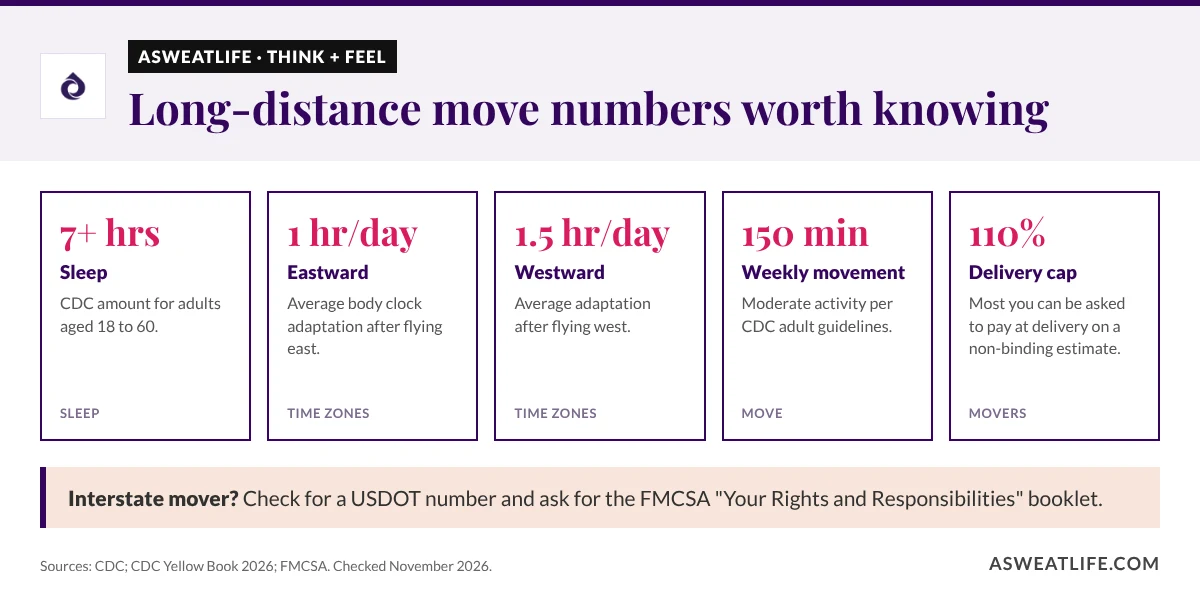
Moving to a new time zone resets more than your clocks. After a vacation you fly home and your body snaps back, but after a move the new hours are permanent, and the CDC Yellow Book puts average body clock adaptation at about 1 hour per day after eastward travel and 1.5 hours per day westward.
Here’s how long the adjustment can take, how to start shifting before you leave, how to use light, caffeine and meals to reset faster, and how to train and sleep well while your body catches up with your new address.
Why Does Moving Across Time Zones Hit So Hard?
Jet lag on a trip is annoying. Jet lag on top of a move is a different thing. You’re short on sleep from weeks of packing, you’re in a bedroom that doesn’t feel like yours yet, and you can’t plan a lazy recovery day because the boxes need unpacking and work starts Monday.
The CDC lists jet lag symptoms that include sleep disturbances, daytime sleepiness and cognitive impairment, along with general malaise and stomach upset. Mayo Clinic notes that symptoms tend to be stronger and last longer the farther you travel, especially heading east. If you’re leaving the West Coast, that covers nearly every move outside the Pacific time zone apart from Alaska and Hawaii.
The upside is that, unlike a vacation, you only have to adjust once. Every choice you make in the first week pushes your body clock toward local time, and it stays there.
How Long Does It Take to Adjust to a New Time Zone?
A simple rule of thumb from Mayo Clinic is that it takes about a day to recover for each time zone crossed. The CDC’s averages are a little more precise, with eastward moves adjusting more slowly. Here’s what that looks like for a move out of San Diego:
| Moving from San Diego to | Time difference | Rough adjustment after flying |
|---|---|---|
| Denver, Salt Lake City | 1 hour ahead | About 1 day |
| Austin, Dallas, Chicago | 2 hours ahead | About 2 days |
| Atlanta, New York, Miami | 3 hours ahead | About 3 days |
| Honolulu | 2 or 3 hours behind, depending on daylight saving time | About 2 days |

These are averages. Your own adjustment depends on how much sleep you’re carrying into the move, how much daylight you get when you arrive and how disciplined you are about local mealtimes and bedtimes. If you’re driving across the country over several days, you’ll absorb the change gradually and may arrive mostly adjusted.
How Can You Start Shifting Before You Leave?
You don’t have to wait until you land. The CDC suggests moving your sleep about 1 hour per day in the 2 to 3 days before you travel, earlier for an eastward move and later for a westward one. Mayo Clinic adds that it helps to start eating meals closer to the times you’ll eat at your destination.
In practice, for a San Diego to New York move, that might look like this:
| Day | Bedtime | Wake time | Other tweaks |
|---|---|---|---|
| 3 days before | 10 p.m. (from 11 p.m.) | 6 a.m. | Dinner an hour earlier |
| 2 days before | 9 p.m. | 5 a.m. | Morning daylight soon after waking |
| 1 day before | 8:30 p.m. | 4:30 a.m. | Caffeine in the morning only |
| Arrival day | Local bedtime | Local wake time | Stay up until local evening |
That schedule is illustrative, and a full three-hour shift isn’t realistic for everyone, especially with packing still to do. Even a one-hour head start takes a day off the adjustment at the other end.
Protect the sleep you do get in that last week too. The CDC says adults aged 18 to 60 need 7 or more hours of sleep a day, and starting the move already short on sleep makes every symptom worse. Our piece on sleep and mental health explains why that matters for mood as much as energy.
How Do Light, Caffeine and Meals Reset Your Body Clock?
Light is the strongest signal your body clock gets, and you can use it on purpose. After moving east, the CDC recommends seeking bright light in the early morning and limiting light in the evening. After moving west, flip it: get light later in the day so you can stay up until local bedtime.
- Morning light (after moving east): open the curtains as soon as you’re up, have breakfast by a window or take a walk before work.
- Evening dimness (after moving east): switch to lamps, dim screens and keep the bedroom dark.
- Caffeine: keep it to the morning. For eastward travel, the CDC’s example itinerary stops caffeine six hours before bedtime at the destination. Our guide to timing caffeine without losing sleep covers how to make that work on training days.
- Meals: eat at local times from day one, even if you’re not hungry. Meal timing is another cue your body uses to set its clock.
- Melatonin: the CDC Yellow Book lists timed melatonin as one treatment for jet lag. Talk to your doctor or pharmacist before trying it, especially if you take other medications.
Flying adds one more factor. The CDC notes that dehydration can make jet lag symptoms worse, and Harvard’s Chan School links good hydration to better sleep, cognition and mood, so drink water through the travel day and go easy on alcohol.
Should You Fly or Drive When You’re Moving Across the Country?
How you get there shapes how you’ll feel when you arrive. Flying gets you there fast but drops the whole time difference on you in one go. Driving takes days, but your body shifts a little each day along the way, and you’ll likely arrive closer to local time.
Say you’re moving from a North Park apartment in San Diego to a new job in Austin. You could rent a truck and drive 1,300 miles with everything you own, or book a San Diego long distance moving company to pack and haul it while you fly ahead and get settled. Either way, check the mover’s USDOT number and the type of estimate before you sign.
The Federal Motor Carrier Safety Administration says a USDOT number is required for interstate moves. It’s also worth knowing what the estimate actually covers:
| Estimate or coverage | What it means |
|---|---|
| Binding estimate | A written price for the goods and services listed; changes should be agreed in writing |
| Non-binding estimate | Based on actual weight and services; FMCSA rules say to have 110% of the estimate available at delivery |
| Full Value Protection | The mover covers the replacement value of lost or damaged items |
| Released value | Cheaper, but coverage is 60 cents per pound per article, so a 10-pound TV is covered for $6 |
If you fly, plan your arrival for daytime when you can, so you can get outside in natural light and push through to a local bedtime.
Plan Your Time Zone Reset
Use the planner below to estimate how long your body clock may take to catch up and what to focus on in your first week.
Moving across time zones? Enter your trip and the planner estimates how long your body clock may take to catch up, plus how to time light, sleep and workouts. Based on CDC Yellow Book averages, so your own adjustment may differ.
Time zones crossed
Direction
How are you getting there?
Your usual sleep
Your priorities
First-week checklist
How Should You Train While Your Body Clock Catches Up?
Expect your workouts to feel off for a few days. Early morning sessions in the new time zone may happen while your body still thinks it’s the middle of the night, and evening workouts can push your bedtime later when you’re trying to move it earlier.
A few ways to train smarter during the adjustment:
- Go easy for the first few days. Walks, mobility work and light strength sessions keep the habit alive without asking much of a tired body.
- Make morning movement do double duty after moving east. An outdoor walk or run gets you daylight at exactly the time your body clock needs it.
- Save hard sessions for when you feel normal. Personal records can wait a week.
- Keep it short. The CDC notes that physical activity can help you sleep better and reduce short-term anxiety, and even 10 to 15 minutes counts.
Once you’re adjusted, rebuild toward the CDC’s guideline of 150 minutes of moderate activity a week. If your old routine didn’t survive the move, a simple four-week workout plan is an easy way to restart.

How Do You Adapt Your Workouts to a New Climate?
A new time zone often comes with new weather, and that can disrupt your routine as much as the clock. San Diego’s mild, mostly dry weather makes outdoor training easy most of the year. Austin, Atlanta and Miami bring long, humid summers; Chicago and New York bring real winters.
| New climate | What changes | How to adapt |
|---|---|---|
| Hot and humid | Higher heart rate at the same pace, heavier sweating | Train early or late, slow your pace and drink more |
| Cold winters | Shorter days, icy surfaces, less daylight in the morning | Layer up, move some sessions indoors, use a light box or bright room in the morning if you struggle to wake |
| Big seasonal swings | Your favorite outdoor routine only works part of the year | Find an indoor backup, such as a gym, pool or studio, early on |
If you’re moving somewhere hot, give your body time. CDC guidance for outdoor workers describes building up heat exposure gradually over 7 to 14 days, and the same patience applies to runs and outdoor workouts.
What Should Your First Two Weeks Look Like?
Break the adjustment into stages so you’re not trying to fix everything at once:
| When | Focus |
|---|---|
| Days 1 to 3 | Local bedtime and wake time, morning light, meals at local times, short walks |
| Days 4 to 7 | Light workouts, a regular grocery routine, one walking or running route you like |
| Week 2 | Normal training volume, a gym or studio, one recurring social plan |
Set up your bedroom before anything else when you arrive. Make the bed, darken the room and get the temperature comfortable, because the CDC’s healthy sleep habits include keeping the bedroom quiet, relaxing and cool. Sleep in a room full of boxes if you have to, but sleep at local time.
Moving to a New Time Zone FAQ
How long does it take to adjust to a new time zone after moving?
The CDC Yellow Book puts average adaptation at about 1 hour per day after traveling east and 1.5 hours per day after traveling west. Mayo Clinic’s rule of thumb is about a day per time zone crossed.
Is it harder to move east or west?
East. The CDC says westward travel is easier to adapt to than eastward travel, which is why most moves out of the West Coast take a little longer to settle.
Should I shift my sleep before moving?
If you can. The CDC suggests moving sleep about an hour a day for two to three days before travel, earlier for eastward moves and later for westward ones.
What’s the fastest way to reset after moving east?
Get bright light early in the morning, keep evenings dim, eat on local time and keep caffeine to the morning.
Can I work out with jet lag?
Yes, but keep it light for the first few days. Outdoor morning walks or runs are especially useful after moving east because they add daylight at the right time.
Does driving instead of flying help with jet lag?
Usually. Crossing time zones over several days lets your body shift gradually, so you’ll likely arrive closer to adjusted.
A move across time zones only asks you to adjust once. Give your body clock a few days of consistent light, meals and bedtimes, and your new city will start to feel like home faster than you might expect.