
Signs Your Dog Is in Pain: Quiet Changes Every Owner Should Notice
The signs your dog is in pain are often quieter than limping or crying out. Here's what to notice in movement, posture and behavior, and when to call a vet.

If your dog still greets you at the door and finishes every meal, it’s easy to assume they feel fine. But the signs your dog is in pain are often quieter than limping or crying out. In one veterinary study, nearly one in four dogs aged 8 months to 4 years already had clinical signs of osteoarthritis.
Below, we cover what that research does and doesn’t show, the changes in movement, posture, behavior and breathing worth noticing, how hip problems tend to look, and when to call a vet, including the signs that need emergency care.
How Common Is Hidden Joint Pain in Dogs?
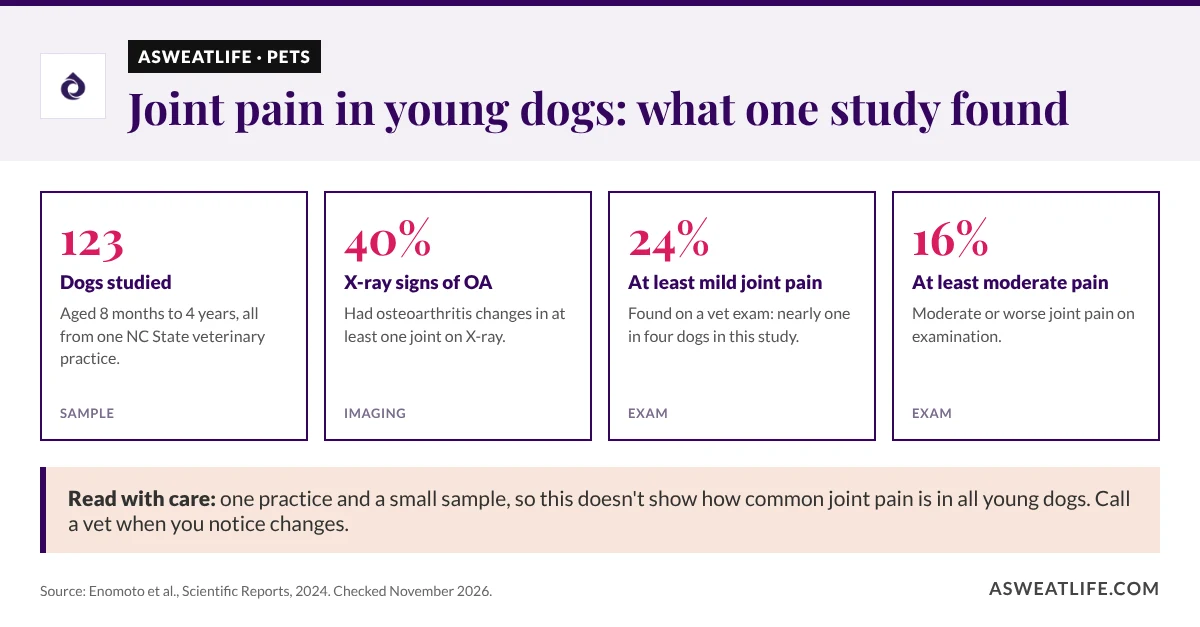
A May 2026 report in dvm360 highlighted a 2024 study by Enomoto and colleagues that looked at young dogs for signs of osteoarthritis. The researchers examined 123 dogs aged 8 months to 4 years from a single primary care practice at the NC State University College of Veterinary Medicine.
About 40% of the dogs had X-ray evidence of osteoarthritis in at least one joint, and about 24% had clinical signs, meaning a vet found at least mild joint pain on examination. That’s nearly one in four dogs in this study.
| Finding | Dogs in the study | Share |
|---|---|---|
| X-ray signs of osteoarthritis in at least one joint | 49 of 123 | 39.8% |
| At least mild joint pain on vet exam | 29 of 123 | 23.6% |
| At least moderate joint pain on vet exam | 20 of 123 | 16.3% |
Keep the limits in mind. The authors note that the dogs came from one practice in one region, the sample was small, and pain was judged by a vet’s exam, which has no gold standard. The study doesn’t tell us how common joint pain is across all young dogs. What it does suggest is that joint changes can start earlier than many owners expect, so it’s worth watching younger dogs too.
Here are the study’s key numbers at a glance.

What Movement Changes Can Signal Pain?
This article is for general education and doesn’t replace advice from a veterinarian. Only a vet can examine your dog, find the cause of pain and recommend treatment.
Changes in how a dog moves are among the signs the American Animal Hospital Association (AAHA) lists, including stiffness when rising and avoiding stairs or jumping. Look for:
- Getting up more slowly after rest, or a visible pause before standing
- Hesitating at stairs, curbs or the car, or needing a run-up to jump on the couch
- Shorter or slower walks, lagging behind, or sitting down mid-walk
- A stiff gait that loosens up after a few minutes of moving
- Limping that comes and goes, or shifting weight between legs
- A “bunny hop,” with both back legs moving together when running
- Less interest in playing, fetching or jumping
If you run or hike with your dog, these changes can show up on the trail first: a dog who used to lead may start trailing behind. Our guide to your first trail run with your dog covers how to build distance gradually and watch how your dog handles the terrain.

How Does Pain Change a Dog’s Posture?
Pain can change how a dog holds its body. These shifts often develop slowly, which makes them easy to miss:
- A hunched or arched back, or a tucked belly or tail
- Head held low
- Sitting awkwardly, with legs splayed or tucked to one side
- Less muscle in the back legs, sometimes with more bulk in the shoulders as weight shifts forward
- Trembling or shaking when the dog isn’t cold or scared
- A tense face: squinting eyes, flattened ears or a tight mouth
Comparing a photo or video from a year ago with how your dog stands and moves today can make gradual changes easier to see.
Which Behavior Changes Point to Pain?
AAHA notes that pets don’t all show pain the same way. Some withdraw, while others become irritable, and both lethargy and restlessness can be signs. A sudden change from your dog’s usual behavior matters more than any single trait. Watch for:
- Irritability or snapping, especially when touched or approached while resting
- Withdrawing, hiding or seeking out quiet corners
- Clinginess or unusual neediness
- Restlessness, pacing or trouble settling at night
- Less interest in food, toys or people
- Licking, chewing or biting at one spot
- House-training accidents in a dog who was reliable
A dog who seems to be getting “grumpy” or “lazy” with age may be uncomfortable, so it’s worth mentioning these changes to your vet instead of putting them down to personality.
What About Vocal and Breathing Changes?
Many owners expect a dog in pain to whine or yelp, and some do. Others stay quiet. AAHA points out that some pets are naturally more vocal than others, so noise alone isn’t a reliable measure of how much pain a dog is in or how long it has been there. Signs to notice include:
- Whimpering, whining or groaning, especially when lying down or getting up
- Yelping when touched or picked up
- Panting at rest or in cool conditions
- Faster or shallower breathing
Labored breathing without heat or exercise is a reason to contact a vet right away. Real breathing difficulty, such as gasping, noisy breathing or blue, gray or pale gums, is on AAHA’s list of signs that need emergency veterinary care.
What Do Hip Problems Look Like?
Hip dysplasia is a developmental condition in which the hip joint fits loosely. Over time, that looseness can lead to inflammation and arthritis. It’s more common in large and giant breeds, but any dog can be affected.
The signs overlap with general pain but often follow a pattern: difficulty rising, back-leg lameness without an obvious injury, a bunny-hopping gait, reluctance to climb or jump, and loss of muscle in the back legs. Because severity varies, Vetstreet notes that some dogs show signs as early as 4 months, while others don’t until middle age or later.
If you have a German Shepherd, Labrador, Golden Retriever, Rottweiler or another large breed, a clear guide to hip dysplasia dog symptoms can help you recognize the pattern so you can raise it with your vet early.
Diagnosis is based on clinical signs, a physical exam and X-rays, according to Vetstreet. A vet can assess the cause of your dog’s discomfort and decide which tests are needed. Treatment plans vary and may include weight management, controlled exercise, medication, physical rehabilitation or surgery, depending on the dog.
What Else Can Cause Pain in Dogs?
The signs above aren’t specific to joints. They can point to many causes, including:
| Possible source | Signs owners may notice |
|---|---|
| Joints, including arthritis and dysplasia | Stiffness, slow rising, avoiding stairs or jumps |
| Injuries to ligaments, muscles or paws | Limping, licking a paw or leg, favoring one side |
| Dental disease | Chewing on one side, dropping food, eating less |
| Ear problems | Head shaking, scratching, sensitivity when the head is touched |
| Back or neck problems | Hunched posture, reluctance to lower the head, yelping on movement |
| Abdominal pain | Tucked belly, restlessness, reduced appetite |
| Skin conditions and allergies | Licking, chewing or scratching one area |
Only a vet can tell these apart. Your role is to notice the changes and describe them clearly so your vet has a good starting point.
When Should You Call a Vet?
Contact your vet when you notice changes that concern you. You don’t need to wait for a set period or for signs to get worse. A short call helps you and your vet decide how soon your dog should be seen.
Some signs need emergency veterinary attention right away. AAHA’s emergency guidance includes:
- Difficulty breathing, gasping or blue, gray or pale gums
- Collapse, unresponsiveness or seizures
- Sudden weakness, paralysis or loss of the ability to walk
- Known trauma, such as being hit by a car, even if your dog seems fine
- A suddenly swollen or bloated belly, especially with retching or weakness
For non-emergency changes, these steps help you and your vet:
- Keep a short diary of what you’ve noticed and when, with video if you can
- Bring your notes and clips to the appointment
- Don’t give your dog human pain relievers. The Merck Veterinary Manual notes that ibuprofen, naproxen, aspirin and acetaminophen are among the human medicines pets most often swallow, and they can be toxic to dogs
- Ease off high-impact activity such as long runs, jumping and rough play until your dog has been examined
- Ask your vet how they’ll assess pain and what a treatment plan might involve
How Can You Help a Dog Living With Ongoing Pain?
Some causes of pain, such as arthritis, are managed over the long term instead of cured. With a plan from your vet, many dogs stay comfortable and active. Plans often include:
- Keeping your dog at a healthy weight to reduce the load on joints
- Regular, gentle, low-impact exercise
- Medication or supplements only as your vet advises
- Physical rehabilitation or hydrotherapy under veterinary guidance
- Home changes such as non-slip rugs, ramps, raised bowls and supportive beds
- Regular check-ups so the plan can be adjusted
Low-key shared activities can help keep your dog moving and engaged. If you’re curious, our writer’s experience with dog yoga shows how gentle movement and time together can fit into a routine. Ask your vet first which activities suit your dog’s condition.
Use the checker below to organize what you’ve noticed before you talk to your vet.
Tick anything you have noticed over the past few weeks. The checker sorts it into a short summary to share with your vet. It doesn’t diagnose anything.
Emergency signs (any of these today?)
Movement
Posture
Behavior
Vocal and breathing
What you’ve noticed
Before the appointment
Dog Pain FAQ
What are the most common signs a dog is in pain?
AAHA lists stiffness or limping, changes in appetite, behavior and posture, over-grooming a sore spot, restlessness or fatigue, more vocalizing and labored breathing. Signs vary between dogs, so changes from your dog’s normal behavior are the key thing to notice.
Do dogs hide pain?
Pets can’t tell us where or when they hurt, and many show pain through subtle changes in movement, posture or behavior instead of crying out. That’s why small changes are worth noticing.
Can young dogs have arthritis?
Yes. In a 2024 study of 123 dogs aged 8 months to 4 years from one veterinary practice, about 24% had clinical signs of osteoarthritis. The study doesn’t show how common it is in all young dogs, but it suggests joint changes can start early.
Can I give my dog ibuprofen or Tylenol?
Only if your vet specifically tells you to. Human pain relievers such as ibuprofen, naproxen and acetaminophen can be toxic to dogs. Call your vet or a pet poison helpline if your dog swallows any.
When is dog pain an emergency?
Difficulty breathing, collapse, sudden paralysis or weakness, known trauma and a suddenly bloated belly need emergency veterinary attention right away.
Watching for the quiet signs, such as slower rising, shorter walks, a changed posture or a shift in temperament, gives you a head start. Keep notes, contact your vet when something changes, and raise any shift in temperament with your vet instead of putting it down to age. For more on how animals support our own well-being, see our beginner’s guide to support animals.