The Five-Minute Outdoor Reset: How to Make Fresh Air a Daily Habit
A five-minute outdoor reset is small enough to do on a busy day. Here's how to attach it to your routine, make your space work and keep it going all year.


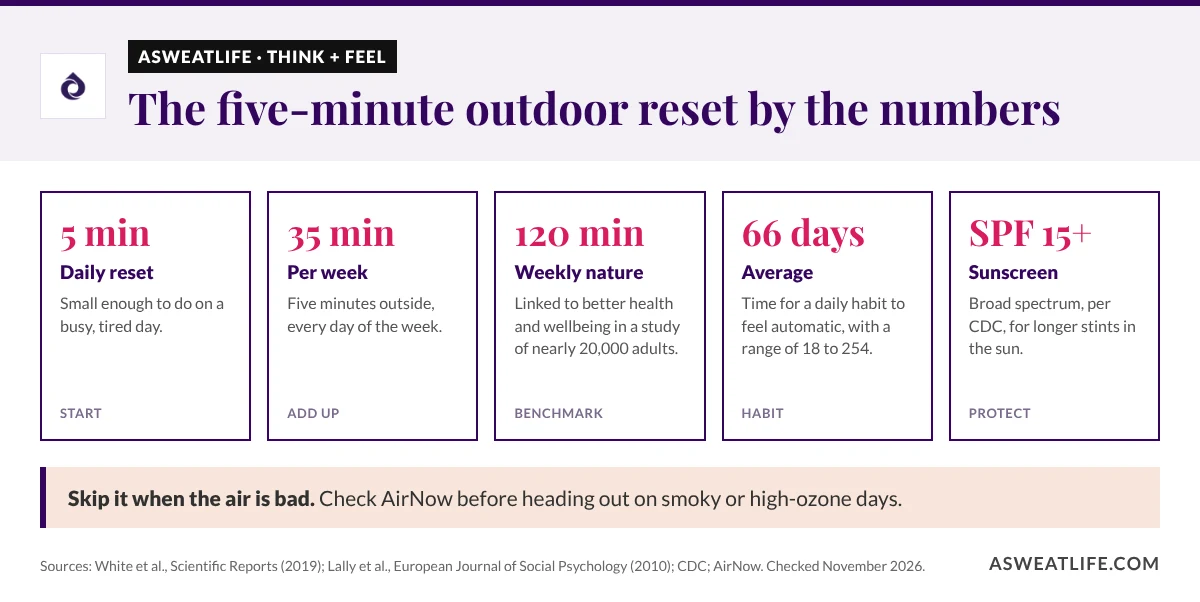
If you often close your laptop and realize you’ve barely left your chair, a five-minute outdoor reset is an easy fresh-air habit to build. A study of nearly 20,000 adults in England linked at least 120 minutes a week in nature with better self-reported health and wellbeing, and it didn’t matter whether that time came in one long visit or several short ones.
Here’s how to set a goal small enough to keep, make the space you already have work, attach the habit to your day, adjust it through the seasons and hold off on big outdoor projects until you know what you’ll actually use.
Why Start With Just Five Minutes Outside?
Most wellness goals fail at the planning stage. You decide to walk every morning, train five days a week, meditate and spend less time on your phone. Then a meeting runs late, the weather turns or you’re simply tired, and the whole plan starts to feel like another chore.
A five-minute goal survives those days. It’s short enough that “I don’t have time” stops being true, and it doesn’t require gear, a change of clothes or a destination. On good days you can stay out longer. On hard days, five minutes still counts.
It also adds up. Five minutes a day is 35 minutes a week, and that’s before any weekend walk or longer outing. Here’s how a few small sessions stack up against two common benchmarks:
| Routine | Minutes outside per week | How it compares |
|---|---|---|
| 5 minutes, 5 weekdays | 25 | A start; add a weekend walk to build toward the 120-minute nature benchmark |
| 5 minutes, every day | 35 | Steady habit; still well under 120 minutes |
| 10 minutes, every day | 70 | More than halfway to 120 minutes |
| 5 minutes daily plus a 90-minute weekend park walk | 125 | Clears the 120-minutes-a-week level in the English study |
| 30-minute brisk walk, 5 days | 150 | Meets the CDC’s 150 minutes of weekly moderate activity |
One caveat on those numbers. The English study counted time in places like parks, woodlands and beaches, and it didn’t count time in people’s own gardens. It was also cross-sectional, so it shows an association rather than proof that the time outside caused the better health. Treat 120 minutes as a useful target to build toward over the week, with your front step as the easy daily part.
A five-minute reset isn’t a replacement for exercise, either. The CDC recommends adults get 150 minutes of moderate-intensity activity each week, plus muscle-strengthening work on two days. If you want a structured way to get there, our simple four-week beginner workout plan pairs well with a daily outdoor habit.

Does Your Outdoor Space Need to Be Perfect?
Social media makes outdoor wellness look expensive: landscaped gardens, outdoor saunas, cold plunges and patios styled like boutique hotels. None of that is required.
A front step can be enough. So can a small balcony, a shared courtyard, a quiet corner of the yard or the stretch of sidewalk outside your door. The space only needs to suit what you plan to do there:
- Stretching: a stable, level surface with room to move your arms and legs.
- Coffee or reading: one comfortable chair, ideally with some shade.
- Walking: a safe, well-lit route from your door. For many people that’s the most practical outdoor space of all.
- Just breathing: anywhere you can stand still for a few minutes without being in the way.
If walking is your reset, comfortable shoes matter more than any patio upgrade. Our guide to common shoe mistakes that make your feet hurt is worth a read before you add distance.
How Do You Remove the Little Things That Stop You?
Think about what actually keeps you indoors. Usually it isn’t a big barrier. It’s a handful of small ones that each add a step:
| What stops you | Small fix to try first |
|---|---|
| Your outdoor chair is always covered in leaves or stored away | Leave one chair out and clear the spot once a week |
| You can never find your shoes or jacket | Keep one pair and one layer by the door |
| The yard gets harsh afternoon sun | Switch your reset to the morning or find a shaded corner |
| The path is dark in the evening | Use a lit sidewalk route or add a simple path light |
| You forget until it’s too late | Attach the reset to something you already do every day (more on that below) |
| You just don’t feel like it | Agree to one minute only and let yourself go back in |
You don’t need to redesign anything. Pick the one obstacle that most often sends you to the couch and fix that first. When it’s gone, the next one will be obvious.
Does Privacy Affect How Comfortable You Feel Outside?
For a lot of people, yes. You might be perfectly happy walking around the neighborhood but feel self-conscious stretching in a front yard where neighbors and passersby can see you. That’s a personal preference, and it’s worth factoring in when you choose where your reset happens.
Some homeowners use hedges, fencing, screens or simply a different seating spot to make an outdoor area feel more private. On properties with a gated entrance, features such as wrought iron gates can help define the line between public and private space while adding to the look of the home.
Keep in mind that open ironwork doesn’t block views on its own. If screening is the goal, it has to be part of the design, for example with planting, panels or a different style of gate, rather than assumed. And if privacy is the real reason you avoid your yard, solving that may do more for your routine than any new outdoor furniture.
If none of that is practical right now, a short walk is a simple workaround. Moving through a space tends to feel less exposed than standing still in it.

How Do You Turn Five Minutes Outside Into a Habit?
A new behavior is easier to remember when it follows something you already do. Habit researchers describe this as linking the action to a consistent cue, and it’s the basis of the habit-stacking idea: “After I do X, I’ll do Y.”
In a well-known study from University College London, participants repeated a new daily health behavior in response to a cue. It took an average of 66 days for the behavior to feel automatic, with a range from 18 days to an estimated 254 days. Missing a single day didn’t derail the process in any meaningful way. So expect this to take a couple of months, and don’t treat one skipped day as failure.
Good cues for an outdoor reset are moments that already happen every day:
- After you finish your morning coffee
- When your lunch break starts
- When you close your laptop for the day
- After you clear the dinner table
- When you take the dog or the trash out
If you work from home, the end of the workday is a particularly useful cue. Stepping outside for a few minutes gives you a clear change of setting between work and the rest of your evening, which can be hard to create when your office is also your kitchen.
What you do out there doesn’t need to be a formal mindfulness exercise. Listen to what’s around you, notice the weather and the light, stretch your back or simply spend a few minutes without a screen. The goal is a break pleasant enough that you’ll want to repeat it.
Plan Your Five-Minute Outdoor Reset
Use the planner below to pick your cue, your spot and the obstacle you’re working on. It writes your habit as one sentence, suggests a fix and adds up your weekly minutes outside.
Build your own five-minute outdoor reset. Pick the moment you’ll attach it to, where you’ll go and what usually stops you. The planner writes your habit cue, suggests one fix and adds up your weekly outdoor minutes.
Attach it to
Where will you go?
What usually stops you?
Season right now
Days per week
Minutes each time
Fix one thing first
This season
Why Should You Let Some Days Count for Less?
A lot of routines break because every session has to produce a number: a distance, a calorie count, a set length of meditation. Tracking can be helpful, but your outdoor reset doesn’t need to become another performance target.
Some days you’ll want to move. Other days you’ll want to sit quietly with a mug in your hands. Both count. Five minutes outside isn’t a substitute for regular exercise, and it won’t fix stress or a health concern on its own. It’s simply one more easy way to get outdoor time into your week.
The right version of the habit fits your energy, mobility, schedule and access to outdoor space right now. If you have a health condition that affects how safely you can be outside in heat, cold or poor air, check with your doctor about what’s right for you.
How Should You Change the Routine With the Seasons?
A habit that feels effortless in May can feel like a chore in January. Instead of dropping it when the weather turns, adjust it:
| Season | What changes | How to adapt your reset |
|---|---|---|
| Summer | Heat and strong sun | Go early or late, find shade and use broad-spectrum sunscreen with SPF 15 or higher for longer stretches outside |
| Fall | Rain, wind and shorter days | Keep a rain layer by the door and move evening resets to a lit route |
| Winter | Cold, ice and early darkness | Walk rather than sit, layer up and skip icy steps and paths |
| Spring | Pollen and changeable weather | Check the forecast and keep one easy indoor fallback ready |
Air quality matters too, especially during wildfire smoke or summer ozone. In some places, AirNow notes that action days are called when the Air Quality Index is forecast to reach Unhealthy for Sensitive Groups. On those days, sensitive groups are advised to cut back on prolonged or heavy outdoor exertion. A few quiet minutes by an open window, or an indoor stretch break, is a perfectly good substitute.
If conditions aren’t safe, stay inside. The point isn’t to force the same activity every day of the year. It’s to build a routine flexible enough to survive weather and real life. For more on why shorter cold-weather outings are still worth it, read what a conservationist, a wildlife presenter and a neuroscientist told us about winter time outside.
Can Your Outdoor Reset Be Social?
It doesn’t always have to be a solo break. Invite a friend for a lap around the block, take a phone call while you walk a safe route or spend a few minutes on the porch with someone you live with.
For people who find solo routines hard to stick with, company can make the habit more enjoyable. It’s also an easy way to connect without planning a whole evening. Not every catch-up needs to happen over dinner or in front of the TV; sometimes walking together is enough.
If you’re using a shared courtyard or building space, keep noise down and be considerate of neighbors who are using it for their own quiet minutes.
Should You Renovate Your Outdoor Space First?
It’s tempting to think a better routine needs a better yard. But a full garden makeover before you know how you’ll use the space can mean spending money on things you never touch.
Try the routine first. For two or three weeks, notice where you naturally want to sit, walk or stretch, and pay attention to sun, shade, noise, privacy and how easy each spot is to get to. You might find the most useful change is one shaded chair rather than a new patio. Or you might realize a safer, better-lit walkway would make short walks far more likely.
If you’re considering larger changes after that, home improvement planning can help you sort out the practical priorities before work starts. Let the design support the habit you’ve already built, rather than becoming a big project that pulls you away from it.
Five-Minute Outdoor Reset FAQ
Does five minutes outside really make a difference?
It’s a starting point. Five minutes a day is easy to repeat, adds up to 35 minutes a week and makes longer outdoor time more likely. Research on weekly nature time points to benefits from around 120 minutes a week, so think of the reset as a foundation you can build on.
What’s the best time of day for an outdoor reset?
The best time is one you’ll actually repeat. Attach it to something you already do daily, such as finishing your coffee, starting lunch or closing your laptop.
How long does it take for the habit to stick?
In one well-known study, it took an average of 66 days for a daily behavior to feel automatic, with a wide range from 18 to 254 days. Missing a single day didn’t meaningfully set people back.
Does sitting in my own yard count as time in nature?
It’s still time outside, and it can still be a good break. The large English study that found the 120-minute benchmark didn’t count time in people’s own gardens, though, so add a park, trail or green space when you can.
What if the weather is bad?
Adjust instead of quitting. Dress for it and walk rather than sit, move to a covered porch or step to an open window for a few minutes. If it’s unsafe outside or the air quality is poor, stay in.
Do I need to change my yard to start?
No. Start with the space you have and fix one small obstacle. Bigger changes make more sense once you know how you actually use the space.
Start Your Outdoor Reset Tomorrow
You don’t need a new season, a new planner or a perfectly organized schedule. Tomorrow, pick one moment: after breakfast, before lunch or when the workday ends. Step outside for five minutes if the weather and your circumstances allow it. Walk a little, sit quietly or just take in a change of scenery.
Then notice how it fits. If you liked it, do it again the next day. If the timing didn’t work, try a different cue. The aim is to make something good for you a little easier to do, and for a lot of people that starts just outside the front door.