How Learning a New Skill Builds Confidence at Any Age
Learning something unfamiliar gives you proof of what you can do. Here's how small wins, patience, practical skills and community build confidence at any age.


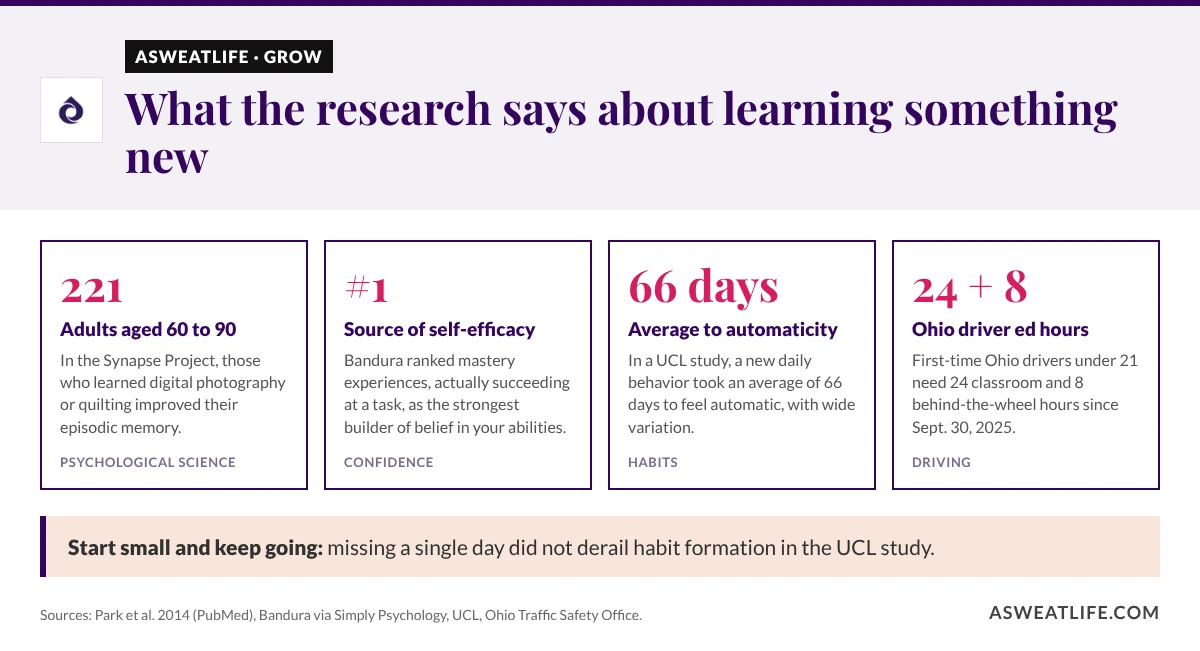
If you feel too old, too busy or too far behind to start something new, learning a new skill is one of the most direct ways to build confidence at any age. In the Synapse Project study of 221 older adults, participants aged 60 to 90 who spent three months learning digital photography or quilting improved their episodic memory.
Below, we cover why mastering something unfamiliar builds self-belief, how to celebrate small wins, how to handle setbacks, which practical skills add independence, and how to turn learning into a lifelong habit.
Why Does Learning a New Skill Build Confidence?
Confidence grows from evidence. Psychologist Albert Bandura described four sources of self-efficacy, your belief that you can succeed at something, and mastery experiences were the strongest of the four. Succeeding at something you couldn’t do before gives you proof you can’t argue with.
That’s why an unfamiliar skill is such a useful tool. Familiar routines feel safe, but they rarely give you new proof of what you can do. Signing up for a dance class with no experience, or finally figuring out the manual settings on a camera, will feel awkward at first. Each session still adds to the evidence.
The Synapse researchers saw a similar pattern with the brain. The groups who learned demanding new skills improved their memory, while groups doing familiar or purely social activities did not show the same gains. Lead researcher Denise Park put it simply: inside your comfort zone, you may be outside the enhancement zone. If your workouts feel stuck in the same loop, our guide to spotting the signs of a fitness rut has ideas for shaking things up.
What Kinds of Skills Can Boost Confidence?
Almost any skill can work, as long as it’s new to you and challenging enough that you can see yourself improve. Here’s how a few common categories compare:
| Skill type | Examples | How it builds confidence | Easy first win |
|---|---|---|---|
| Movement | Dance, climbing, a new sport | You feel progress in your body, from coordination to strength | Finish one full beginner class |
| Creative | Photography, pottery, an instrument | You end up with something you made yourself | Complete one rough piece and keep it |
| Language | Spanish, ASL, Italian | You can use it with real people right away | Introduce yourself out loud |
| Practical | Cooking, driving, budgeting | You handle daily life with less help from others | Make one recipe start to finish |

Hands-on crafts are especially good at this because the results are visible. Our look at the benefits of glass blowing shows how a completely unfamiliar craft can pull your focus into the present moment.
How Do You Celebrate Small Achievements?
Big milestones take months. Small ones happen every week, and they’re where confidence actually gets built. Someone learning to cook might master one simple recipe before trying anything complicated. Someone learning guitar might celebrate the first time they get through a full song without stopping.
The trick is noticing them. Progress is hard to see day to day, so give yourself a way to look back:
- Keep a one-line log after each session about what felt easier than last time.
- Save early attempts, like your first photos, recordings or sketches, so you can compare them later.
- Set milestones you can hit within weeks, such as finishing a beginner course or holding a short conversation.
- Compare yourself with your own starting point instead of with people who have been doing it for years.
Use the planner below to turn the time you actually have into total practice hours and a few milestones to watch for.
Pick the kind of skill you want to learn and how much time you can realistically give it. The planner turns that into total practice hours and three small milestones to track, so progress is easier to see.
Type of skill
Minutes per session
Sessions per week
Weeks you want to plan
Milestones to track
How Do You Stay Patient When Progress Feels Slow?
Mistakes and frustration are part of learning anything new. How you read them makes the difference. If every mistake feels like proof you can’t do it, you’ll quit. If you treat each one as information about what to practice next, setbacks become part of the process.
Someone learning a language, for example, may struggle for weeks with pronunciation or vocabulary. A few minutes of practice each day usually works better than an occasional long session followed by a long break.
Being patient with yourself is a skill too, and it carries over. The same calm approach to a missed note or a botched recipe can help when something goes wrong at work or in a relationship.
Can Practical Skills Make You More Independent?
Some skills pay off every day. Managing your own money, cooking nutritious meals, making basic home repairs or getting around unfamiliar places can all make daily life feel more manageable, and that sense of capability is a big part of confidence.
Driving is a good example. Plenty of adults never learned, or learned long ago and feel anxious behind the wheel. For adults who want to start or rebuild that skill, private driving lessons can provide a more personalized learning experience, because the instructor can adjust the pace and the routes to the student. Lessons in a quiet area before moving to busier roads can make the process feel less overwhelming.
Rules for new drivers vary by state, so check yours before booking. In Ohio, for example:
| Ohio new driver | What’s required | Source |
|---|---|---|
| Under 21 (since Sept. 30, 2025) | A Class D driver training course plus 50 hours of supervised practice for under-21 drivers, including 10 at night | Ohio Traffic Safety Office |
| Class D course | 24 hours of classroom or online instruction and 8 hours of behind-the-wheel training | Ohio Traffic Safety Office |
| 21 and older | No course needed before the first test, but anyone who fails it must take an Ohio abbreviated adult driver training course before retesting | Ohio Traffic Safety Office |
Even when training isn’t required, professional lessons can help an adult learner build skills and confidence before taking the test.
How Does Learning With Other People Help?
Classes, workshops, clubs and online communities put you around people working on the same thing. That makes it easier to ask questions, laugh at mistakes and keep showing up. Connection matters for health too: the U.S. Surgeon General’s 2023 advisory on loneliness and social connection links social isolation with higher risks of heart disease, dementia and depression.
Sharing goals with others also builds accountability. When a class expects you, or a friend is learning alongside you, skipping a session gets harder. Over time, those weekly classmates can turn into real friendships.
How Do You Make Learning a Lifelong Habit?
Start with one realistic goal that fits your schedule. Ten or fifteen minutes a day is enough to begin. Expect it to take a while: in a UCL study, a new daily behavior took an average of 66 days to feel automatic, and the time varied widely from person to person. The researchers also found that missing a single day didn’t derail the process.
Choose something you’re genuinely curious about instead of what’s trending, because enjoyment makes consistency easier. Once one skill sticks, the confidence you’ve built makes the next one less intimidating.
If you want learning to sit alongside your workouts and sleep, our guide to building a wellness routine shows how to stack small habits together.
This article is for general information and isn’t a substitute for advice from a qualified health professional.
Learning a New Skill FAQ
Is it ever too late to learn a new skill?
No. Participants in the Synapse Project were aged 60 to 90, and those who took on demanding new skills improved their memory. Adults of any age can learn, even if the pace differs.
How long does it take to feel more confident?
It varies. Many people notice a lift after their first few small wins, which is why tracking early progress helps. A new routine can take a couple of months to feel automatic.
What’s a good first skill to learn as an adult?
Pick something you’re curious about that gives quick feedback, like a beginner dance or cooking class, a language app paired with real conversation, or a craft workshop.
How much time should I spend practicing?
Short, regular sessions are easier to sustain than occasional long ones. Fifteen to twenty minutes a few times a week is a realistic starting point for most people.