How to Choose a Sports Bra: Support Levels, Sister Sizes, and a Five-Point Fit Check
Match the support level to your workout, pick the right style for your chest, and confirm the size with the five-point fit check breast health researchers use.

If you’ve ever finished a run with sore straps, a band that crept up your back, or the nagging sense that everything was bouncing a little too freely, your sports bra is probably the wrong size, the wrong support level, or both. You’re in good company: somewhere between 70% and 100% of women wear the wrong bra size, and the number on the tag is only the starting point.
Learning how to choose a sports bra comes down to three decisions: the support level your workout needs, the style that suits your chest, and a size you confirm with a fit check (not a tape measure alone). Here’s how to nail each one (spoiler: your favorite bra might not pass), including the five-point fit check researchers at the University of Portsmouth use, plus the signs it’s time to retire a bra you love.
Sports Bra Support Levels: Match the Bra to the Impact
Most brands sell sports bras in three support levels: low (sometimes called light), medium, and high. The level describes how much the bra limits breast movement, and the right one depends on how much bouncing, jumping, and pounding your workout involves.
Pick your hardest regular workout to see which support level to shop for.
The usual split looks like this: High-support bras are built for running, jumping, HIIT, tennis, and basketball, medium support suits cycling, rowing, and strength training, and light support covers Pilates, yoga, and lifting. If you have a larger bust, Nike suggests medium or high support even for low-impact exercise, for the extra compression and coverage.
| Support level | Typical workouts | What to look for |
|---|---|---|
| Low (light) | Yoga, Pilates, lifting | Comfortable fabric and a band that stays put when you twist and fold |
| Medium | Cycling, rowing, strength training | Some compression, a firmer band, and straps that hold through overhead moves |
| High | Running, jumping, HIIT, tennis, basketball | Encapsulation cups, an adjustable underband, wide straps, and a higher neckline |
Your schedule matters here too. If your week mixes a low-impact HIIT workout for your level with a Saturday long run, buy for the hardest session you do (or keep one bra for each). And support is personal: if a high-support bra simply feels better in yoga, wear it.
Compression, Encapsulation, or Combination: Which Sports Bra Style Fits You?
Beyond the support label, sports bras come in three construction styles, and knowing which is which makes the support level easier to judge on a hanger.
- Compression: the classic pullover shelf bra. It presses both breasts down against the chest together. It’s usually the most comfortable choice for low-impact workouts and smaller cup sizes.
- Encapsulation: separate cups that support each breast individually, more like an everyday bra. It’s a strong pick for larger busts.
- Combination: individual cups plus a compression layer, for the most hold during high-impact work.
If you’re shopping for a larger bust or for running, the Research Group in Breast Health lists five features that add support: an encapsulation style, padded cups, nylon fabric, an adjustable underband, and a higher neckline. That last one is easy to overlook. The group found that every 1cm (about 0.4 inch) of extra neckline height cuts breast bounce by about 1%, so a scoop that sits a couple of inches higher does real work.
The adjustable underband earns its place because your ribcage expands as you breathe hard, and a hook-and-eye band lets you loosen or tighten it as the bra (and your training) changes.
Why the Right Sports Bra Changes Your Workout
Fit affects more than comfort. In a survey of UK female athletes, 51% reported breast pain and 29% said a poorly fitting bra hurt their performance. When elite athletes got an individual bra assessment, 17% said it significantly improved their performance, and around 97% of Team GB athletes prescribed a fitted bra reported better comfort, fit, and support.
Low breast support has also been linked to shorter strides, altered breathing, more upper-body effort, and faster fatigue on the treadmill. A University of Memphis study found that greater breast support was associated with lower oxygen consumption and better running economy (translation: the same pace took less energy). If you’re logging miles for a race, that’s one more reason to test your bra during your half marathon training plan and not on race morning.
One honest caveat on “more is better”: a 2025 University of Portsmouth modeling study found that bras that eliminated all breast movement led to higher loads on the spine while running, which could raise the risk of lower back pain. The researchers call it a preliminary, simulation-based result, and the ideal amount of bounce reduction is still being worked out. For now, the takeaway is to aim for a bra that controls movement comfortably, without squeezing so hard that it restricts you.
How to Find Your Sports Bra Size
Start with the brand’s size chart: measure snugly around your ribcage just under your bust for the band and around the fullest part of your bust for the cup, then plan to adjust. Two things trip people up:
- The tape measure isn’t the final word. The traditional tape-measure method has been shown to overestimate band size and underestimate cup size, so a measured size can leave you with a loose band and cramped cups.
- Sizing varies by brand. Dr. Nichola Renwick of the Research Group in Breast Health compares it to jeans: you’d never assume your size in one brand fits the same in another, so try bras on before you commit.
If you wear a band-and-cup size (like 34C), learn your sister sizes: bras that share the same cup volume on a different band. A 34C, 32D, and 36B all hold the same cup volume. That gives you a few quick fixes:
- Band too tight, cups fine: go up a band and down a cup (34C to 36B).
- Band rides up or shifts, cups fine: go down a band and up a cup (34C to 32D).
- Cups feel too full: keep the band and go up a cup.
Sizes like S, M, and L don’t sister size, so the simplest approach is to order your usual size, one size up, and one size down, then keep the one that passes the fit check below. If you’re in extended sizes, it’s worth looking at brands focused on body-positive activewear, since a bigger size run usually means more band-and-cup options.
The Five-Point Sports Bra Fit Check
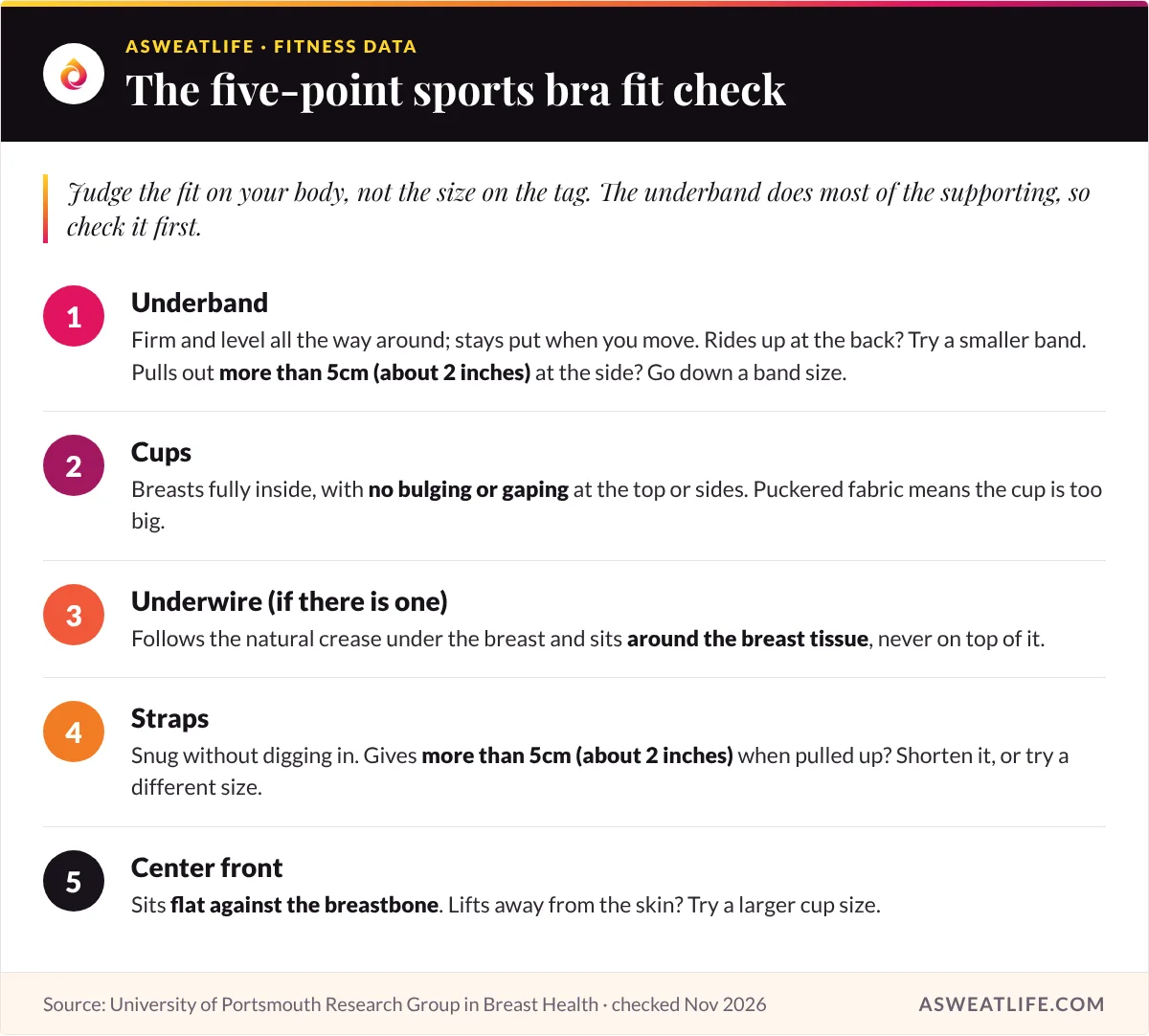
Once you have a bra on, run through the five-point bra fit guide from the University of Portsmouth Breast Health Research Group. It judges how the bra fits your body, so it works whatever the tag says. Do it in front of a mirror.
1. Underband
The underband does most of the supporting, so check it first. It should sit firmly and level all the way around your ribcage, stay put when you move, and still let you breathe deeply without flesh bulging over it. If it rides up at the back, try a smaller band. If you can pull it more than 5cm (about 2 inches) away from your body at the side, go down a band size.
2. Cups
Your breasts should sit fully inside the cups with no bulging or gaping at the top or sides. Spillage means the cup is too small; wrinkled or puckered cup fabric means it’s too big.
3. Underwire (If There Is One)
Plenty of sports bras skip the wire. If yours has one, it should follow the natural crease under your breast and sit around the breast tissue, never on top of it.
4. Straps
Straps should feel comfortable and snug without digging in, and they shouldn’t slip or sag. Pull one up: if it gives more than 5cm (about 2 inches), shorten it. If it still stretches too much at its shortest, try a different size. And if the straps feel like they’re carrying all the weight, the band is probably too loose.
5. Center Front
The center panel between the cups should sit flat against your breastbone. If it lifts away from your skin, try a larger cup size.
Then move. Jog in place, do a few jumping jacks, and reach overhead the way you would in class. If you notice discomfort, the band sliding, or yourself holding back, the bra isn’t the one (or it’s the wrong support level for that workout).
Signs Your Sports Bra Isn’t Supportive Enough
Even a bra that passed the fitting-room test can let you down mid-workout. Watch for these signals:
- Breast pain during exercise, or catching yourself shortening your stride or holding back on jumps.
- Chafing, or a bra that won’t stay in place.
- A band that feels restrictive around your ribcage when you breathe hard.
- Straps doing all the work, leaving red grooves in your shoulders.
Any of these usually means you need a different size, a higher support level, or both. Larger busts in particular may need to move up a level, even for workouts labeled low impact.
How Often Should You Replace a Sports Bra?
Sports bras wear out faster than you’d guess: they start to lose support after about 25 washes, though it varies by brand and fabric. If you work out three or four times a week in the same bra, that’s only a couple of months, which lines up with our guide to when to throw out your workout gear, where a sports bra gets about six months.
The better test is how it feels: once a bra stops feeling supportive during a sweat sesh, it’s done, whatever its age. Rotating two or three bras and cleaning your workout gear gently can help each one last longer. Your next step? Pull out the bra you wear most, run it through the five-point check tonight, and put a replacement on your list if it fails.
Frequently Asked Questions
Should a Sports Bra Feel Tighter Than a Regular Bra?
A sports bra should feel snug, with a firm band that stays level, but it should never stop you from taking a full breath or let flesh bulge over the band. If you can’t breathe deeply, go up a band size and down a cup.
Can I Wear a High-Support Sports Bra for Yoga?
Yes. Support levels are a guide, and people with larger busts often wear medium or high support for low-impact workouts like yoga and Pilates. Pick the bra that keeps you comfortable through the whole flow.
Is My Sports Bra Size the Same as My Everyday Bra Size?
Not always. Sizing varies between brands and styles, so treat your everyday size as a starting point, try the sister sizes either side, and let the five-point fit check decide.
Is It Bad to Wear a Sports Bra All Day?
Breast health researcher Nichola Renwick says there’s no evidence that long-term sports bra use causes damage, and a correctly fitting bra shouldn’t be uncomfortable. If yours leaves you sore by the afternoon, check the fit.
Do I Need a New Sports Bra if I’m Starting Group Fitness Classes?
Match the bra to the class format: a yoga or barre class works in light support, while a bootcamp or HIIT class calls for high support. If you’re nervous about your first fitness class at a new studio, one well-fitting high-support bra covers almost any class on the schedule.