Waiting to Feel Happy Until You Find Your Calling? New Research Says Flip the Order
A two-year study of 303 adults found that happiness predicted a stronger sense of purpose later, while purpose did not predict future happiness. Here's what it means for your goals.


If you’ve been waiting to feel happy until you finally nail down your life’s big mission, new research suggests you might have the order backwards. In a study that followed 303 adults over two years, people who felt happier at the start went on to report a stronger sense of purpose later, while having a purpose did not predict future happiness.
The study, “Purpose and Happiness: A Comparison,” was published in The Journal of Positive Psychology by a team led by George Mason University psychologists Patrick E. McKnight and Todd B. Kashdan. Their results point to a one-way relationship: feeling good may lay the emotional groundwork you need to chase meaningful, long-term goals. Here’s what the researchers did, what they found, and what it could mean for the goals on your list.
What the Happiness and Purpose Study Found
The headline result is about timing. People with higher happiness at the start of the study reported more purpose six months later, and happiness at the six-month mark predicted purpose at the two-year mark. Running the arrow the other way turned up nothing: purpose at baseline did not predict later increases in happiness.
Tap through the results to see which direction held up at each check-in.
That’s why the authors describe the link as one-way. The two experiences didn’t feed each other in a loop. Happiness came first, and purpose followed.
| Direction tested | Baseline to six months | Six months to two years |
|---|---|---|
| Earlier happiness predicting later purpose | Predicted more purpose | Predicted more purpose |
| Earlier purpose predicting later happiness | No link found | No link found |
Both happiness and purpose were fairly stable over the two years, so people who started high tended to stay high, and the two were moderately related to each other at every check-in. Happy people often report purpose and purposeful people are often happy, which is exactly why earlier research that measured people once couldn’t say which came first.
A quick vocab check, since the two words get used interchangeably: in this research, happiness means your overall sense that life is going well, with frequent positive emotions, infrequent negative ones, and high life satisfaction. Purpose means having long-term aims that organize how you spend your time, energy, and resources. You can have one without the other (more on that below).
How the Researchers Tracked Happiness and Purpose
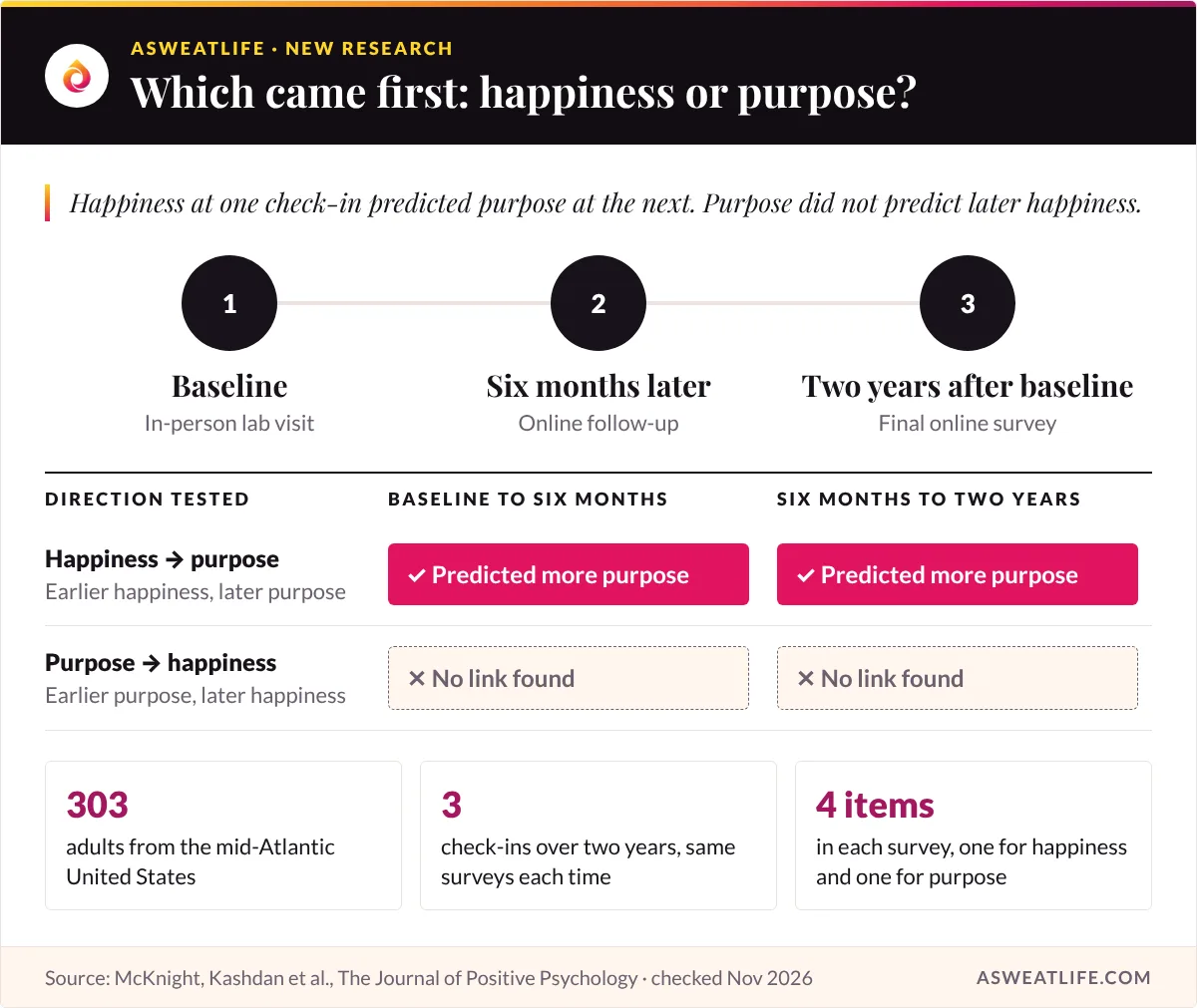
To get at the order, McKnight, Kashdan, and colleagues Amie MacKay, Kerry Kelso, and Madeleine Gross recruited 303 adults from the mid-Atlantic United States and checked in with them three times:
- Baseline: an in-person lab visit
- Six months later: an online follow-up
- Two years after baseline: a final online survey
Participants were mostly women in their early twenties to mid-thirties, and the group was a mix of full-time workers, part-time workers, and students. Everyone answered the same two short surveys each time. The happiness survey had four items asking about overall life satisfaction and whether a person enjoys life regardless of their circumstances. The purpose survey, also four items, asked about the thinking and motivation side of having a life mission, such as whether your future plans match your true interests and values.
Before comparing scores, the team confirmed the questionnaires measured happiness and purpose the same way across the full two years, so a change in someone’s score reflected a real shift and not a quirk of the survey. They then used statistical models to test whether earlier scores predicted later ones, with adjustments for participants who missed a follow-up.
Why Feeling Good Might Come Before Finding a Mission
The researchers’ explanation centers on security. Happiness may give you a sense of psychological safety that makes you more willing to explore, try new things, and take risks, and that experimentation is how many people figure out what their mission is and start working toward it.
That idea fits an older theory in positive psychology. Psychologist Barbara Fredrickson’s broaden-and-build theory holds that positive emotions widen the range of thoughts and actions you consider in the moment, and that wider range builds lasting personal resources over time. A wider view and a bigger stock of resources are handy things to have when you’re deciding what you want your life to be about.
Why Purpose Doesn’t Always Make You Happier
Purpose didn’t boost later happiness, and the authors have a theory about that too. Pursuing a purpose often involves sacrifice, obstacles, and delayed gratification. Training for a marathon, building a business, or caring for a family member can feel deeply meaningful and still be stressful on a random Tuesday, and that stress can drag down short-term contentment.
The authors also suggest that people with a strong purpose may tolerate distress better and see stressors as challenges. That can ease the emotional strain without necessarily nudging overall happiness upward.
Kashdan has been making a version of this argument for a while. In a post he wrote while the study was in press, he said, “Our new research pulls them apart to ask smarter questions.” He points to parents, artists, caretakers, and activists as people who “don’t always feel happy but they’re often brimming with meaning.”
Earlier work found a similar split. In a 2013 survey study, Baumeister and colleagues found that higher stress, worry, and anxiety went with more meaning but less happiness, and that meaning was linked to being a giver while happiness was linked to being a taker.
Limits of the Study and What Comes Next
Like any single study, this one comes with caveats, and the authors spell them out. The sample was regional and mostly well educated, so the pattern may not hold everywhere. Participants were in early to mid-adulthood, a stretch packed with big life transitions. Response rates dropped over the two years, and follow-up participation wasn’t heavily incentivized. Life events the team didn’t measure, such as losing a job or a health problem, could also move happiness and purpose at the same time.
It’s also an observational study, so it shows which experience tends to come first; it can’t prove that one causes the other. (Quick translation: when psychologists say happiness “predicts” purpose, they mean earlier happiness scores forecast later purpose scores, even after accounting for how much purpose a person started with.)
Next, the researchers want to test the pattern in more diverse groups, including teenagers and older adults, and to see whether certain kinds of goals, such as ones focused on helping others, can bring happiness along with purpose.
What the Happiness and Purpose Research Means for Your Goals
If you’ve been treating happiness as the reward you get after you find your calling, this study gives you permission to flip the script. Feeling good may be part of the foundation that helps you explore, take a few risks, and land on goals that matter to you.
You don’t have to force cheerfulness. The small things that lift your mood day to day can count as groundwork for your bigger goals. So what reliably makes you happy on an ordinary weekday? (A sweat sesh with friends absolutely counts.) A few places to start:
- The habits in our five-part happiness training guide, from exercise and sleep to self-compassion
- A one-minute nightly check-in that asks what was the best part of your day
- Ways to find movement that brings you joy, so your workouts lift your mood
- A daily practice for setting your happiness intentions
And if a big goal feels more like a grind than a joy right now, that’s normal: the study’s authors note that purpose often comes with stress and sacrifice. Give yourself grace, and lean on these tips to recommit to your goals when motivation dips. For a look at what a long-haul mission can sound like, listen to Ariana Alejandra Gibson on her life’s mission to end mental health stigma.
If low mood sticks around for weeks, talking with a mental health professional is a smart next step. On the #WeGotGoals podcast, Dr. Jamie Goldstein talked through finding the mental health tools that work for you.