Progressive Overload: How to Keep Building Strength Without a Plateau
Progressive overload means making your workouts a little harder over time. Here are eight ways to do it, how much weight to add, and how to break a plateau.


If your goblet squat has felt exactly the same for two months, your muscles have probably run out of reasons to change. Progressive overload is the fix: you gradually make your training a little harder over time, by adding weight, reps, sets, or control, so your body keeps a reason to get stronger.
The rule of thumb strength scientists have used for years is refreshingly specific. Once you can do one or two reps more than your target on two sessions in a row, add 2 to 10% to the load. Weight is only one lever, though, and on light dumbbells it’s often the clumsiest one. Below, we break down how progressive overload works, eight ways to apply it, exactly how much to add (with a table that turns those percentages into pounds), and what to do when your progress stalls.
What Is Progressive Overload?
Progressive overload means steadily raising the demand you place on your muscles so they have to keep adapting. Your body is efficient: once a workout stops being a challenge, it stops paying you back with new strength. Overload keeps the challenge one small step ahead of what you can already do.
The latest big-picture evidence backs this up. In 2026 the American College of Sports Medicine replaced its 2009 guidance with a position stand built on 137 systematic reviews and more than 30,000 participants. Under the new stand, progression isn’t needed for a routine to do you good, but it’s likely necessary for anyone seeking continued longer-term progress. Quick translation: any new routine will make you stronger for a while, but if you want to still be getting stronger next year, you’ll need to keep nudging the work up.
Progressive overload applies to women in the same way it applies to men. The National Strength and Conditioning Association made that point in 2026 when it updated its female athlete guidance for the first time in 37 years, and we covered why the new NSCA guidelines say women respond to strength training much like men.
Why Your Strength Gains Stall
Plateaus usually have a boring cause: the same weights, for the same reps, on the same days, for months. The 2009 ACSM position stand put it plainly. Nobody can improve at the same rate forever, but adjusting your load, exercises, sets and reps, frequency, and rest periods can limit plateaus.
The other common cause is the opposite problem: adding too much, too fast, without enough recovery. Recovery is part of training, so a plan that piles on weight every week while your sleep and rest days shrink will stall too (and it’s more likely to leave you sore and cranky). The goal of progressive overload is a small, steady push you can recover from.
Eight Ways to Apply Progressive Overload
The 2026 ACSM guidance names several ways to progress: more load, more reps or sets, better movement quality, more speed, or less rest. Here’s how each one looks in an actual workout. Change one at a time so you know what’s working.
1. Add Weight
The classic. Once your target reps start to feel easy, go a little heavier. For strength specifically, the 2026 ACSM review found the biggest gains came from lifting heavier loads (at least 80% of your one-rep max) for two to three sets, at least twice a week, with those lifts at the start of your session. You don’t have to start there; heavy loading is where you build toward.
2. Add Reps
Keep the weight and do one or two more reps each session. This is the easiest lever when the next dumbbell up is a big jump, and research suggests it works almost as well as adding weight (more on that study below).
3. Add Sets
Going from two sets to three raises your total work without touching the weight. Volume matters most for muscle size: the same 2026 review linked growth to at least 10 sets per muscle group per week.
4. Train More Often
If you strength train once a week, a second session is progress in itself. The CDC recommends muscle-strengthening activity on two or more days a week that works all major muscle groups, so two sessions is a smart baseline before you chase more.
5. Use a Bigger Range of Motion
Squatting a little deeper, lowering a pushup all the way to the floor, or pausing at the bottom of a lunge makes the same weight harder. The ACSM review also tied strength gains to training through a complete range of motion.
6. Slow Down the Lowering Phase
Taking three or four seconds to lower the weight adds challenge with zero new equipment. It’s the go-to lever for at-home and bodyweight workouts, and the 2026 review linked eccentric (lowering-phase) overload to muscle growth.
7. Shorten Your Rest
Doing the same work with less rest between sets increases the density of your workout. Use this one sparingly for strength-focused lifts: the 2009 ACSM stand recommends at least two to three minutes of rest for heavy core exercises such as the squat.
8. Choose a Harder Variation
Moving from an incline pushup to a floor pushup, or from a two-legged squat to a split squat, raises the demand without adding a single pound. If you’re building a routine at home, our guide to creating your own strength workout routine at home shows how to structure moves you can scale up.
How Much Weight Should You Add?
The 2009 ACSM guideline gives the clearest answer: when you can do your current weight for one or two reps more than your target on two sessions in a row, increase the load by 2 to 10%. Use the lower end for small-muscle exercises such as biceps curls and lateral raises, and the higher end for big lifts such as squats and deadlifts. A simpler gym-floor version: if you can do at least five more reps on your last set, add 5 pounds.
Type in the weight you lift now to see what 2 to 10% looks like in pounds, and whether your next step up fits.
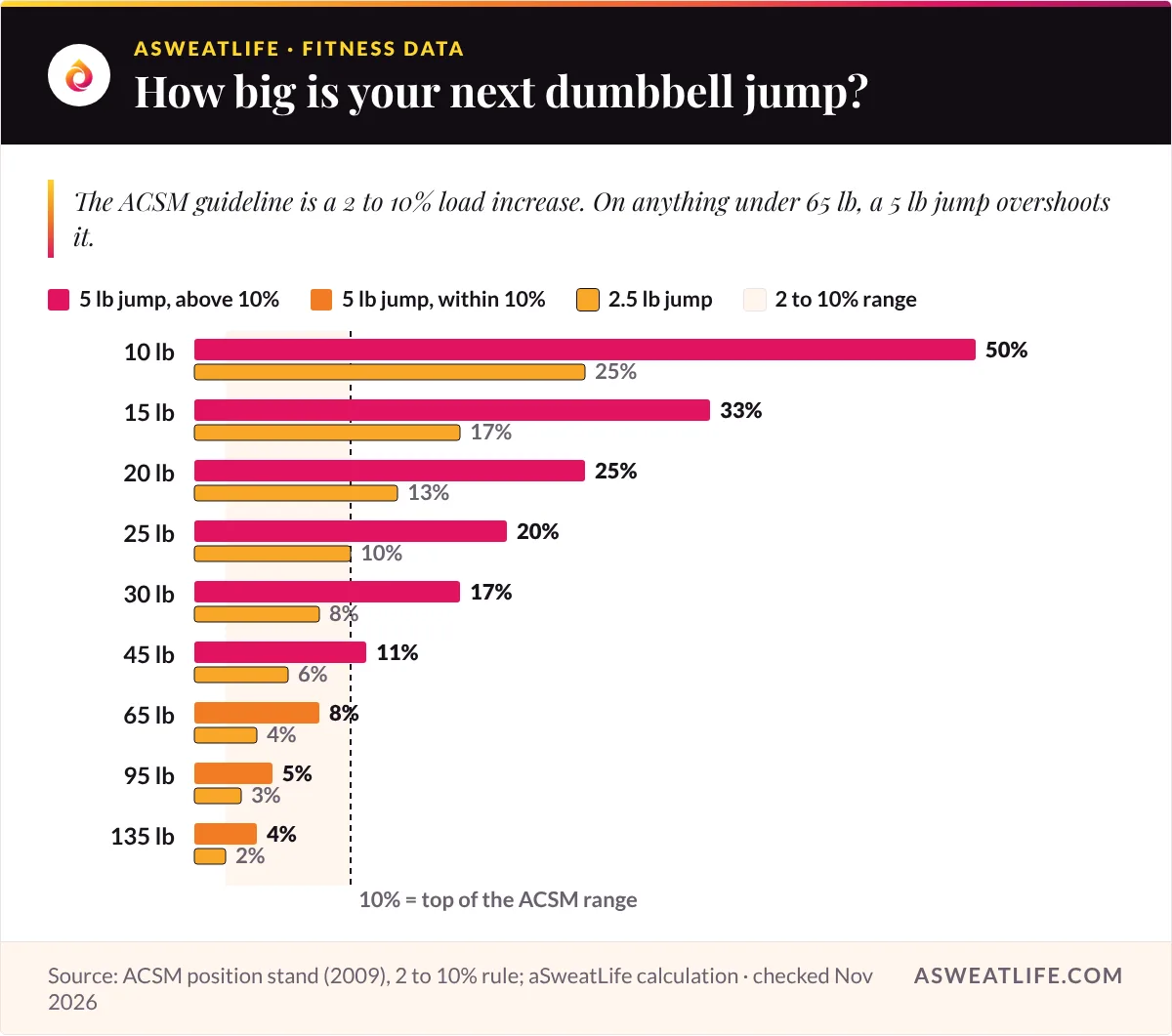
Here’s where light weights get tricky. If the next dumbbell on the rack is 5 pounds heavier, that jump can be far bigger than 2 to 10%. We ran the numbers for common working weights:
| Current weight | 2% increase | 10% increase | A 2.5 lb jump equals | A 5 lb jump equals |
|---|---|---|---|---|
| 10 lb | 0.2 lb | 1 lb | 25% | 50% |
| 15 lb | 0.3 lb | 1.5 lb | 17% | 33% |
| 20 lb | 0.4 lb | 2 lb | 13% | 25% |
| 25 lb | 0.5 lb | 2.5 lb | 10% | 20% |
| 30 lb | 0.6 lb | 3 lb | 8% | 17% |
| 45 lb | 0.9 lb | 4.5 lb | 6% | 11% |
| 65 lb | 1.3 lb | 6.5 lb | 4% | 8% |
| 95 lb | 1.9 lb | 9.5 lb | 3% | 5% |
| 135 lb | 2.7 lb | 13.5 lb | 2% | 4% |
Read the last column before you grab the next dumbbell. Going from 10 to 15 pounds is a 50% jump, five times the top of the ACSM range, which is why a new weight can feel impossible even when you’ve been crushing the old one. Up to 25 pounds, a 5-pound step is at least double the guideline. Once you’re lifting around 65 pounds or more, a 5-pound step falls inside the 2 to 10% window. On lighter weights, add reps first, then make the jump when the extra reps give you a cushion.
A Simple Plan: Double Progression
Double progression is the easiest way to put all of this on autopilot, because you progress reps first and weight second. Pick a rep range, such as 8 to 12, and follow these steps:
- Start light enough that you can do every set at the bottom of the range (8 reps) with good form.
- Add a rep or two each session at the same weight, set by set, until you hit the top of the range (12 reps) on every set.
- Repeat it on a second session. That’s the ACSM’s two-sessions-in-a-row test, and it keeps one good day from fooling you.
- Increase the weight by the smallest jump available, drop back to 8 reps, and climb again.
Research supports leaning on reps. In a 2022 study of 43 trained adults over eight weeks, one group added weight while the other kept the weight and added reps. Both groups got stronger and built muscle, with the weight group’s back squat strength only slightly ahead (an effect size of about 2 kg). The catch: the rep group found sets harder to push to their limit, and the participants were young and already experienced, so adding weight is still the main event over the long run.
If you’re brand new, start with our guide on how to start a strength training routine, then layer in double progression after your first few weeks.
How Hard Should Each Set Feel?
You don’t need to grind every set until you physically can’t move the weight. The 2026 ACSM review found that taking sets to momentary muscular failure does not enhance gains in strength, muscle size, or power.
A more useful gauge is reps in reserve (RIR): how many more reps you could have done when you stopped. It pairs with a 1-to-10 effort scale, where an RPE of 10 means zero reps left and an RPE of 9 means one. Stopping a rep or two short of failure on most sets keeps the effort honest and leaves you fresher for the next one. When the last rep of a set that used to feel like a 9 starts feeling like a 7, that’s your sign to progress.
How to Break a Strength Plateau
Stuck at the same weight for three or four weeks? Run through this list in order:
- Check your log. If you aren’t writing down weights and reps, you can’t tell whether you’re overloading at all. A notes app works fine. It also helps to know how long it takes to see progress in training, so you don’t call a plateau too early.
- Check your recovery. Lingering soreness, poor sleep, and workouts that suddenly feel much harder are some of the signs it’s time to take a rest day.
- Take a deload. A deload is a planned easy stretch. Coaches typically schedule one every four to six weeks for about seven days, cutting reps, sets, or load so fatigue can clear before you push again.
- Pull a different lever. If load has stalled, spend a few weeks adding reps, sets, or a slower tempo, then come back to the weight.
- Change the plan along with the weights. Cycling your training in planned phases is called periodization, and our explainer on why periodization training can help you crush your goals walks through how to set it up. If the whole routine feels stale, these signs you’re in a fitness rut can help you shake it up.
- Fuel the work. Training harder asks more of your plate, and our sample days for eating 100 grams of protein a day make that easier on a busy week.
Progressive Overload Mistakes to Avoid
- Changing everything at once. Heavier weight, more sets, and shorter rest in the same week is a recipe for a bad session. Change one variable at a time so you know what’s working and what’s too much.
- Letting form slide to hit a number. A rep with a rounded back or a half-depth squat doesn’t count as progress. If you can’t finish a set with good form, the weight is too heavy for now.
- Expecting a straight line. Some weeks you’ll add a rep; some weeks you’ll match last week. Matching counts. Over a few months, the trend is what matters. (And if life eats a week of workouts? Pick up a little lighter and climb again.)
- Skipping the boring weeks. Deloads and rest days can feel like lost time, but they’re what let you keep pushing for months.
When to Check With a Professional
Muscle fatigue and next-day soreness are normal. Sharp pain, joint pain that lingers, or pain that changes how you move is a signal to stop that exercise and talk with a doctor or physical therapist. Older adults, particularly those with heart conditions, osteopenia, or osteoporosis, should check with a physical therapist or athletic trainer before starting a progressive overload plan.
Frequently Asked Questions
Does Progressive Overload Work With Bodyweight Exercises?
Yes. Progressive overload with bodyweight training comes from adding reps or sets, slowing the lowering phase, increasing range of motion, shortening rest, or moving to a harder variation such as a split squat or a floor pushup.
Does Progressive Overload Apply to Running and Cardio?
Yes. For running, progressive overload means gradually increasing time, distance, or the share of faster intervals in a workout, one change at a time, the same way you would with weights.
Do You Have to Keep Progressing Forever?
No. The 2026 ACSM position stand notes that progression is necessary only if you want continued longer-term gains, so a steady routine still delivers benefits when you’re short on time or energy.
How Often Should You Strength Train to See Progress?
Two sessions a week is the baseline: it matches the CDC’s minimum for muscle-strengthening activity and the 2026 ACSM finding that strength gains were greater with at least two sessions per week.