Hair Tests for Heavy Metals: Options, Limitations, and Cost
How heavy metal hair tests work, the main types you'll see, their limits, how they compare with blood and urine tests, and what they cost.


If you’ve seen a heavy metal hair test advertised and wondered what it can tell you, the short answer is less than the marketing suggests. Western Australia’s Department of Health says hair levels are not considered a good marker of either exposure or health, and that results should be read with caution.
Below, we cover how hair testing works, the main types of test you’ll see, what they can’t tell you, how hair compares with blood and urine, and what tests cost.
How Does a Hair Test for Heavy Metals Work?
This article is general information only. It doesn’t replace medical advice, and it can’t tell you if you’ve been exposed to a harmful level of any metal. If you’re worried about exposure or have symptoms, speak with a doctor.
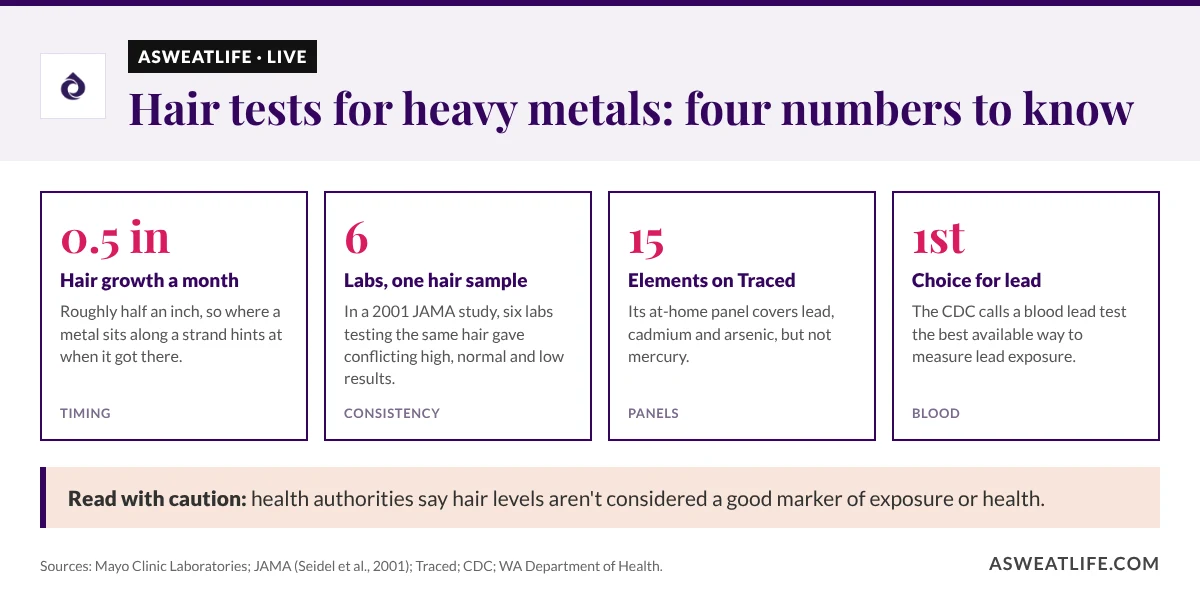
Some elements are taken up into hair as it grows, so a cut strand holds a record of what was present while it formed. Mayo Clinic Laboratories notes that hair grows at approximately half an inch a month, which is why the distance along a strand can hint at timing.
You usually send a small amount of hair cut close to the scalp, and the lab measures elements in it, typically with mass spectrometry. Most tests report one figure per element for the whole sample. A few read along the strand to show change over time.
The catch is that a measurable amount of metal in hair doesn’t translate neatly into an amount in your body, or into a health risk. That gap shapes everything else in this guide.

What Types of Heavy Metal Hair Tests Are There?
Hair tests fall into a few broad groups. They differ in who orders them, how many elements they cover and how results are presented:
| Type | How you get it | What’s reported | Worth knowing |
|---|---|---|---|
| At-home consumer kit | Order online, cut and mail hair yourself | A set panel of elements, often compared with the company’s own database | Usually sold for educational use only |
| Practitioner-ordered broad panel | Through a practitioner, sometimes called hair tissue mineral analysis (HTMA) | Dozens of toxic and nutrient elements, often with mineral ratios | Ratios and nutrient figures aren’t an established way to judge nutritional status |
| Clinical lab test | Ordered by a physician through a hospital or reference lab | A short, targeted list such as arsenic, lead and mercury | Read alongside your history and other tests |
| Walk-in retail test | Hair collected at a testing store | A small panel of toxic metals | Check the exact panel and price locally |
An Example of an At-Home Kit: Traced
Traced sells an at-home heavy metal hair test that you collect yourself and mail to its lab. The company says its test is built on research at Mount Sinai and maps results onto a 30-day timeline, which it presents as a way to connect changes in levels to particular weeks or habits.
Its results are shown as percentiles against Traced’s global reference database. That’s a comparison with other people who’ve tested, and Traced’s own FAQ says these levels are not clinical thresholds and don’t show whether a level is safe for you. Here’s what the company lists at the time of writing (November 2026):
- Sample: at least five strands cut close to the scalp, 1.5 inches or longer
- Panel: 15 elements, including lead, cadmium, arsenic, nickel, barium and aluminum, plus essential elements such as zinc and magnesium; mercury isn’t included
- Results: about 15 business days after the sample reaches the lab
- Price: $299, or $239 per test on a quarterly plan
- Status: described as educational only and not approved by the FDA; wait at least a month after dyeing or chemical treatment before collecting
Clinical Lab Tests
Hospital reference labs offer narrower hair tests that a physician orders. Mayo Clinic Laboratories’ Heavy Metals, Hair (HMHA) test, for example, covers arsenic, lead and mercury, and lists its use as detecting nonacute exposure. The lab notes that its hair tests were developed in-house and haven’t been cleared or approved by the FDA, and that cosmetic products and hair dyes can be a source of contamination.
What Can’t a Hair Test Tell You?
This is the most important part to understand before you order. Hair testing has well-documented limits:
- It doesn’t reliably reflect what’s in your body. A CDC-hosted review of metals testing found that hair results do not reliably represent the levels of metals inside the body and can’t be matched to conventional tests such as blood. The authors don’t recommend hair analysis for judging individual health effects.
- Labs can disagree. In a 2001 study in JAMA, researchers sent split hair from one healthy volunteer to six commercial labs. Their reference ranges varied greatly, giving conflicting high, normal and low readings for nearly every mineral.
- Outside contamination is hard to rule out. Hair picks up metals from dust, water, dyes and styling products, and a lab can’t always separate those from what came from inside the body.
- Mineral and nutrient figures aren’t a nutrition test. In the same JAMA study, labs gave conflicting diet and supplement advice from identical hair. Seeing mineral levels or ratios on a report doesn’t establish a deficiency or tell you what to take.
None of that makes a hair result meaningless. Treat it as a data point to discuss with a professional. It can’t diagnose anything, give you a clean bill of health or justify starting a supplement or a detox plan.
Hair vs. Blood vs. Urine Tests
Health authorities generally point to blood or urine when exposure needs to be measured, with a clinician deciding which test fits the metal and the situation:
| Sample | What it reflects | How it’s usually used |
|---|---|---|
| Blood | What’s circulating now | Recent or ongoing exposure; the CDC calls a blood lead test the best available measure of lead exposure |
| Urine | What the body is clearing | Common for several metals, chosen by a clinician based on the metal |
| Hair | What was present while the hair grew | Research and informational use; results need cautious interpretation |
For lead in particular, the CDC is direct: a blood lead test is the best available way to measure exposure. If you’re weighing a hair test, the guide below can help you decide where to start.
Pick what’s prompting your question and the metal you’re most curious about. The guide suggests a sensible first step and what to check before you order anything. It offers general information only and can’t assess your health.
What’s prompting this?
Main metal of interest
Check before you order
How Much Does a Heavy Metal Hair Test Cost?
Prices vary by type. At the time of writing, Traced lists its kit at $299, or $239 per test on a quarterly plan. Practitioner-ordered panels and clinical lab tests often don’t publish a price, because it depends on the practitioner, the lab and your insurance. Walk-in testing stores usually set prices by location.
Insurance coverage for hair analysis isn’t guaranteed, so check with your insurer before you order. If a clinician recommends blood or urine testing because of a specific exposure, ask how that’s billed too, since it’s handled differently from a consumer kit.
Questions to Ask Before You Order
- Why do I want this test? Curiosity is a different starting point from symptoms or a known exposure, which call for a clinician first.
- Does the panel cover the metal I care about? Panels range from three metals to dozens of elements, and some leave out mercury.
- How are results reported? A percentile against a company database, a lab reference range and a mineral ratio each mean something different, and none is a medical safety limit on its own.
- Is my hair suitable? Recent dye, bleach, perms or heavy product use can affect results.
- What will I do with the result? Know who you’d talk to if something surprises you.
If your interest comes from wanting fewer everyday exposures, it can be just as useful to look at what you use daily, from what goes into your protein or greens powder to how to check workout clothes and gear. And if you’re curious what other body fluids can reveal, see our look at what your sweat can reveal about your health.
When to See a Healthcare Professional First
Skip the home kit and talk to a doctor if you have symptoms you’re worried about, a known exposure at work, at home or through a hobby, or if you’re pregnant or asking on behalf of a child. A clinician can decide whether testing is needed and which sample to use.
Heavy Metal Hair Test FAQ
Can a hair test diagnose heavy metal poisoning?
No. Hair results can’t confirm or rule out poisoning. Diagnosis involves a clinician, your history and usually blood or urine testing.
How accurate are hair tests for heavy metals?
Accuracy is limited. Health authorities say hair levels aren’t considered a good marker of exposure or health, and studies have found different labs giving conflicting results for the same hair.
Can I test my hair for heavy metals at home?
Yes. At-home kits such as Traced let you cut a small sample and mail it to a lab. These are generally sold for educational purposes only.
Can a hair test show mineral deficiencies?
It isn’t an established way to judge nutritional status. Mineral levels and ratios in hair vary between labs, so talk to a clinician or dietitian about standard tests if you’re concerned about a deficiency.
Is a heavy metal hair test the same as HTMA?
Not always. Hair tissue mineral analysis (HTMA) usually reports nutrient minerals and ratios as well as toxic metals, while some heavy metal hair tests cover only a few toxic elements.
How much does a heavy metal hair test cost?
Traced lists its at-home kit at $299 at the time of writing. Practitioner-ordered and clinical tests vary, and insurance coverage isn’t guaranteed.
A heavy metal hair test can be an interesting snapshot, as long as you treat it as information rather than an answer. Check what the panel covers and how results are reported, keep expectations modest, and take any real concern to a healthcare professional.