
How to Talk With Your Partner About Midlife Health Changes
A practical guide to talking with your partner about changing sleep, comfort, intimacy and care needs in midlife, with listening tips and ways to share support.


This article is for general information and doesn’t replace advice from your doctor. If a change worries you or doesn’t ease, talk to a healthcare provider.
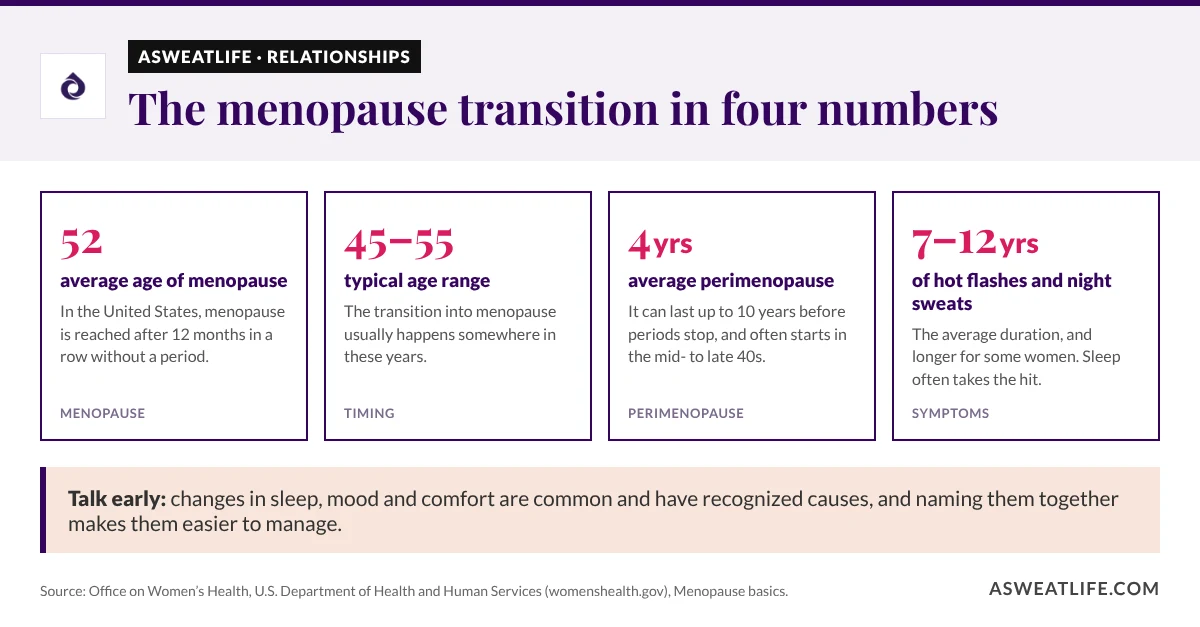
If your sleep, energy or comfort has been shifting and you haven’t found the words to tell your partner, you’re far from alone. Talking with your partner about midlife health changes gets easier once you know how common they are: the Office on Women’s Health says perimenopause lasts about four years on average, and it can run up to ten.
Below, we cover how to get clear on what’s changing, how to choose the moment, how to listen well, how to talk about comfort and intimacy, how to set boundaries, and how to turn understanding into practical support.
What Midlife Health Changes Are Worth Talking About?
Before you talk to your partner, get clear on what you’re actually experiencing. A change you’ve named is much easier to explain than a vague sense that something feels off. Spend a week or two jotting down what you notice in a private note:
- Changes in sleep, energy or mood
- Shifts in physical comfort from day to day
- Moments when intimacy felt different
- Anything you’d like more help with at home
For many women, some of these changes are linked to hormones. The Office on Women’s Health explains that lower levels of estrogen can affect the tissues of the vagina, vulva, bladder and urinary tract, and its list of common symptoms includes hot flashes, trouble sleeping, mood changes, vaginal dryness and pain during sex. Knowing a change has a common, recognized cause can make it far easier to say out loud. Our guide to the role hormones play in aging well goes deeper on the science.
Men go through midlife changes too, and the same approach works for anyone. Write down what you notice before you try to talk about it, so the conversation starts from facts rather than worry.
| What you’ve noticed | A plain way to say it |
|---|---|
| Waking at night, tired by mid-afternoon | “My sleep has changed, and I’m running out of energy earlier in the day.” |
| Shorter fuse or low mood | “I’ve been feeling more on edge lately, and I want you to know it’s not about you.” |
| Discomfort or dryness during sex | “Some things feel different physically, and I’d like us to figure it out together.” |
| Struggling to keep up at home | “I could use more help on my low-energy days.” |

When Is the Right Time to Start the Conversation?
The right moment makes the first conversation much easier. Avoid starting a sensitive talk in bed, during an argument or as one of you is heading out the door. Pick a time when you’re both rested and unhurried, such as a weekend walk or a quiet evening at home.
Side-by-side settings like a walk or a drive can help, because there’s less pressure to hold eye contact while you find the words. Open with something simple and honest: “I’ve noticed some changes lately, and I’d like to talk about them with you.”
You don’t need to cover everything in one go. Treat the first talk as an opening, and agree that either of you can come back to it. If intimacy is part of what’s changed, raise it sooner rather than later: MedlinePlus notes that painful sex may affect your relationship with your partner, and that talking openly with your partner may help.
Agree on a pause phrase either of you can use when a conversation gets to be too much, such as “Can we come back to this tomorrow?” Knowing there’s a gentle way out makes it easier for both of you to start. The planner below can help you pick an opening line and what to agree on before you finish.
Pick what you want to raise, where you’ll talk and what you need from your partner. You’ll get an opening line, a question to ask them, a pause phrase and one small next step.
1. What do you want to talk about?
2. Where will you talk?
3. What do you need most right now?
4. Is this the first time you’re raising it?
Then ask
Agree before you finish
How Can You Listen Well When Your Partner Opens Up?
Listening well matters more than having the right answer. When a partner shares something personal, the instinct is often to reassure or fix it straight away, which can leave them feeling unheard. It works both ways: when your partner responds to what you’ve shared, hear their reaction fully before explaining yourself again. You may both be adjusting at the same time.
Ask Before You Advise
Before offering suggestions, ask what would help most right now. “Do you want ideas, or do you mostly want me to listen?” is a simple question that heads off a lot of frustration.
Reflect Back What You Hear
Repeat what you’ve understood in your own words, such as “So the tiredness is affecting your evenings more than anything else?” It shows you’re paying attention and gives your partner a chance to correct a wrong impression.
Leave Room for Silence
Pauses are normal in a hard conversation. Give your partner time to find their words, and resist filling every silence. Some of the most honest things get said after a long pause.
How Do You Talk About Comfort and Intimacy?
Comfort and intimacy deserve their own conversation, because they’re often the hardest changes to name. Being specific about what feels different helps you both adjust and keeps either of you from quietly drawing the wrong conclusions.
Talk about what has changed and what you’d like to try. Some couples agree to slow down, explore different kinds of closeness or simply talk more openly about what feels good and what doesn’t. If dryness has become part of everyday discomfort, you might mention the options you’re considering, such as NeuEve’s OB-GYN-developed vaginal moisturizer, so your partner understands what you’re trying and why. The brand says it was founded by an OB-GYN and that its products are free of estrogen hormones. Read the ingredient list of any product, and ask your doctor whether it suits your health history.
MedlinePlus advises seeing a provider if dryness, soreness or painful sex continues even after using a water-soluble lubricant. Keep the conversation two-sided, too: ask whether anything has changed for your partner, and listen with the same patience you’d want.
How Do You Set Privacy and Boundaries Around Health?
Privacy still matters inside a close relationship. Sharing a health change with your partner doesn’t mean you’ve agreed to share every detail, or that they can share it with anyone else. Talk openly about where the lines sit:
| Decide together | Example agreement |
|---|---|
| Which details stay between you | “Symptoms and appointments stay between us.” |
| Who else should know | “We’ll tell the kids I’m seeing a doctor, nothing more.” |
| How much to share about appointments | “Tell me the headline; I’ll ask if I want more.” |
| What check-ins feel supportive | “Check in once a week unless I ask for more.” |
| When to revisit | “Let’s check these again in three months.” |
Your boundaries may shift over time, and that’s fine. Revisit your agreements every few months, especially if your health needs change. And if your partner chooses to keep some things to themselves, accept that without pressing.
What Practical Support Can a Partner Offer?
Practical support is what turns understanding into real help. Agree on specific things rather than leaving it at “let me know if you need anything.” Your partner might take on more of the evening routine on low-energy days, help plan meals around better sleep or join you for regular walks. Name one specific task you’d like help with, and say what helps and what doesn’t.
Support can also mean sharing the work of looking after your health, from booking the yearly doctor appointments to keep to following through on what you learn. Some couples find it easier to attend a first wellness consultation together, whether with a primary care doctor or a practice such as The Longevity Centers of America’s in-person Greenville, SC longevity clinic. At any longevity or regenerative clinic, ask which treatments are standard care and which are off-label or investigational; the Greenville clinic’s own page notes that some of its therapies fall into that second group.
Write your shared questions down before any appointment and agree who will ask which ones. Afterward, talk about what you heard while it’s fresh and decide who handles next steps. Strength training and bone health become bigger priorities after 40 too, and our guide to bone health for active women over 40 is a good shared read.
Start this week: write down two or three changes you’ve noticed, pick a calm moment to share one of them, and agree on one small way to support each other before you finish talking.
Midlife Health Conversations FAQ
How do I start talking to my partner about midlife health changes?
Write down the changes you’ve noticed so you can explain them clearly. Then choose a calm, unhurried moment, such as a walk, and open with a simple statement that you’d like to talk.
What if my partner doesn’t react well?
Give it time. Use your pause phrase, agree to come back to it, and remember that your partner may be adjusting to changes of their own.
How can partners respect privacy when discussing health?
Agree together on which details stay between you and whether anyone else should know. Revisit those agreements every few months as your health needs change.
When should I see a doctor about vaginal dryness or painful sex?
MedlinePlus advises contacting your provider if dryness, soreness, burning, itching or painful sex continues after using a water-soluble lubricant.
What practical support can a partner offer in midlife?
Taking on more of the routine on low-energy days, joining you for walks, helping with meals and coming to appointments with written questions are all good places to start.