How Gyms and Fitness Studios Can Build Better Retirement Benefits
A practical guide for gym and studio owners: which coaches a plan can cover, how 401(k), SIMPLE and state IRAs compare, 2026 limits, tax credits and the part-time rule.


Gyms, boutique studios and personal training businesses compete hard for good coaches, and retirement benefits are one of the few perks that can keep them for years. That matters in an industry where, according to the Bureau of Labor Statistics, many fitness trainers and instructors work variable or part-time schedules.
Below you’ll find how to decide who on your team can be covered, which plan types suit a small fitness business, what the 2026 limits and tax credits look like, how state rules and the part-time rule apply, and how to run the plan through payroll and explain it to staff.
Why Do Retirement Benefits Matter for Fitness Businesses?
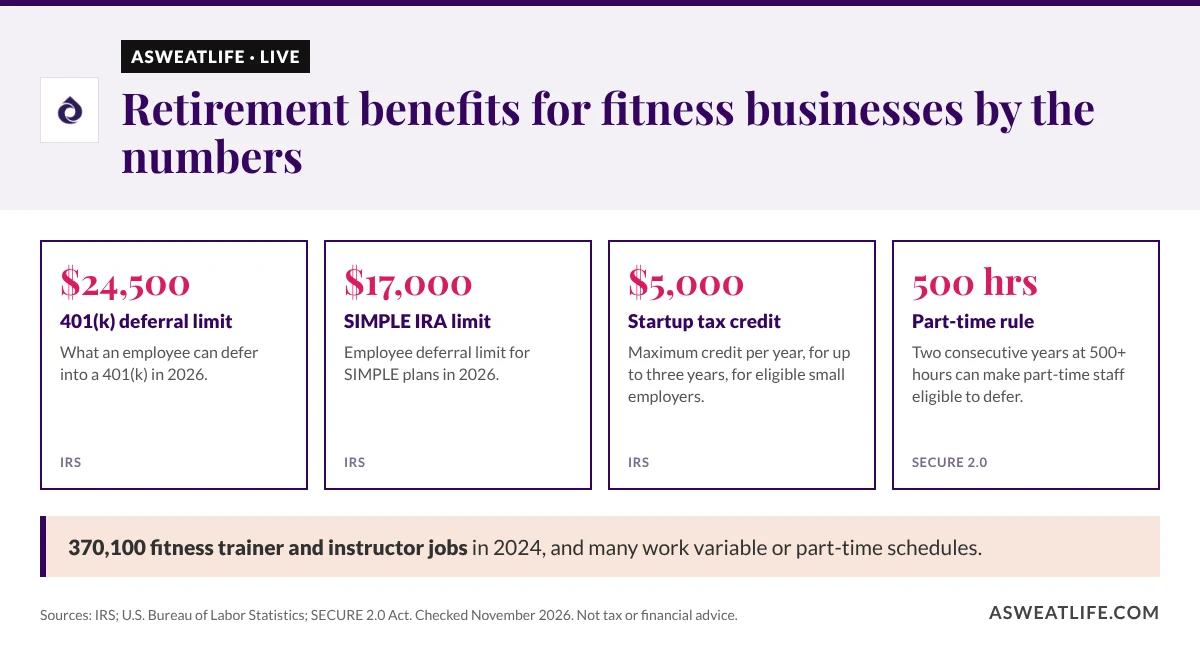
Coaching is a physical job with a long-term question attached. Many trainers and instructors teach early mornings, evenings and weekends, often across several locations, and plenty of them wonder how long they can keep demonstrating burpees and carrying kettlebells. The BLS counted 370,100 fitness trainer and instructor jobs in 2024, with a median annual wage of $46,180 in May 2024.
A workplace retirement plan gives your team a simple way to save through payroll deductions, so they don’t have to remember to move money into an account each month. Employers can also choose to add matching or non-elective contributions, depending on the plan’s rules. Owners can usually take part too, as long as they meet the plan’s eligibility and contribution requirements, which makes this a business decision as much as a staff perk.
A retirement plan won’t replace fair pay, respectful management, reasonable class loads or a healthy studio culture. When it’s affordable and easy to understand, though, it can round out the package that keeps your best coaches from leaving for the gym down the street.
This article is general information and isn’t tax, legal or financial advice. Rules and limits change, so check the details for your business with a qualified tax professional or benefits adviser.
Which of Your Coaches Can a Plan Actually Cover?
This is the first question for most studios, because fitness businesses often mix employees with independent contractors. A 401(k) or SIMPLE IRA covers your employees. Instructors who are genuinely independent contractors aren’t part of your plan, though they can set up their own retirement accounts, such as a SEP IRA or a one-participant 401(k).
Calling someone a contractor doesn’t make them one. The IRS looks at the whole relationship, including how much control the business has over when, where and how the work is done. If you set class schedules, require your programming and uniforms, and the coach can’t make a profit or loss, that points toward employee status. Getting this right matters before you design a plan, because misclassification can create tax problems as well as benefit gaps.
- List every coach, front-desk staffer and manager, and note how each is paid today.
- Flag anyone whose classification looks uncertain, and review it with a tax professional.
- Note typical weekly hours, since part-time eligibility rules depend on hours worked.

Which Retirement Plan Fits a Gym or Studio?
The best plan isn’t automatically the one with the lowest setup cost. Compare contribution rules, employer commitments, reporting work and the support you’ll need before choosing.
| Plan type | Employee deferrals (2026) | Employer role | Often suits |
|---|---|---|---|
| 401(k) | Up to $24,500, plus catch-up for ages 50+ | Optional match or non-elective contributions, depending on design | Studios and gyms that want flexibility, Roth options and automatic enrollment |
| SIMPLE IRA | Up to $17,000, plus catch-up for ages 50+ | Required matching or non-elective contributions | Small studios that want lower admin work |
| SEP IRA | None (employer-funded only) | Employer contributes a percentage of pay for eligible staff | Owner-only businesses or owners with very few employees |
| State-facilitated IRA | Lower IRA limits; payroll deduction | Facilitate payroll deductions; no employer contribution | Businesses in states with a mandate that don’t want their own plan yet |

For 2026, the IRS raised the 401(k) deferral limit to $24,500, up from $23,500 in 2025. Workers aged 50 and over can generally add a catch-up contribution of $8,000, and those aged 60 to 63 have a higher catch-up limit of $11,250. The SIMPLE plan deferral limit is $17,000 for 2026.
The IRS page on annual 401(k) contribution limits also covers catch-up provisions for older participants, and the amounts can change each year, so check them before each enrollment season.
What Will a Plan Cost, and What Tax Credits Help?
Look past the advertised setup price. Total costs can include recordkeeping, investment expenses, payroll integration, compliance support, employee education and any employer contributions you choose to make.
Small employers can offset part of that cost. Under the IRS retirement plan startup costs tax credit, eligible employers with 50 or fewer employees can claim a credit of 100% of eligible startup costs, capped at up to $5,000 a year, for three years. There are related credits for automatic enrollment and for employer contributions, each with its own rules.
| Credit | Who it’s for | Amount |
|---|---|---|
| Startup costs credit | Eligible employers starting a SEP, SIMPLE IRA or qualified plan such as a 401(k) | Up to $5,000 a year for 3 years (100% of eligible costs with 50 or fewer employees) |
| Automatic enrollment credit | Eligible employers adding auto-enrollment | Up to $500 a year for 3 years |
| Employer contribution credit | Eligible employers with up to 50 employees (phased out for 51 to 100) | Up to $1,000 per eligible employee in the early plan years |
Eligibility depends on factors such as how many employees earned at least $5,000 and any plan you’ve sponsored in the past few years. A tax professional can confirm which credits your business qualifies for.
Before you sign, run through this cost checklist:
- One-time setup and conversion costs
- Recurring administrative and recordkeeping fees
- Investment-related expenses inside the funds
- Estimated employer contributions at different participation levels
- How fees are disclosed to the business and to participants
Do Part-Time Instructors Have to Be Included?
Often, eventually. Under SECURE 2.0, starting with 2025 plan years, a 401(k) generally must let long-term part-time employees make their own salary deferrals once they’ve worked at least 500 hours in each of two consecutive 12-month periods and reached age 21.
500 hours a year is roughly 10 hours a week, which many regular instructors reach. Track hours for everyone on payroll from day one, including coaches who teach only a few classes, so you know when someone becomes eligible. The rule covers employee deferrals; whether part-time staff get employer contributions depends on your plan design.
What State Retirement Rules Apply to Your Studio?
A growing number of states require employers that don’t offer a qualifying plan to register with a state-run savings program, usually an automatic payroll-deduction IRA. California’s CalSavers, for example, now covers employers with one or more employees, and Illinois Secure Choice applies to businesses with five or more employees.
Rules depend on where your employees work, how many you have and how long you’ve been in business. Check the relevant state agency before you launch, and again when you open a second location in another state. Keep records of registration, exemptions, employee notices and payroll activity, because state requirements change.
How Do You Make Enrollment Easy for Busy Coaches?
Coaches spend their days on the studio floor, and few have time to read a thick benefits packet. Plan design can make joining feel simple:
- Automatic enrollment, with a clear opt-out process
- Automatic annual contribution increases
- Traditional and Roth contribution options
- A short list of understandable investment choices
- Clear eligibility rules for part-time staff
- Vesting rules for any employer contributions
Automatic features shouldn’t replace communication. Employees still need the required notices, should understand how deductions affect their pay and need to know how to change their contribution rate or investments.
How Should the Plan Connect With Payroll?
Fitness payroll can be messy: hourly class rates, per-session training pay, commissions on memberships and packages, and staff who teach at more than one location. Your retirement plan needs a reliable process for recording elections, applying deductions, sending contributions on time, fixing errors and answering questions.
When you compare providers of employer retirement plan services, ask how their system handles variable pay, new hires, bonuses, leave, terminations and retroactive adjustments. Test the workflow before the first deduction runs, and decide who on your team owns each step.
The U.S. Department of Labor’s guide to retirement solutions for small businesses lays out how common arrangements compare and what each one asks of the employer day to day.
How Do You Explain the Plan to Your Team?
People use benefits they understand. Announce the plan before enrollment opens, explain eligibility in plain terms and show what a contribution looks like in a real paycheck.
For example, an instructor earning $1,500 a month who contributes 3% would put $45 a month, or $540 a year, into the plan. At 5%, that’s $75 a month, or $900 a year, before any employer contribution. Explain pre-tax and Roth options without assuming anyone knows the jargon.
Repeat the message at onboarding, after the first payroll deduction and during annual benefit reviews. A two-minute chat after a team training session can do more than a long document. If your team is interested in money basics more broadly, our article on smart money moves every woman should make is an easy starting point, and our look at the wellness benefit with the biggest impact covers other perks worth considering.
What Mistakes Should Fitness Business Owners Avoid?
- Choosing a plan before comparing total fees and employer obligations
- Treating coaches as contractors without checking the classification rules
- Overlooking state registration or exemption requirements
- Not tracking part-time hours, then missing the long-term part-time rule
- Assuming enrollment means employees understand the benefit
- Missing deposit deadlines or failing to fix errors promptly
- Neglecting plan documents and annual compliance as the business grows
What Is a Simple Action Plan to Get Started?
- Review your team. Confirm who is an employee, their typical hours and your budget.
- Compare plan types. Weigh flexibility, cost, admin work and employer commitments.
- Check tax credits and state rules. Confirm incentives, deadlines and obligations.
- Build the payroll process. Assign responsibility for elections, deductions, deposits and corrections.
- Prepare staff communication. Use short explanations and paycheck examples.
- Review every year. Reassess participation, costs, staffing changes and compliance.
Owners benefit too. Building your own savings while you run a physical, demanding business is part of planning for the day you step back from teaching. For a wider view of long-term planning, read our piece on how early retirement can work.
Frequently Asked Questions
Can a small gym or studio offer a 401(k)?
Yes. Small businesses can sponsor a 401(k), and eligible employers with 50 or fewer employees may claim tax credits that offset startup costs for the first three years.
Can independent contractor instructors join my studio’s retirement plan?
No. Workplace plans such as a 401(k) or SIMPLE IRA cover employees. Genuine independent contractors can open their own accounts, such as a SEP IRA or a one-participant 401(k).
What is the 401(k) contribution limit for 2026?
Employees can defer up to $24,500 in 2026. Workers aged 50 and over can generally add $8,000 in catch-up contributions, and those aged 60 to 63 can add up to $11,250.
Do part-time fitness instructors qualify for a 401(k)?
Under SECURE 2.0, a 401(k) generally must let part-time employees defer once they’ve worked at least 500 hours in each of two consecutive years and are at least 21.
What is the cheapest retirement plan for a small studio?
It depends on your team and budget. SIMPLE IRAs and state-facilitated IRAs usually involve less administration, while a 401(k) offers more flexibility. Compare total costs, including employer contributions, before deciding.