Hybrid Mattresses for Heavier Sleepers: Support and Durability Guide
How heavier sleepers can choose a hybrid mattress that lasts, from support and zoning to weight limits, warranty terms, edge support and bed frame capacity.


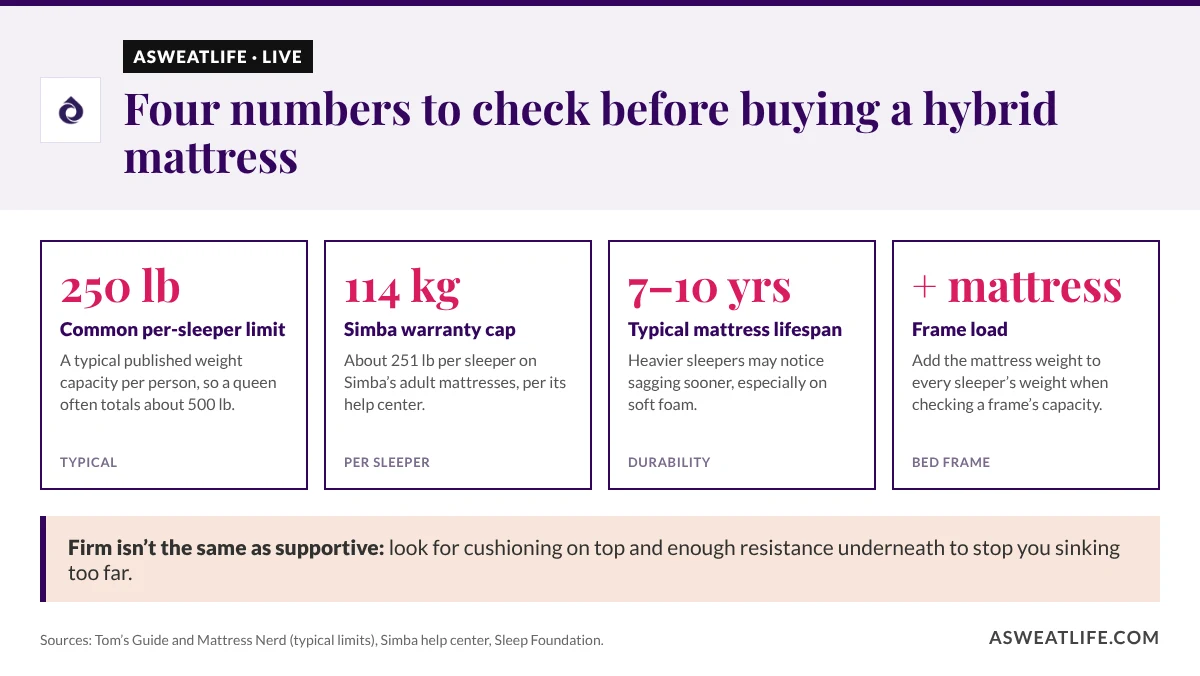
If you’re a heavier sleeper shopping for a hybrid mattress, the spec that matters most is often the one brands bury: the weight limit. Many mattresses are rated for about 250 pounds per person, so a bed that feels firm to a lighter partner can feel noticeably softer, and wear faster, under more weight.
Below, we cover the difference between firmness and support, what to look for in springs, zoning and comfort layers, why weight limits and warranties deserve a close read, and how to check edge support and your bed frame.
What Is the Difference Between Firmness and Support?
It’s tempting to assume a heavier sleeper should simply buy the firmest mattress available. But firmness describes how the surface feels, while support describes how well the mattress spreads your weight and keeps your spine in a comfortable position.
A very firm surface can push back hard and still feel uncomfortable at the shoulders and hips. A mattress with softer comfort layers can still be supportive if what sits underneath is built for the load. The goal is cushioning on top without sinking too far, which is why hybrid construction, with separate comfort and support layers, is worth a look.
Good sleep is a big part of recovery from training, and your mattress plays into that. Our look at sleep and mental health covers why consistent rest matters beyond feeling less tired.
What Should You Look for in a Hybrid Mattress?
Here’s what each part of a hybrid does and what to check when you’re a heavier sleeper:
| Feature | What it does | What to check |
|---|---|---|
| Pocket springs | Compress independently, so heavier areas sink more without dragging the rest | The manufacturer’s weight guidance; spring count alone tells you little |
| Zoned support | Changes firmness across sections, often firmer under the hips and torso | A clear explanation of how many zones there are and where they sit |
| Comfort layers | Cushion the body before you reach the firmer support below | Foam density or durability testing, since foam softens with repeated compression |
| Edge reinforcement | Keeps the perimeter stable when you sit on the side | How the edge feels when you sit or lie near it |
| Weight limit and warranty | Sets the capacity the brand stands behind | Whether the limit is per sleeper or for the whole mattress |
Pocket Springs
Most hybrids use pocket springs that move independently, so the mattress can respond more under your hips and torso than under your legs. A higher spring count isn’t automatically more supportive or more durable, though. Spring design, gauge, the surrounding materials and the brand’s weight guidance all matter more than the headline number.
Zoned Support
Zoned systems vary the springs or foam across the mattress, often adding resistance under the pelvis and more give at the shoulders. Terms like five-zone or seven-zone are a starting point, but look for a plain explanation of what each zone does rather than relying on the label.
Comfort Layers
Comfort layers decide how far you sink before you meet firmer support, and they need to stay resilient over years of compression. Hybrids combine foam, microsprings and natural fibers in different ways. Simba, a UK-based brand, uses Aerocoil microsprings across its hybrid range, with some models adding wool and other natural fibers on top. Its hybrid mattress constructions with multiple comfort layers range from a 1,000-spring, four-layer model up to an 11-layer model with more than 8,000 springs.
For a heavier sleeper, the useful question is how a mattress performs under your weight. The number of materials on the spec sheet tells you much less.
Why Should You Check the Weight Limit First?
Check this before anything else, especially when buying online. Some brands publish a maximum weight, often tied to warranty cover, and it matters whether that figure applies per sleeper or to the whole mattress.
Simba is a useful example of why to read the terms. Its help center says its 10-year warranty covers a maximum of 18 stone (114kg) per sleeper on adult mattresses, which is about 251 pounds. If you’re above a brand’s stated limit, contact them before buying and ask how it affects both performance and the guarantee. A mattress with a published capacity that fits you matters more than materials or firmness that sound right on paper.
Enter your numbers below to see where you stand on both the mattress and the bed frame.
Enter the weights in pounds and the limits from the mattress and bed frame specs. The checker shows how much headroom you have on each, so you know what to ask the manufacturer before you buy.
Your weight (lb)
Partner’s weight (lb, leave blank if none)
Mattress limit per sleeper (lb)
Mattress weight (lb, from the spec)
Bed frame weight capacity (lb)
What to do next
How Do You Test Edge Support?
Edge support is easy to overlook, but sitting on the side of the bed concentrates a lot of pressure on a small area. If the perimeter compresses too much, getting in and out of bed can feel unstable, and two people may end up drifting toward the middle.
Some hybrids add reinforcement around the edge. If you can try a mattress in person, sit on the edge as well as lying in the center, then roll toward the side and see whether the support feels consistent.
How Long Will a Mattress Last for a Heavier Sleeper?
Most mattresses last between 7 and 10 years, but heavier sleepers may notice sagging sooner, particularly on soft foam layers. Repeated compression of comfort layers and springs gradually changes how a mattress feels.
Read the warranty for what it covers before you buy:
| Warranty term | What to look for |
|---|---|
| Weight limit | Whether it applies per sleeper or to the whole mattress, and what happens above it |
| Sagging threshold | How deep an indentation must be before it counts as a defect |
| Foundation rules | Which bases or frames you must use to keep cover valid |
| Length and proration | Whether cover is full for the whole term or reduces over time |
| Exclusions | Stains, misuse or damage the warranty won’t cover |
A long guarantee is reassuring only if you understand exactly what it promises. Independent durability testing, where it exists, is another way to judge long-term performance beyond first impressions in a showroom.
Does Your Bed Frame Need a Higher Capacity?
Yes, potentially. The frame has its own limit, and it needs to carry the sleepers plus the mattress. Mattress Nerd recommends a frame rated above the combined load, meaning the weight of everyone in the bed plus the mattress itself.
Larger beds may need extra center supports or legs, particularly on slatted bases, and slats should be close enough together to support the mattress evenly. A weak frame can undermine a good mattress, so treat the two as one purchase.
Changing your sleep setup is a good moment to look at the rest of your evening routine too. Our guides to fitting coffee into your training day without losing sleep and to building a wellness routine from small habits pair well with a new mattress.
Hybrid Mattress FAQ
Are hybrid mattresses good for heavier people?
They can be, when the springs and comfort layers are built for the sleeper’s weight. Choose a model whose published weight guidance covers you and that has solid support underneath.
Do heavier sleepers need an extra-firm mattress?
Not automatically. Pressure relief matters alongside support, and a very firm mattress can feel uncomfortable at the shoulders and hips. Body weight, sleeping position and construction all play a part.
Is a thicker mattress better for heavier sleepers?
Thickness alone doesn’t make a mattress suitable. A deeper mattress may have more layers, but the quality and density of those materials matter more than the total depth.
Does body weight affect a mattress warranty?
It can. Some brands set a maximum weight for warranty eligibility, so read the terms and ask the manufacturer if you’re above the stated limit.