Exercise Physiologist Urges Lifters to Move First and Stretch Later in Winter
Holding static stretches for more than 60 seconds per muscle group before training can temporarily cut strength and power by about 4% to 7.5%. Here's the warmup to do first when it's cold.


If your winter workouts start with a long hamstring hold on a cold garage floor, it might be time to switch up the order. Exercise physiologist Courtney Smith is warning that static stretching does little for a cold body before training, and the research behind her advice shows that holding a stretch for more than 60 seconds per muscle group can temporarily cut strength and power by about 4% to 7.5%.
It’s the latest turn in a long-running debate over what counts as a proper warmup before a workout. The answer from Smith and the science is refreshingly simple: move first, keep any pre-workout holds short, and save the long stretches for after you train, especially when it’s below 45 degrees outside.
What the Expert Is Warning About Cold-Weather Stretching
Smith, a registered dietitian and certified personal trainer with a master’s degree in exercise physiology, told Men’s Journal that static stretching is “not dangerous on its own, but it does not do what a cold body needs before a workout.”
“Holding a stretch does not raise your muscle temperature or get blood flowing like a dynamic stretch does, so in sub-45-degree weather, you are still starting your workout with cold, stiff muscles,” Smith said.
Her fix is about sequence. “Warm up with movement first, and save static stretching for after your workout,” she said. That applies most to heavy lifting in a chilly space, like squats in an unheated garage gym this winter, where you’d be asking cold muscles for maximum effort straight away.
What the 2019 Review Found About Static Stretching and Strength
The strength figures come from a 2019 review in Frontiers in Physiology by Helmi Chaabene, David Behm, Yassine Negra and Urs Granacher, which pulled together years of stretching studies to clear up how much a pre-workout hold costs you. The deciding factor was how long each muscle group stays in the stretch.
Toggle between hold length and recovery time to see how the strength cost of a static stretch changes.
- 60 seconds or less per muscle group: a trivial dip of about 1% to 2% in strength and power.
- More than 60 seconds per muscle group: a substantial, practically relevant drop of about 4.0% to 7.5%.
- Extreme protocols: in a 2000 study the review cites, participants spent 30 minutes under stretch (13 sets of 135 seconds), and their maximal isometric strength fell 28% immediately afterward.
Nobody does 30 minutes of stretching before a lift (we hope), but that older study shows how the effect fades. Strength was still 21% lower five minutes later and 9% lower after 60 minutes. The loss is temporary, though it lasts well beyond the few minutes between a stretch and your first working set.
Why Cold Muscles Need Movement First
Temperature is the other half of the story. During short bouts of exercise, performance improves by 2% to 5% for every 1°C rise in muscle temperature, and cold conditions change the nerve signals that drive a muscle to contract.
That is why Smith singles out cold weather. A static hold keeps you still, so your muscles stay roughly as cold as when you started, while movement raises muscle temperature and gets blood flowing before you ask for strength or speed.
Is Static Stretching Before a Workout Ever OK?
Short holds are fine for most people. The 2019 review argues that the old advice to skip stretching entirely before strength and power work needs updating: holds of 60 seconds or less per muscle group, done inside a full warmup that also includes aerobic and dynamic activity, cost very little. The authors add that those short holds may even lower the risk of muscle and tendon injuries in sprinting and change-of-direction sports.
They flag one group for extra caution: high-performance athletes right before competition, where even a 1% to 2% dip can affect results. For the rest of us chasing a new deadlift number or a winter 10K, the takeaway is permission. A brief stretch on a tight spot inside a moving warmup is fine; a long, still stretching session before heavy lifting is the habit to drop.
What a Proper Warmup Before a Cold-Weather Workout Looks Like
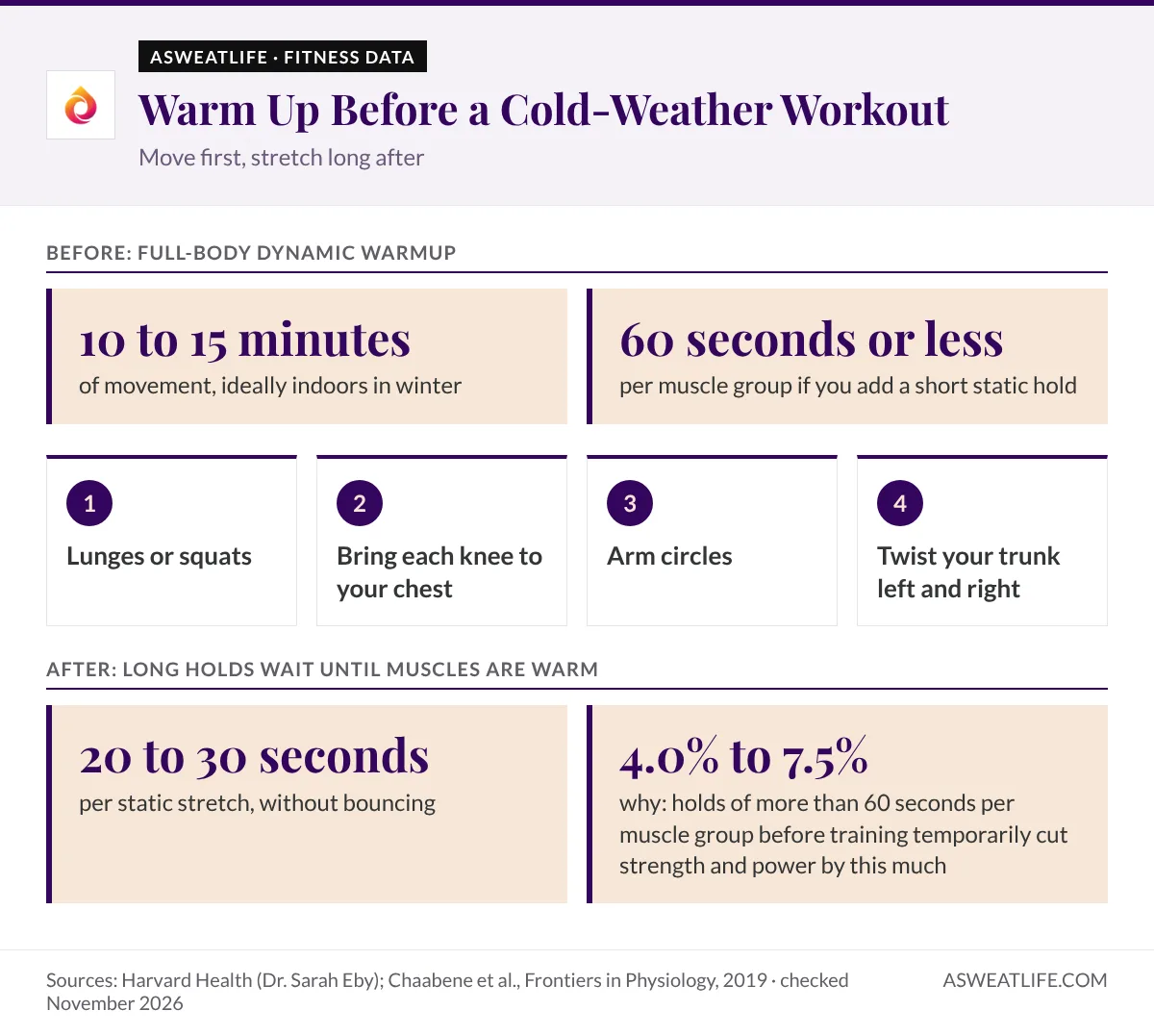
Cold weather pulls blood toward your core and away from your arms and legs, and muscles with less oxygen are stiffer, work less well and tire easily. Sarah Eby, a sports medicine physician at Massachusetts General Hospital, recommends a full-body dynamic warmup of about 10 to 15 minutes, ideally done indoors in winter.
- Do lunges or squats.
- Bring each knee to your chest.
- Make circles with your arms.
- Twist your trunk left and right.
- After the workout, while your muscles are warm, hold static stretches for 20 to 30 seconds each, without bouncing.
Eby’s routine matches Smith’s order: movement before the workout, longer holds after it. If your training plan takes you outside this season, here’s how to become an all-weather runner this winter, and our picks of the best outerwear for every workout can keep you warm from your first lunge to your last stretch. On days the cold wins, these online workouts so you can skip the cold weather keep your routine going indoors.
Your next step is a small one: at your next cold-morning session, swap the long pre-lift hamstring hold for 10 minutes of lunges, knee hugs, arm circles and trunk twists, then give that hamstring its stretch once you’re done.
This article is for educational purposes and does not replace advice from a doctor, registered dietitian or qualified trainer.