
Your BMI Leaves Out Where Fat Sits, and a Study of 4.2 Million Adults Shows Why That Matters
A study of 4,258,033 adults found visceral fat and blood sugar measures flagged heart disease and diabetes risk better than BMI, but no single number did it all.


If your yearly physical still sums up your health with height, weight and a BMI, a very large new study suggests it may be time to look beyond the scale. Researchers who followed 4,258,033 adults in China found that measures of where fat is stored and how the body handles blood fats and sugar flagged heart disease and diabetes risk better than body size alone, though no single number did the job well by itself.
The nationwide cohort study published online in Science Bulletin on October 11, 2026, compared 15 body shape, visceral fat and metabolic measures against four major chronic diseases. Here’s what it found, where its limits are and what you might bring up at your next appointment.
What the 4.2 Million-Person Study Found
The team, based at Fuwai Hospital’s National Clinical Research Center of Cardiovascular Diseases in Beijing, used data from the ChinaHEART cohort, which enrolled adults aged 35 to 75 across all 31 provinces of the Chinese mainland between November 2014 and December 2023. Participants were followed for a median of 4.9 years, more than 20 million person-years in total.
Over that stretch, the researchers counted deaths or first hospital stays from four conditions: 329,073 cardiovascular disease events, 113,373 cancer events, 71,925 diabetes events and 38,674 chronic obstructive pulmonary disease (COPD) events.
So what did they find? Higher values on most measures went along with higher risk of cardiovascular disease and diabetes, and the measures that reflect visceral fat and insulin resistance predicted those two conditions more accurately than BMI or body shape did. For cancer and COPD, the links were weaker and messier, with some measures showing nonlinear or even inverse patterns.
The 15 Measures the Researchers Compared
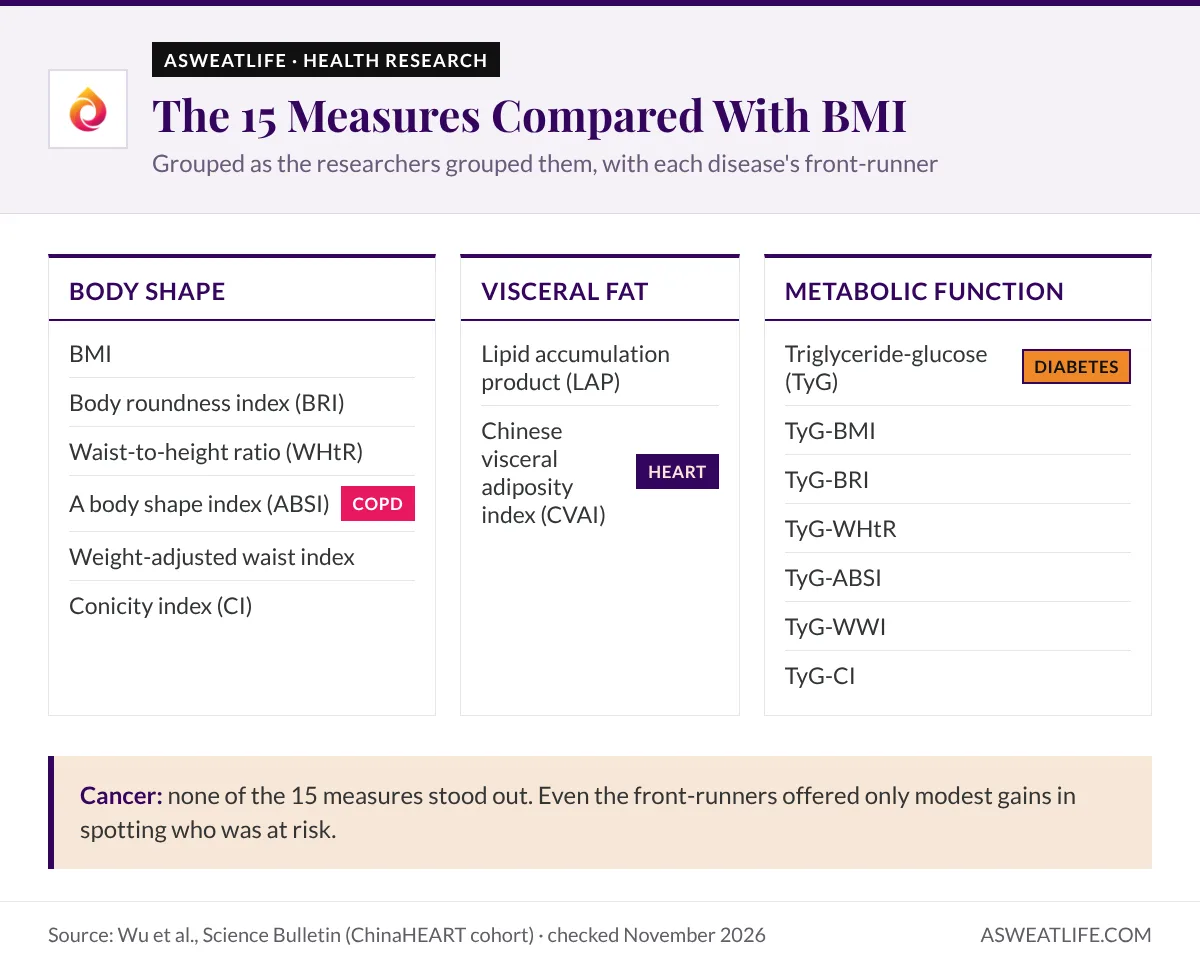
The paper sorted its 15 indices into three groups:
- Body shape: BMI, body roundness index (BRI), waist-to-height ratio (WHtR), a body shape index (ABSI), weight-adjusted waist index (WWI) and conicity index (CI).
- Visceral fat: lipid accumulation product (LAP) and the Chinese visceral adiposity index (CVAI).
- Metabolic function: the triglyceride-glucose index (TyG), plus TyG paired with each body shape measure: TyG-BMI, TyG-BRI, TyG-WHtR, TyG-ABSI, TyG-WWI and TyG-CI.
Visceral fat is the fat stored around the organs in your abdomen, which a scale can’t see. TyG combines triglyceride and blood sugar levels into one number, and the authors use it as a marker of insulin resistance.
Which Measure Worked Best for Each Disease
No single measure came out on top for everything. Each disease had a different front-runner:
Pick a disease to see which measure came out ahead and how many events the researchers recorded for it.
- Cardiovascular disease: CVAI, the visceral fat index, showed relatively higher discrimination than the other 14.
- Diabetes: TyG, the triglyceride and blood sugar measure, did best.
- COPD: ABSI, one of the body shape measures, did relatively better.
- Cancer: all 15 measures had limited ability to separate higher-risk from lower-risk people.
“Relatively” is doing a lot of work there. Even the best performers offered only modest improvements in identifying who was at risk, and none could reliably predict who would go on to develop a disease. The authors describe the 15 measures as complementary risk markers that belong alongside other clinical information, and they don’t present any of them as a way to diagnose or predict disease on its own.
Why BMI Alone Can Miss Part of the Picture
BMI is your weight relative to your height. It does not distinguish between fat, muscle and bone, and it doesn’t show where in the body fat is carried, which is exactly the gap this study set out to measure. The CDC still describes BMI as a quick, safe and reliable screening measure, one that should be considered with other factors for any individual.
The new results fit with a January 2025 shift in how experts define obesity. A Lancet Diabetes & Endocrinology commission recommended using BMI only as a surrogate measure of health risk at the population level and for screening, with excess body fat confirmed by direct measurement or at least one other measure, such as waist circumference, waist-to-hip ratio or waist-to-height ratio.
The ChinaHEART authors land in a similar place: decisions about weight management should be guided by an assessment of actual health risk, with body weight and body shape as only part of that assessment, and obesity definitions may need tailoring for different population groups.
What the Study Can’t Tell You
The cohort is made up entirely of Chinese adults aged 35 to 75, and the authors themselves call for population-specific approaches, so the ranking of measures may not carry over directly to adults in the US.
Several of the stronger composite measures fold in blood lipid or glucose results, so part of their edge may come from that extra lab data and not from body measurements at all. And because this is an observational study, it shows which measures track with later disease; it can’t show that moving any one number changes your risk.
What This Means for Your Next Checkup
For your own health goals, the takeaway is to widen the dashboard. A tape measure and a routine blood panel add information the scale can’t, and this study suggests each tells a different part of the story depending on which condition you’re watching.
Your next step: at your next physical, ask your doctor which measures beyond BMI make sense for you, such as waist-to-height ratio or your triglyceride and blood sugar results, and what your numbers mean taken together. If blood sugar is the piece you’re most curious about, our look at blood sugar and longevity covers where glucose monitoring fits in. One number on one day is a data point, so give yourself grace and look at the trend.
This article is for educational purposes and does not replace advice from a doctor, registered dietitian or qualified trainer.