What to Look for on a Vaginal Probiotic Label: Strains, CFUs, Allergens and Storage Explained
A plain guide to reading a vaginal probiotic label, from strain names and CFU counts to allergens, storage and directions, plus what the research does and doesn't show.


If you’re comparing vaginal probiotics, the label is the most reliable information you’ll get before you buy. It also deserves a careful read: the National Center for Complementary and Integrative Health notes that some probiotic products contain microorganisms other than those listed on the label.
Below, we cover how to read strain names and CFU counts, what dates, storage and ingredients tell you, how oral capsules differ from vaginal products, and what the research can and can’t show.
Why Does the Label Matter So Much?
This article is for general education only and isn’t medical advice. Talk to your doctor, gynecologist or pharmacist before starting a probiotic, especially if you’re pregnant, have a health condition or take other medication.
Most probiotics in the US are sold as dietary supplements. Supplements don’t need FDA approval before they go on sale, so the company decides much of what you see on the package without any FDA sign-off beforehand.
The NIH Office of Dietary Supplements also points out that there are no official recommendations on probiotic use for healthy people, and suggests asking a health care provider which one to choose. The label won’t answer that question for you, but it tells you what you’re actually buying.
What Should You Look for on a Vaginal Probiotic Label?
Use this checklist with the package in front of you:
| Label detail | What to look for | Why it matters |
|---|---|---|
| Strain names | Genus, species and a strain code, such as L. rhamnosus GR-1 | Research is linked to specific strains |
| CFU count | Colony-forming units per serving | Shows how many live microbes are claimed |
| CFU timing | A count guaranteed through the expiration date | Live counts can fall over time |
| Expiration date | A clear use-by or best-by date | Older products may hold fewer live microbes |
| Storage | Refrigerate or room temperature | Poor storage can reduce live counts |
| Other ingredients | Capsule materials, fillers and additives | Helps spot ingredients you avoid |
| Allergens | A “Contains” statement or allergens named in the ingredients | Required for the nine major food allergens |
| Directions | Dose, how often, and how to take it | Oral and vaginal products are used differently |

Strain Names
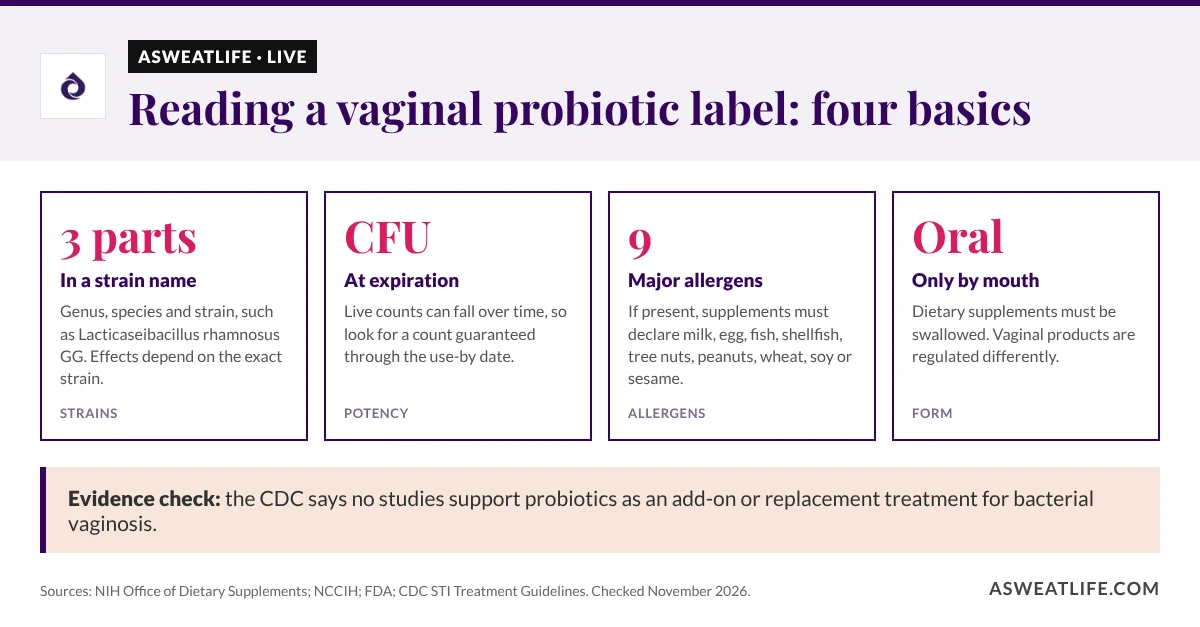
Probiotic microbes are named by genus, species and strain. The Office of Dietary Supplements uses Lacticaseibacillus rhamnosus GG as its example, where GG is the strain. A label that lists only “Lactobacillus” or a species without a strain code makes it hard to match the product to any study.
CFU Counts and Expiration Dates
CFUs, or colony-forming units, estimate how many live microbes a serving contains. A higher number isn’t automatically better, since any effect depends on the strain as well as the count. Because live counts can drop over time, some experts suggest choosing products that state the CFUs they’ll contain by the expiration date, rather than at manufacture.
Storage Requirements
Some probiotics need refrigeration and others are shelf-stable. Follow the label, keep the container closed, and avoid leaving it somewhere hot, such as a car or a gym bag.
Ingredients and Allergens
Read the full ingredient list as well as the probiotic strains. Under federal law, packaged foods and supplements must declare the nine major food allergens: milk, egg, fish, crustacean shellfish, tree nuts, peanuts, wheat, soybeans and sesame. Free-from claims such as “dairy-free” are voluntary, so ask the company about cross-contact if you have a serious allergy.
Directions for Use
Check how much to take, how often and how. If your clinician has given you different instructions, follow theirs.
Sponsor note: This article is sponsored by HPD Rx. Its Pro-Fem Vaginal Health Probiotic is an oral capsule. Its product page lists two strains, Lactobacillus rhamnosus GR-1 and Lactobacillus reuteri RC-14, at 5 billion CFU per capsule taken once a day, shelf-stable storage, and hypromellose and titanium dioxide as other ingredients. The page doesn’t say whether the CFU count applies at manufacture or through the expiration date, so check the bottle or ask the company. aSweatLife hasn’t tested this product, and this note isn’t a medical endorsement.
Try the checker below with any product you’re considering.
Have the bottle or box in front of you. Choose the form, tick what the label shows, and the checker lists what’s missing and what to ask the company or your pharmacist. It reviews the label only and can’t tell you whether a product will work for you.
What form is it?
Does the label claim to treat or prevent an infection?
What does the label show?
Missing, and what to ask
Worth knowing
How Do Oral Capsules Differ From Vaginal Products?
“Vaginal probiotic” can describe two very different things. The FDA says dietary supplements must be swallowed to count as supplements, so a capsule you take by mouth and a product you insert vaginally are regulated differently.
| Oral capsules | Vaginal inserts or suppositories | |
|---|---|---|
| How it’s used | Swallowed | Inserted into the vagina |
| How it’s sold in the US | Usually as a dietary supplement | Can’t be sold as a dietary supplement |
| Label to check | Supplement Facts panel | Product labeling and any medical guidance |
| Before using | Read the directions and allergens | Ask a clinician first |
Don’t use an oral capsule vaginally, or swap one form for the other, unless a clinician has told you to. The directions on the label tell you which kind of product you have.
What Does the Research Show About Vaginal Probiotics?
The honest answer is that the evidence is limited and mixed. Research on probiotics is strain-specific: NCCIH explains that a benefit from one Lactobacillus type doesn’t mean another kind will do the same. A study on a particular strain, dose and form also doesn’t prove that a different product containing that strain will deliver the same result.
For specific conditions:
- Bacterial vaginosis (BV): the CDC’s BV treatment guidelines say no studies support probiotics as an adjunctive or replacement therapy for BV.
- Yeast infections: a Cochrane review of probiotics alongside antifungal treatment rated the evidence as low or very low quality, meaning there’s very little confidence in the results.
- Urinary tract infections: NCCIH cites a 2015 review of nine studies that found no evidence probiotics help prevent UTIs.
Probiotics are generally considered safe for healthy people, but they can cause side effects such as gas, and people who are seriously ill or have weakened immune systems face higher risks. Our guide to side effects when starting probiotics covers what to expect, and our look at ways to support your vaginal microbiome covers everyday habits.
When Should You See a Doctor Instead?
Persistent or recurring symptoms, such as unusual discharge, odor, itching, burning or pain when you pee, need a medical assessment. BV, yeast infections, UTIs and sexually transmitted infections can look alike, and each needs the right diagnosis.
Supplements shouldn’t replace treatment your clinician prescribes. If symptoms keep coming back, the CDC advises returning for evaluation. Regular checkups help too, and our list of doctor appointments to book every year is a useful reminder.
Vaginal Probiotic Label FAQ
What does CFU mean on a probiotic label?
CFU stands for colony-forming units, an estimate of the live microbes in each serving. Look for a count that’s guaranteed through the expiration date.
Do I need a strain code on the label?
It helps. Research is linked to specific strains, so a full name such as L. rhamnosus GR-1 makes it easier to see what’s been studied.
Are oral and vaginal probiotics the same?
No. Oral capsules are swallowed and are usually sold as dietary supplements, while vaginal products are inserted and regulated differently.
Should probiotics be refrigerated?
Some need refrigeration and some are shelf-stable. Follow the storage instructions on the label.
Can a probiotic replace treatment for an infection?
No. Supplements shouldn’t replace prescribed treatment, and persistent or recurring symptoms need a medical assessment.
A good label won’t tell you whether a probiotic will help you, but it will tell you exactly what’s in the bottle. Read it closely, compare it with the research, and bring your questions to a clinician.