
Plyometrics for Bone Density After 40: A Small Dose of Jumping Helps

If you’re over 40 and building strength for the long haul, here’s some encouraging news: coaches and doctors are urging women like you to try a small dose of plyometrics for stronger bones. The advice is to start with one or two jumping moves per session, keep the reps low and build up slowly.
The case rests on how bone responds to impact. Research reviews point to jumping as one of the stronger exercise signals for bone density, though the evidence in older women is mixed and jumping works best alongside strength training rather than in place of it.
What the research says about jumping and bone density
A meta-analysis of jump training in adults pooled 15 articles and found that jumping raised bone mineral density at the femoral neck, the upper part of the thigh bone at the hip, though jumping alone didn’t significantly change lumbar spine density in that analysis. A 2025 review found that high-impact plyometrics increased lumbar spine bone density in postmenopausal women, with the biggest gains when jumping was combined with resistance training.
Broader exercise research is more cautious. A systematic review of exercise in postmenopausal women found a statistically significant but small effect on bone density at the lumbar spine and proximal femur, with results varying by exercise protocol. In other words, jumping looks promising, but it is not a guaranteed fix.
The stakes are real. About 80 percent of people with osteoporosis are women, and the spine is the most common fracture site for women, with the hip a close second.
How much jumping is enough?
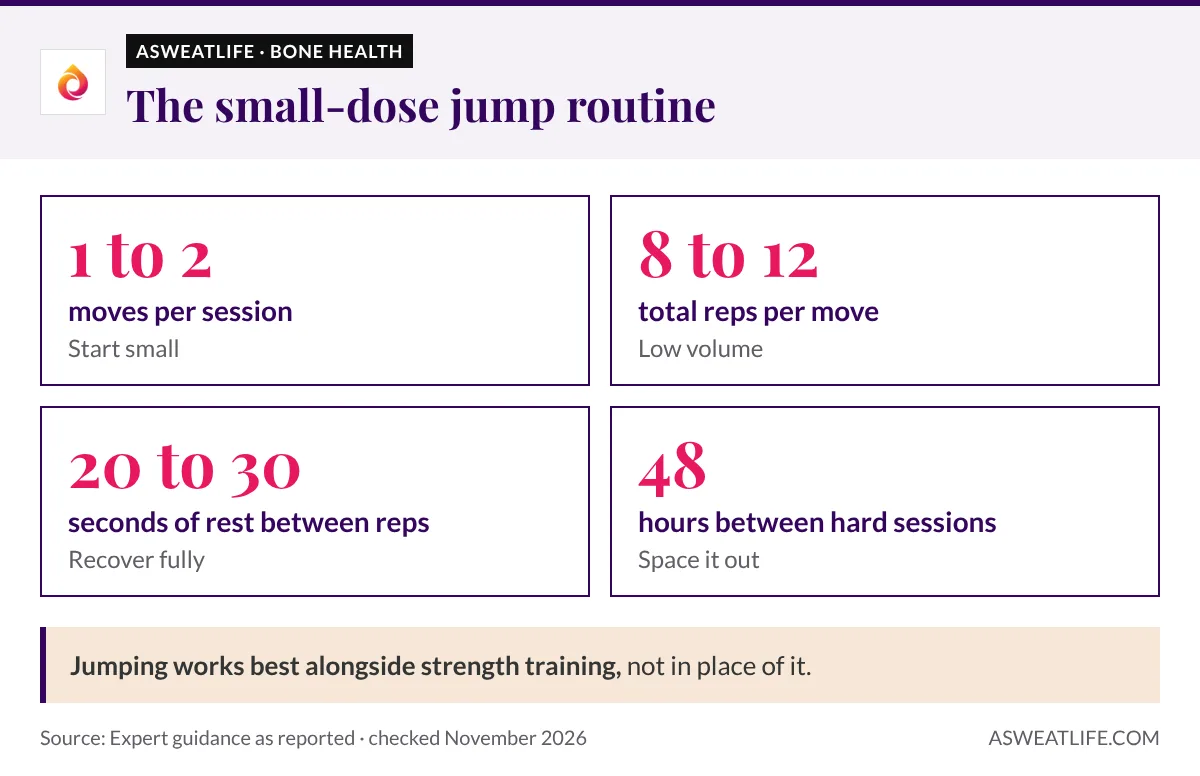
The good news? The starting dose is modest. Do one or two plyometric movements per session, with 8 to 12 total reps per movement and at least 20 to 30 seconds of rest between reps. Place them after your warm-up and before main strength work, and leave 48 hours between higher-intensity jump sessions.
Here is the suggested progression for easing into jumping, stage by stage.
Start with calf raises, heel drops and small pogo hops using two-foot takeoffs, and stay on two-foot hops for at least two to three weeks before moving on. Staggered-stance jumps come next, then bigger moves such as broad jumps, burpee broad jumps, tuck jumps and depth jumps, and finally single-leg hopping in place, forward and side to side. Medicine ball throws, D-ball slams and rotational wall throws can cover the upper body and midline.
A coach’s example of the approach
Tina Tang, a powerlifter and coach who trains women over 40, was diagnosed with osteopenia at 52. After adding plyometrics to her training, a DEXA scan at 54 showed improvement, including in her right hip. It is one person’s result and not proof the routine works for everyone, but it shows how the approach looks in practice.
Are jumping workouts safe after 40?
The risk comes from poor progression, weak landing mechanics or undiagnosed conditions, not from jumping itself. Parini A. Patel, DO, an interventional pain and musculoskeletal medicine physician at Atlantic Health in New Jersey, says, “Jumping does not cause wear-and-tear, worsen osteoarthritis, or increase fracture risk.”
Landing technique matters: soft knees, hips back and an engaged core. If you have bone density concerns (especially a diagnosis of osteoporosis or a past fracture), take medications or have an existing condition, check with your doctor before changing your routine. Women with pelvic floor symptoms such as leakage, pressure or pain are advised to see a pelvic floor physical therapist first, since prolapse or incontinence may call for strengthening work beforehand. Sharp pain, new neurological symptoms or lingering soreness are reasons to stop and consult an expert.
Do plyometrics replace strength training?
No. The experts describe plyometrics as a complement to traditional strength training, not a substitute for it.
How many jumps are needed for a benefit?
The suggested starting dose is one or two movements per session at 8 to 12 total reps each, which is a small amount compared with a full jump-training workout. Your next step: on your next strength day, add one move, like small pogo hops, after your warm-up, keep it to 8 to 12 reps and notice how your body feels the next day.
This article is for educational purposes and does not replace advice from a doctor, registered dietitian or qualified trainer.