
How to Recover After a Day When Everything Goes Wrong
When everything goes wrong, carrying the stress into your evening steals your rest. Here's how to switch off, reset tonight and protect tomorrow.


You overslept, the coffee hit your shirt, traffic doubled your commute and the inbox was already on fire by 9 a.m. If you’re trying to figure out how to recover after a day when everything goes wrong, you’re in good company: in the 2026 Stress in America survey, 71% of U.S. adults named money alone as a significant source of stress.
Below you’ll find why a bad day lingers into the evening, the habits that keep stress switched on, a simple evening reset with research-backed timing and how to protect tomorrow.
Why Does a Bad Day Follow You Home?
Small problems stack. A late start leads to a rushed meeting, which leads to a mistake, which leads to an awkward email, and by evening you’re carrying the whole chain. That buildup tends to show up in the body as tight shoulders, a short fuse and a mind that keeps jumping between tasks.
Researchers who study recovery call the missing ingredient psychological detachment: mentally switching off from work during your time off. In a diary study by Sabine Sonnentag and Ute-Vera Bayer, people who detached in the evening reported better mood and less fatigue, and the link with lower fatigue was especially strong on days with heavy time pressure. In other words, the worst days are exactly the ones where switching off pays off most.
It also helps to see the day for what it was: a run of events that went badly over a few hours. It says nothing final about your ability, your progress or your worth.
What Keeps Stress Switched On After a Rough Day?
A few common habits keep your stress response running long after the problem has passed. Spotting them is half the work.
| Habit | What it looks like | What to try instead |
|---|---|---|
| Replaying | Running the argument or mistake on a loop all evening | Name what went wrong once, write it down, then change the subject |
| Late-night fixing | Rewriting the presentation or answering emails at 10 p.m. | Write the first step on tomorrow’s list and close the laptop |
| Demanding instant recovery | Expecting to feel cheerful the moment you walk in the door | Give yourself an hour to be tired and quiet |
| Staying plugged in | Checking work chat or doom-scrolling the news in bed | Put notifications on pause and the phone away from the bed |

Late-night fixing deserves a special mention. When you’re drained, complicated problems feel bigger than they are and decisions get worse. Most of what feels urgent at 10 p.m. will be easier to handle after a night’s sleep.
How Do You Reset Your Evening After Everything Goes Wrong?
This article is for general information and isn’t medical advice. If stress, low mood or poor sleep is affecting your daily life, talk to your doctor or a licensed mental health professional.
The goal tonight is to signal to your mind and body that the hard part is over. Four simple steps cover most of it.
1. Draw a Clear Finish Line
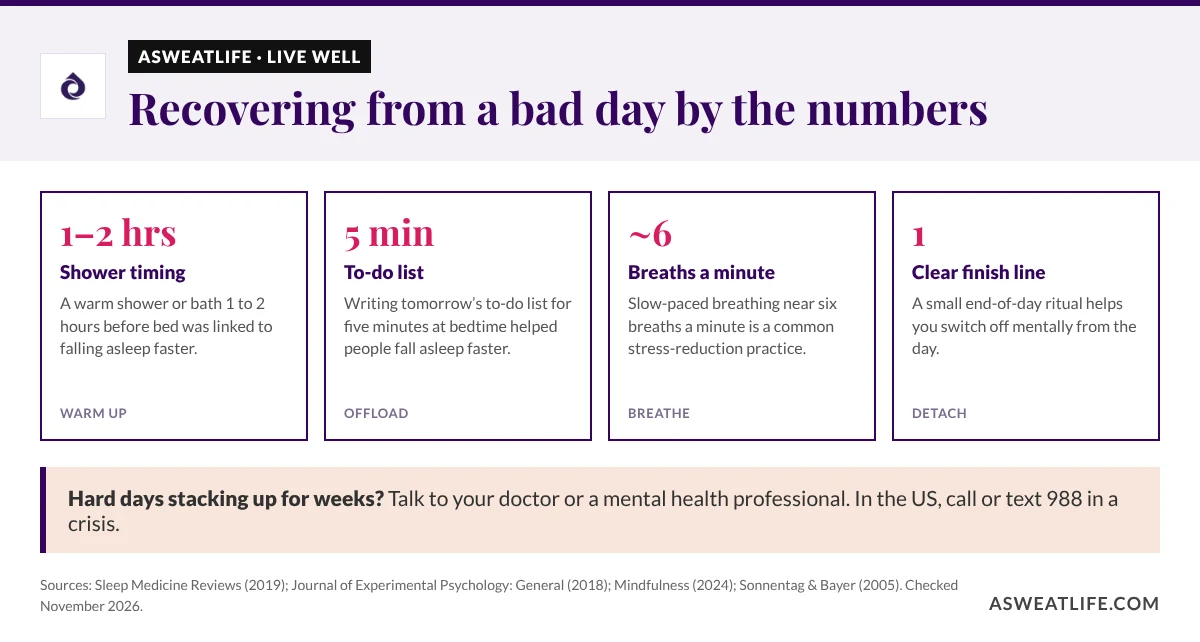
Pick a small ritual that marks the end of the day: change out of work clothes, wash your face, shut the laptop and put it out of sight. It sounds minor, but a physical cue makes the mental switch easier.
2. Lower the Bar for Tonight
Drop every chore that can wait. Eat something simple, skip the deep clean and give yourself permission to go to bed early. A low-key evening is a perfectly valid plan.
3. Take a Warm Shower at the Right Time
A warm shower or bath does more than feel nice. A 2019 meta-analysis in Sleep Medicine Reviews linked water of about 104 to 108.5°F to better self-rated sleep quality and sleep efficiency, and when it was scheduled one to two hours before bed, it was associated with falling asleep faster. If your bedtime is 11 p.m., aim for somewhere between 9 and 10 p.m.
4. Slow Your Breathing
Slow-paced breathing, sometimes called deep breathing, means slowing down to around six breaths a minute, or a five-second inhale and a five-second exhale. A 2024 meta-analysis of 31 studies found that it lowered blood pressure right away, though its effect on perceived stress was smaller and not statistically clear. Treat it as a way to settle your body, then let the rest of your evening do its part.
If you want to start over earlier in the day, our five rituals to restart a bad day work well before the evening even arrives.
Plan Tonight in a Minute
Use the planner below to turn these steps into a timeline that fits tonight’s schedule and what’s weighing on you most.
Tell the planner when you got home, when you want to be asleep and what is weighing on you most. It builds a simple evening around research-backed timing, so you are not making decisions when you are already worn out.
When does your evening start?
When do you want to be asleep?
What is weighing on you most?
How much energy is left?
Your timeline
For what is weighing on you
How Can You Stop Today From Ruining Tomorrow?
Once the evening has settled, a few small moves keep today’s mess from spilling into the morning.
Write tomorrow’s to-do list. In a 2018 study from Baylor and Emory universities, people who spent five minutes writing a to-do list at bedtime fell asleep faster than those who wrote about tasks they had already finished. The more specific their lists, the faster they fell asleep. Getting tomorrow’s jobs onto paper means your brain doesn’t have to keep rehearsing them.
Reframe the story. Tell yourself plainly that today was one hard day. A rough Tuesday doesn’t define your week, your habits or where you’ll be in a year. If that’s hard to do on your own, the reflection activities and short lessons on stress and overthinking in the Overwell app are one way to sort through what actually happened before bed, so your racing thoughts have somewhere to go.
Lean on small comforts. Warm tea, calm music or a light book are all easier on your mind before sleep than work email or breaking news.
Set one gentle intention. Pick a single thing you’d like tomorrow to include, like a walk at lunch or leaving on time, and leave the rest for the morning.
| When | What to do | Why it helps |
|---|---|---|
| As soon as you get home | End-of-day ritual | Creates a clear break from work |
| Early evening | Simple dinner, drop non-essential chores | Saves your limited energy |
| 1 to 2 hours before bed | Warm shower or bath | Linked to falling asleep faster |
| 15 minutes before bed | Slow breathing, then a to-do list | Settles your body and offloads tomorrow’s tasks |
| Lights out | Phone away from the bed | Keeps work and news out of your head |
If bad days are becoming the norm rather than the exception, it may be time to look at the bigger picture. Our guide on protecting your mental health in a demanding career covers boundaries, workload and when to ask for help, and these small wellness habits that last can make the hard days a little less heavy.
Frequently Asked Questions About Recovering From a Bad Day
Is It OK to Go to Bed Early After a Bad Day?
Yes. An early night is one of the simplest ways to recover, as long as you’re tired enough to sleep. If you lie awake replaying the day, get up, write down what’s on your mind and try again when you feel sleepy.
Should I Talk About My Bad Day or Try to Forget It?
Both can help. Talking it through with someone you trust can make a hard day feel lighter. What tends to keep stress going is replaying it alone over and over. Once you’ve said it out loud or written it down, let yourself move on to something else.
How Long Does It Take to Recover From a Stressful Day?
It varies from person to person. A single evening with a clear break from work, some physical relaxation and a decent night’s sleep is often enough after one rough day. If stress or exhaustion carries on for weeks, talk to your doctor or a mental health professional.
What If Every Day Feels Like a Bad Day?
That’s a sign to get support. Talk to your doctor or a licensed therapist. If you’re in crisis in the U.S., call or text 988 to reach the 988 Suicide and Crisis Lifeline.
Be Gentle With Yourself Tonight
You can’t control every delay, mistake or bad email in a day, but you can choose how you treat yourself once it’s over. Getting through a hard day is enough. You don’t need to fix everything tonight to deserve rest.
Close the laptop, take that warm shower, write tomorrow’s list and let today be done. Tomorrow starts with a clean slate.