
How Long Does It Take to Train for a Half Marathon? Weeks by Level
Most beginner half marathon plans run 12 weeks. Starting from scratch, plan on about 21 weeks; already running a 5K, eight to 12. Here's how to tell if you're ready and when to start.


If you’ve signed up for a half marathon (or you’re eyeing one on the calendar and wondering if you can pull it off), your half marathon training timeline depends on where you’re starting. Most beginner plans run 12 weeks, and they assume you can already handle a four-mile run. Starting from the couch, you’ll want about 21 weeks: nine to build up to running 30 minutes without stopping, then 12 on a proper plan.
Already running a 5K most weekends? You could be race-ready in eight to 12 weeks. Below you’ll find the timeline for each starting point, a quick check to see if you’re ready to begin, and how to count back from your race date so you start on time.
Half Marathon Training Timeline by Starting Level
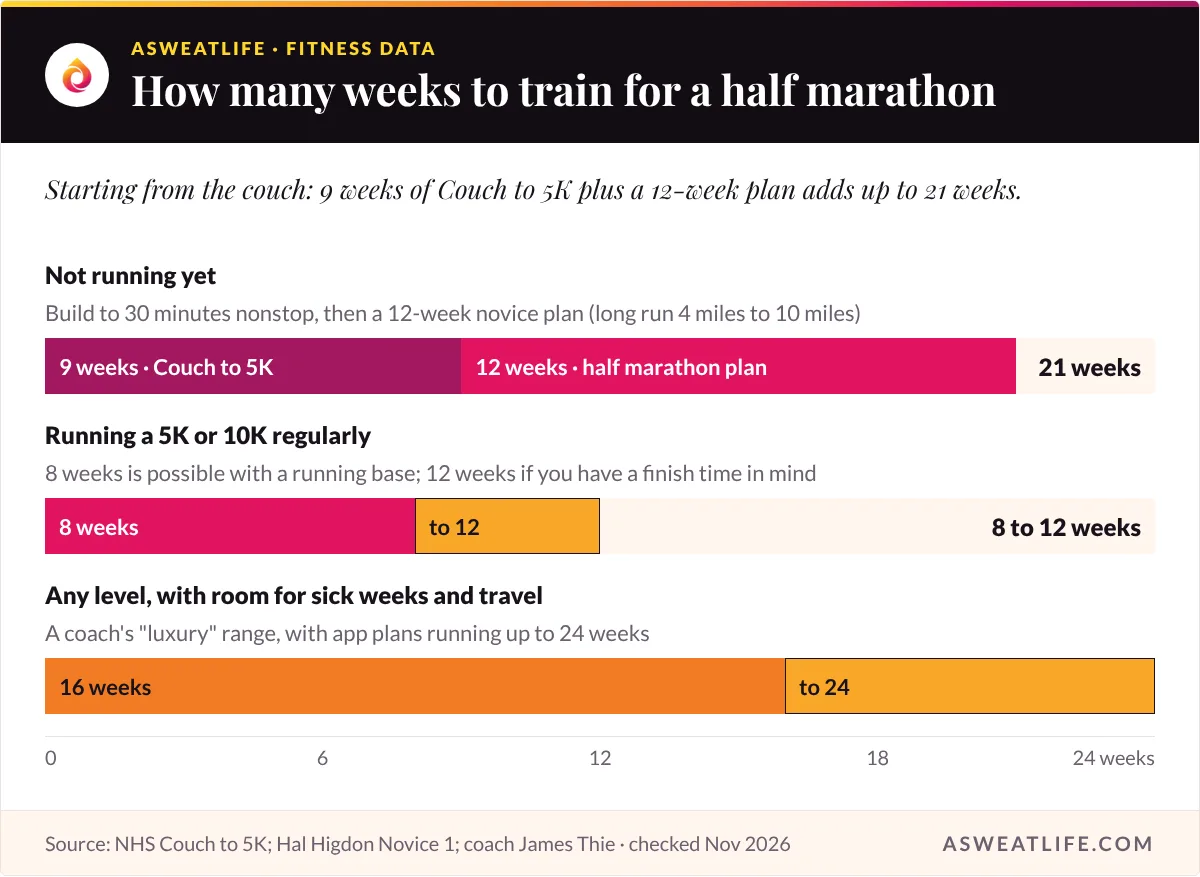
Here’s how the weeks stack up, based on Couch to 5K, Higdon’s 12-week Novice 1 plan, and a coach’s guidance for runners who already have a base.
| Where you’re starting | Build-up first | Half marathon plan | Total weeks |
|---|---|---|---|
| Not running yet | 9 weeks (Couch to 5K) | 12 weeks | 21 weeks |
| Running a 5K or 10K regularly | None | 8 to 12 weeks | 8 to 12 weeks |
| Any level, with room for sick weeks and travel | Depends on your base | 16 to 24 weeks | 16 to 24 weeks |
The 21-week figure is simple addition, but it’s easy to miss. A 12-week plan only works if week one doesn’t flatten you, so the build-up phase is part of your training, too.
How Many Weeks Do You Need If You’re Starting From Scratch?
Plan on about five months. The first block gets you running continuously: the NHS Couch to 5K program takes you to running 5K in nine weeks, with three runs a week and rest days in between, and by the end you’re running for 30 minutes without stopping. (If nine weeks feels fast, you’re allowed to repeat a week. Nobody is checking.)
Once you hit that mark, you’re ready to learn how to train for a half marathon on a structured plan. Hal Higdon’s Novice 1 program, one of the best-known beginner schedules, lasts 12 weeks, and your longest run grows from 4 miles in week one to 10 miles in week 11 before an easier taper week that has you rested for race day in week 12. Nine weeks plus 12 weeks gets you to 21.
Want more cushion? Running coach James Thie, a senior lecturer at Cardiff Metropolitan University, calls 12 weeks the minimum and describes 16 or 20 weeks as “the luxury,” with plans on the Coopah app he coaches for running up to 24 weeks. For a true beginner starting from scratch, he calls 24 weeks “probably ideal.” Extra weeks give you slack for a cold, a work trip, or a week when life simply wins.
If running 30 minutes straight still sounds wild, the run/walk method is a smart way to build endurance while leaving room to recover between runs.
How Many Weeks If You Already Run a 5K?
Eight to 12 weeks. “If you’re already parkrunning, that’s a nice base,” Thie says. “You could definitely do it in eight weeks.” With 12 weeks, he says, you can prepare more fully if you have a finish time in mind.
Your current long run decides which end of that range fits. A 5K is 3.1 miles, a little short of the 4-mile long run that opens Higdon’s Novice 1 plan, so a 12-week schedule gives you time to grow without big jumps. If you’re comfortable running a 10K (6.2 miles), you already have more than half of a 10-mile peak long run banked, and eight weeks is a realistic build.
Whichever you choose, make room for strength training for runners.
How Do You Know You’re Ready To Start a Half Marathon Plan?
Run through this checklist before you commit to a start date:
- You can run 30 minutes without stopping. That’s the finish line of Couch to 5K and a fair entry ticket for most beginner half marathon plans.
- A four-mile run feels doable. Novice plans open with long runs of about that distance, so week one should feel like a stretch you can manage.
- You can protect three or four run days a week. Higdon’s novice schedule runs on Tuesday, Thursday, and Sunday, with an optional short run or cross-training on Wednesday.
- You’re running pain-free. If something hurts on short runs, get it checked before you add miles.
- Your calendar has enough weeks. Count back from race day (more on that below) and make sure the plan fits with a little buffer.
If you’re worried about your health before starting, the NHS advises seeing a doctor before you begin a program like Couch to 5K. That’s a good call for a half marathon build, too.
Ticked most of the boxes but not all? That’s fine. Start with the build-up phase now and pick a race a few weeks later. A goal you can reach beats a goal you have to limp toward.
How To Count Back From Your Race Date
Grab your race date and work backward. Subtract the length of your plan to find your start date, then subtract any build-up weeks. If you’re starting from scratch and your race is 21 weeks away, Couch to 5K starts this week. If it’s 16 weeks away, look for a later race or a shorter goal (a 10K is a great one).
Pick your race date and starting level to see the date each plan needs to begin.
Then add a buffer. Few plans go exactly to schedule: a cold, a work trip, or a stretch of bad sleep can cost you a week, and that’s normal. If yours goes sideways, read what to do if your marathon training didn’t go to plan before you panic. Patience pays here, too: how long it takes to see progress in training varies a lot from person to person.
What About Weekly Mileage?
A typical beginner plan has you running three or four days a week, with workouts from 2 to 10 miles and one weekend long run that does most of the growing.
Watch how fast that long run grows. A 2025 study of 5,205 runners in the British Journal of Sports Medicine found that overuse injuries rose when a single run exceeded the longest run of the past 30 days by more than 10%. In plain words: if your longest run this month was 5 miles, keep your next long run around 5.5. Build slowly, and use your rest days for recovery during half marathon training.
Your next step: pick your race, count back the weeks for your starting level, and put day one on the calendar this week. Five months sounds like a lot until you’re crossing the line at mile 13.1.