
Beginner 5K Training Plan: A 14-Week Path Into Half Marathon Training
An eight-week run-walk 5K plan, a six-week bridge that builds your long run to about 4 miles, and a weekly mileage table that shows how the load climbs before half marathon training.


If a half marathon is the big goal and running for one straight minute still feels like a lot (no judgment here), a beginner 5K training plan is the smartest place to start. Most beginner 5K plans take eight to nine weeks with three runs a week, and the NHS Couch to 5K program opens with one-minute runs and 90-second walks, so nobody expects you to run the whole thing on day one.
The plan below goes one step further. It’s built in three phases: an eight-week run-walk plan to your first 5K, a six-week bridge that grows your easy runs and your long run to about 4 miles, and then a 12-week half marathon plan. That’s roughly six months from your first interval to 13.1 miles, with rest days baked into every week and a weekly mileage table so you can see exactly how the load climbs.
How This Beginner 5K Training Plan Builds Toward a Half Marathon
Each phase has one job. Phase one (weeks 1 to 8) teaches your legs, lungs, and schedule to handle three sessions a week, using walk breaks that shrink as you get fitter. Phase two (weeks 9 to 14) turns those sessions into continuous easy runs and adds a weekly long run. Phase three (weeks 15 to 26) is a standard 12-week beginner half marathon plan.
- Phase one, weeks 1 to 8: three run-walk sessions a week, ending with a 5K (3.1 miles).
- Phase two, weeks 9 to 14: three continuous easy runs a week, one of them a long run that reaches 52 minutes.
- Phase three, weeks 15 to 26: a 12-week half marathon plan with long runs that start around 4 miles.
You can stop after any phase and still have a finished goal. A 5K is a real race, and plenty of runners stay there happily. But if 13.1 is calling your name, the first 14 weeks set you up to start a half marathon plan without jumping in cold.
What You Need Before Week 1
The entry ticket is modest: you should be able to walk briskly for 30 to 45 minutes, because each phase-one session runs about 34 to 44 minutes once you add the warm-up and cool-down. If you have a heart condition, joint pain, or any health worry, check in with your doctor first. The NHS gives the same advice to anyone worried about their health before starting Couch to 5K.
Gear-wise, the one thing worth spending on is a pair of running shoes that fits. A running specialty store can watch you jog and suggest a few options, and our guide on how many pairs of running shoes you need and when to replace them covers the rest. Beyond that, you need comfortable clothes, a watch or phone with an interval timer, and three time slots a week you can protect.
The plan fills about two-thirds of the weekly activity target, too. The CDC says adults need 150 minutes of moderate-intensity physical activity a week plus at least two days of muscle-strengthening work, and three 34-minute sessions get you to about 100 of those minutes.
Weeks 1 to 8: The Run-Walk 5K Plan

Every session starts with a 5-minute brisk walk and ends with a 5-minute easy walk. The intervals in the table go in between. Do each week’s session three times, with at least one rest or cross-training day between sessions.
| Week | Each session (after warm-up) | Running per session | Running per week |
|---|---|---|---|
| 1 | 8 rounds: run 1 min, walk 2 min | 8 min | 24 min |
| 2 | 8 rounds: run 90 sec, walk 90 sec | 12 min | 36 min |
| 3 | 6 rounds: run 2.5 min, walk 90 sec | 15 min | 45 min |
| 4 | 5 rounds: run 4 min, walk 90 sec | 20 min | 60 min |
| 5 | 4 rounds: run 6 min, walk 90 sec | 24 min | 72 min |
| 6 | 3 rounds: run 9 min, walk 90 sec | 27 min | 81 min |
| 7 | 2 rounds: run 15 min, walk 2 min | 30 min | 90 min |
| 8 | Run 25 min; run 20 min easy plus four 20-second strides (short, relaxed pickups); then your 5K | 25 min, 20 min, 5K | 45 min + 5K race |
Notice what stays steady: the interval block only grows from 24 minutes in week 1 to 34 minutes in week 7. What changes is how much of that time you spend running. The walk breaks are your shock absorber, and they shrink as your body adapts.
If a week feels rough, repeat it. Nobody’s grading you, and finishing in 10 or 11 weeks lands you in exactly the same place. The same goes for the 5K itself in week 8: sign up for a local race if you love a start line (everything is better with friends), or map 3.1 miles from your door and run it solo. Walk breaks are allowed on race day too.
How to Schedule Your Three Runs and Rest Days
A simple pattern that works for most busy weeks:
- Monday: run
- Tuesday: strength or rest
- Wednesday: run
- Thursday: rest or easy cross-training (walk, bike, yoga)
- Friday: strength or rest
- Saturday: run
- Sunday: full rest
Shuffle the days to fit your life, with one rule: never run two days in a row during phase one. Rest is when the adaptation happens. If you can’t decide between a lazy day and a gentle walk, our breakdown of an active recovery or a full rest day helps, and so do the signs it’s time to take a rest day, like soreness that won’t quit.
Weeks 9 to 14: The Bridge to Half Marathon Training
Once you’ve run your 5K, the walk breaks go (keep them whenever you need them) and the week gets a long run. Two runs stay short and easy; the third grows a little each week. Week 12 is a lighter cutback week so your body can catch up before the last push.
| Week | Easy run 1 | Easy run 2 | Long run | Running per week |
|---|---|---|---|---|
| 9 | 25 min | 25 min | 35 min | 85 min |
| 10 | 25 min | 30 min | 38 min | 93 min |
| 11 | 30 min | 30 min | 42 min | 102 min |
| 12 (cutback) | 25 min | 30 min | 35 min | 90 min |
| 13 | 30 min | 30 min | 48 min | 108 min |
| 14 | 30 min | 30 min | 52 min | 112 min |
The goal by week 14 is a long run of about 4 miles, because that’s where a typical beginner half marathon plan starts its long runs. If your 52-minute run covers less than that, repeat week 14 (or add a few minutes to the long run) before moving on. Want a fourth day? Add a 20-minute easy run or a cross-training session, but only after week 11 feels comfortable.
The Weekly Mileage Table
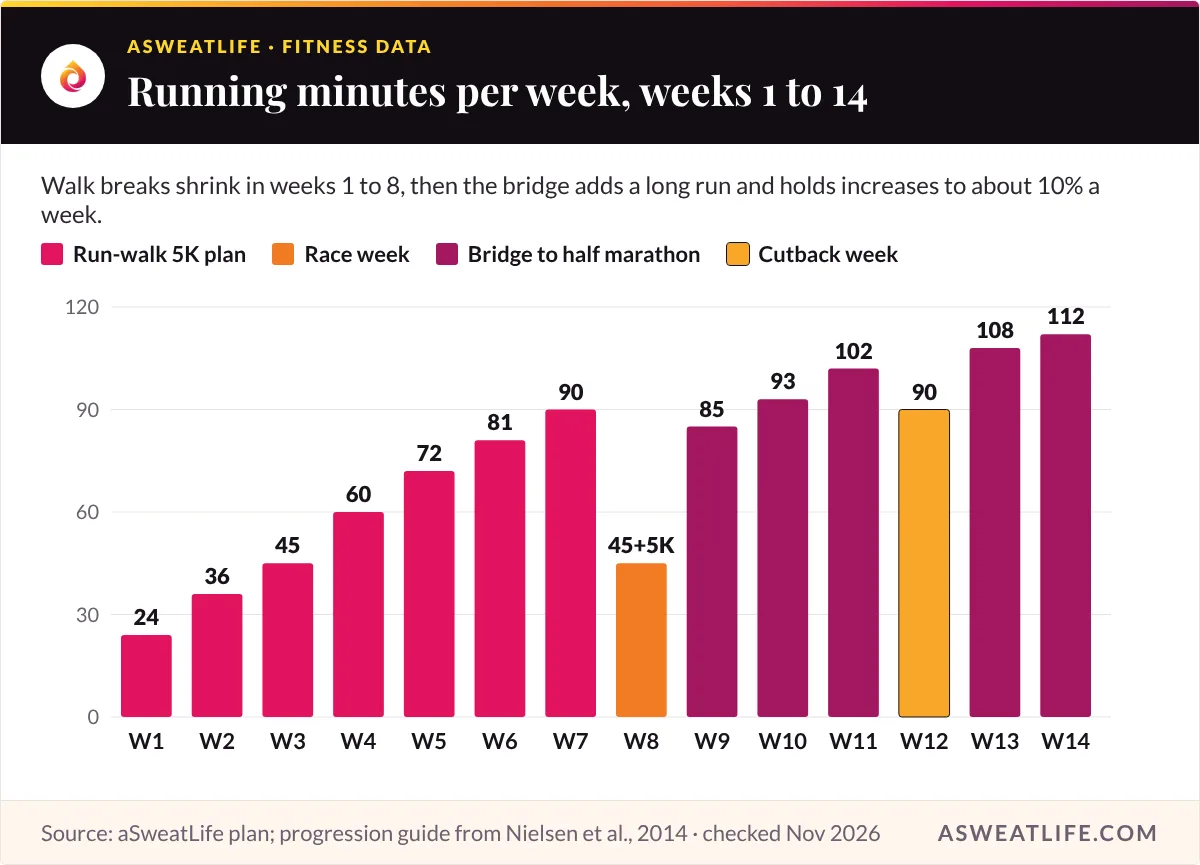
The plan is written in minutes because beginners run at wildly different paces, and time on your feet is what your body actually feels. To translate minutes into miles, divide by your easy pace. The table shows that math at two common beginner paces, 12 and 14 minutes per mile, plus the change from the week before.
Pick your own easy pace to see what each week of the plan looks like in miles.
| Week | Running minutes | Miles at 12 min/mile | Miles at 14 min/mile | Change from prior week |
|---|---|---|---|---|
| 1 | 24 | 2.0 | 1.7 | Start |
| 2 | 36 | 3.0 | 2.6 | +50% |
| 3 | 45 | 3.8 | 3.2 | +25% |
| 4 | 60 | 5.0 | 4.3 | +33% |
| 5 | 72 | 6.0 | 5.1 | +20% |
| 6 | 81 | 6.8 | 5.8 | +13% |
| 7 | 90 | 7.5 | 6.4 | +11% |
| 8 | 45 + 5K race | 6.9 | 6.3 | Race week |
| 9 | 85 | 7.1 | 6.1 | Reset |
| 10 | 93 | 7.8 | 6.6 | +9% |
| 11 | 102 | 8.5 | 7.3 | +10% |
| 12 | 90 | 7.5 | 6.4 | Cutback |
| 13 | 108 | 9.0 | 7.7 | +6% on week 11 |
| 14 | 112 | 9.3 | 8.0 | +4% |
Those early jumps look big on paper, and they are, which is why the walk breaks matter: in phase one your total session time barely moves while the running share climbs. Once the walk breaks go in phase two, the plan holds each week’s increase to about 10% or less (week 13 is measured against week 11, since week 12 is a planned cutback). That lines up with a 2014 study of 874 novice runners, which found that runners who increased distance by more than 30% over two weeks seemed more vulnerable to distance-related injuries than those who kept increases under 10%. (Honest caveat: the researchers note that the science behind progression rules is still limited, so treat 10% as a guardrail and listen to your body.)
Why Run-Walk Works, and When to Drop the Walk Breaks
Walk breaks are nothing to be embarrassed about. In a 2016 study of 42 non-elite marathoners, the run-walk group finished in 4:14:25 on average and the running-only group in 4:07:40, a difference that wasn’t statistically significant, and the run-walkers reported less muscle pain and fatigue afterward. Coach Jeff Galloway’s Run Walk Run method builds whole race plans this way, with examples like 30-second walk breaks every two minutes.
So when do you stop walking? Let the plan drop them on schedule, and add them back any time a run feels too hard. If you get to the half marathon and still like a one-minute walk every mile, that’s a strategy, and a good one.
How Fast Should Your Easy Runs Feel?
Slower than you think. Nearly every run in this plan should be easy, and the simplest check is the talk test: the CDC’s rule of thumb is that during moderate activity you can talk, but not sing. If you can only get out a few words between breaths, you’ve drifted into vigorous effort, so slow down or take a walk break.
Pace numbers can wait until the plan is behind you. If you like data, our explainer on pace training versus heart rate training covers the two main ways runners measure effort.
Strength and Cross-Training on Your Off Days

The CDC’s guidance of two strength days a week fits neatly into the Tuesday and Friday slots. Squats, lunges, glute bridges, calf raises, and planks all build the muscles that keep your knees, hips, and ankles happy as the miles grow. Our guide on adding strength training to your running program has the why and the how, and if you’re brand new to lifting, start with how to start a strength training routine.
Cross-training (cycling, swimming, an elliptical, a long walk) adds aerobic fitness without the pounding of running. Keep it easy in phases one and two; its job is to support your runs, so save the hard efforts for another season.
Weeks 15 to 26: Starting Your Half Marathon Plan
With a 4-mile long run under your belt, you’re ready for a beginner half marathon plan. Hal Higdon’s novice program is a good example of what to expect: it runs 12 weeks with workouts from 2 to 10 miles, long runs that build from 4 miles in week 1 to 10 miles in week 11, Mondays as rest days, and a cross-training session before each weekend long run. Higdon also tells runners to feel free to walk during workouts whenever they need to.
That makes the hand-off from week 14 smooth: your long run already matches the first week of the plan, and you’re used to three runs plus rest. For the full picture of what those 12 weeks involve, read our guide to how to train for a half marathon, then bookmark our tips on how to recover during half marathon training for when the long runs get long.
Common Beginner Mistakes and How to Fix Them
- Running every session too fast. If the talk test fails, the run is too hard. Slow down until you can chat.
- Adding miles because you feel great. Feeling great in week 4 is the plan working. Stick to the table, especially once the walk breaks are gone.
- Skipping rest days. Back-to-back runs in phase one cut into the recovery your legs need.
- Running through sharp pain. General soreness that fades in a day or two is normal. Pain that changes how you walk or run, or that lingers, is a reason to stop and see a doctor or physical therapist.
- Quitting after a missed week. Life happens. Repeat the last week you completed and keep going.
Your next step is small: pick your three run days for the coming week, put them in your calendar like meetings, and do week 1. If you’d like company along the way, here’s how to reboot your walking or running routine with others.
Frequently Asked Questions
Can I Walk Part of My First 5K?
Yes. Walk breaks are normal at 5K races, and run-walk is a recognized strategy at every distance, including the half marathon.
How Long Does It Take to Go From a Beginner 5K to a Half Marathon?
With this plan, about 26 weeks: eight weeks to a 5K, six weeks of bridge training, and a 12-week half marathon plan. Repeating weeks adds time, and that’s fine.
Can I Do This Plan on a Treadmill?
Yes. The plan is written in minutes, so it works the same on a treadmill. Keep the speed easy enough to pass the talk test.
Is There a Shorter 5K Plan If I Already Run a Little?
If you can already run 15 minutes without stopping, start this plan at week 6 or try the free 5K training plan created by Puma Running.