Non-Toxic Workout Clothes and Gear: What to Check

Disclosure: This post includes sponsored partner content.
If you’re shopping for non-toxic workout clothes, the labels on leggings and sports bras promise a lot and explain very little. One rule does give you a firm baseline: California has banned new textiles containing regulated PFAS since January 1, 2025. A “clean” hangtag still doesn’t say what anyone tested.
Here’s how to read a clothing claim and check a certificate, then how to put your laundry, gym habits, skin care and supplements through the same test, one small swap at a time.
What Should Non-Toxic Workout Clothes Be Able to Show You?
“Non-toxic” on a hangtag doesn’t tell you what anyone checked. Brands often blur three separate questions together, so pull them apart:
- What is it made of? The fiber content describes the material, including the stretch component.
- What was tested? A lab test tells you what a lab looked for in a sample, and how small an amount it could detect.
- What is certified? A certification tells you that a defined product or process met a standard’s requirements.
A good product page, or a good answer from customer service, should cover all of these:
- What is the garment made from, down to the elastane?
- Has a water-repellent, stain-resistant or anti-odor finish been added?
- What was tested, by which lab, and to what detection limit?
- Does the evidence cover this garment, or only one of the fabrics in it?
- Can you check the certificate or read the report yourself?
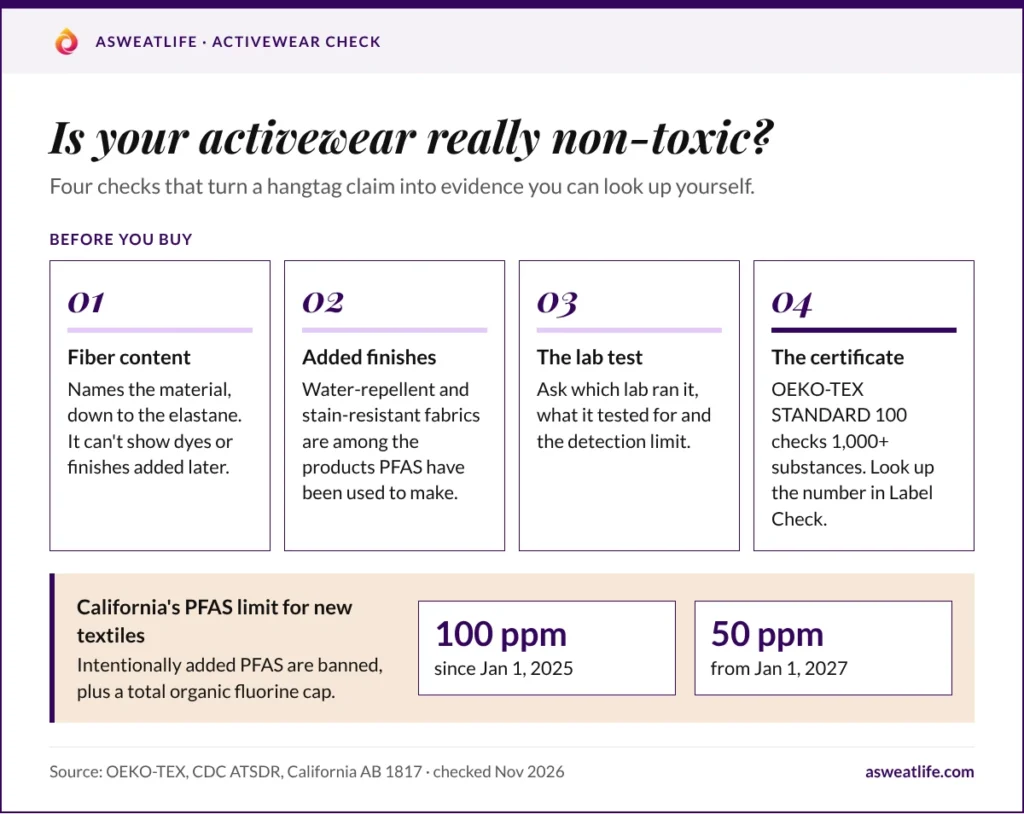
The four checks below sum it up, with California’s PFAS limit for new textiles alongside.
None of that matters if you can’t train in it, of course. Squat, reach and bend in the fitting room. Check that seams don’t rub, the waistband stays put and the sports bra gives you the support you need. Our guide to choosing workout clothes covers fit, support, and sweat-wicking, so add the questions above to that list and keep the rest.
Is Cotton or Synthetic Activewear Safer?
Fiber content helps you narrow the options, but it can’t settle the question on its own. A plant fiber can still carry dyes and finishes added after it was grown. A synthetic blend can be perfectly fine, because what counts is what was added to it and whether anyone tested for it.
Your skin and your workout can also pull in different directions. For children with eczema, the American Academy of Dermatology (AAD) advises loose-fitting clothes made from 100% cotton and avoiding wool and synthetic fibers like polyester. For a sweaty interval class, you may want a fabric that dries fast. There’s no single right answer, so write down what you need before you shop, something like: “a supportive bra for running, leggings that stay up and nothing that irritates the backs of my knees.”
How to Check an OEKO-TEX, GOTS or PFAS-Free Claim
Two certifications come up often in activewear:
- OEKO-TEX STANDARD 100 is, in its own words, a label for textiles tested for harmful substances, checked against a list of more than 1,000 substances. Every label carries a certificate number, and you can enter it in OEKO-TEX’s Label Check to see which products it actually covers.
- GOTS (the Global Organic Textile Standard) certifies textiles made with organic fibers, with environmental and social requirements that run through fiber processing, spinning, dyeing and manufacturing.
Treat a logo as the start of the check. A certificate held by a fabric supplier tells you about that fabric, and the finished leggings may need their own, so make sure the certificate matches the item you’re buying.
PFAS, sometimes called “forever chemicals,” deserve a specific question. The CDC’s Agency for Toxic Substances and Disease Registry lists water-repellent clothing and stain-resistant fabrics among the products PFAS have been used to make. If a brand says “PFAS-free,” ask whether that means none were intentionally added or that the garment was tested. If it was tested, ask what kind of test was used and how low it could detect.
That last question carries more weight than people expect. A result written as “none detected, tested down to 20 ppm” tells you more than a bare “PFAS-free,” because the detection limit shows how sensitive the test was. The most useful brands publish the full report with the lab named, so you can read it yourself.
| Label or claim | What it tells you | What to check |
|---|---|---|
| “Non-toxic” or “clean” | No defined standard behind the word | Ask what was tested, by which lab |
| OEKO-TEX STANDARD 100 | The certified item passed tests for a list of harmful substances | Enter the certificate number in Label Check |
| GOTS | Organic fibers, with processing and social criteria | Confirm the certificate covers the finished garment |
| “PFAS-free” | Could mean none added, or tested below a limit | Ask for the test method and detection limit |
| “Third-party tested” | Someone outside the brand ran a test | Ask what was tested for, and see the report |
How Does Your Laundry Routine Affect Your Workout Clothes?
You wash workout clothes far more often than you buy them, so your detergent is one of the most repeated choices in your whole routine. Start with what you already own:
- Read the care label on the garment.
- Read the directions on your detergent, and measure the dose every time.
- Use the wash and dry settings the care label recommends. For most leggings, that means cold water and a gentle cycle, then hanging them to dry.
- Let everything dry completely before it goes back in a drawer.
If fragrance bothers your skin, that’s a sensible place to begin. For children with eczema, the AAD recommends detergent that is fragrance-free and dye-free. If you’re shopping for a non-toxic laundry detergent, use the same test as for your clothes: look for a company that lists every ingredient, says plainly whether fragrance or dye has been added and shows you lab results with the detection limits.
Washing has limits, too. It handles sweat and odor, but it can’t tell you whether a garment was treated with PFAS or anything else. Only the manufacturer’s information and testing can answer that.
Sweat, Odor and the Gym Bag
The easiest habit to fix is the bundle of damp clothes zipped into your bag. We’ve covered what else can go wrong when you’re sitting in damp workout clothes, and the smell is only the start. Hang used kit somewhere it can dry until wash day, and every so often, clean the gym bag itself.
The AAD’s advice for avoiding skin infections at the gym includes washing your gym clothes after you wear them. Keep enough clean kit in rotation to make that realistic.
If a smell survives the wash, check the basics before you add another product. Was the machine overloaded? Did you measure the detergent? Did the clothes sit damp before they went in? Follow the garment maker’s odor instructions before trying a soak or a hack from social media. And if a piece still smells after all that, it may be time to replace it.
How Should You Clean Shared Gym Equipment?
This is one place to keep every step. The AAD recommends that you disinfect equipment before and after using it, consider a towel as a barrier on benches and bike seats, and never walk barefoot at a public gym.
Disinfectants only work when you use them as directed. The EPA explains that every disinfectant has a contact time, the time it must stay on the surface to be effective, and that “the surface should be visibly wet for the entire contact time.” A quick swipe that dries in five seconds may not meet the label’s directions. If the cleaning station doesn’t show them, ask staff.
If a gym product irritates your skin or your breathing, tell staff which one and ask whether there’s an approved alternative. Check with them before bringing your own cleaner for shared equipment, since staff have to manage what’s safe for each surface. For more habits that help, see our tips on staying healthy at the gym.
Your own mat is simpler: follow the maker’s care instructions, because the right method depends on the material. Here’s how to deep clean your yoga mat, and whatever method you use, let it dry fully before you roll it up.
How Can You Simplify What Goes on Your Skin?
Look at everything you apply before and after training: deodorant, body spray, makeup, cleanser and moisturizer. Change one product at a time, so that if something helps, or causes a problem, you know which one it was.
After a workout, gentle beats thorough. The AAD’s advice on workouts and acne suggests a mild, oil-free cleanser, being very gentle with acne-prone skin and showering soon after you train. If you can’t, change out of your workout clothes. Our tips on body acne cover the same ground for anyone who sweats every day.
If you train outside, keep sunscreen in the routine. The same AAD page recommends broad-spectrum, water-resistant sunscreen with SPF 30 or higher, and we have a full skincare routine for outdoor workouts.
If a rash keeps coming back, see a doctor or dermatologist. Bring a list of your workout clothes, detergent and skin products, so the appointment can focus on likely triggers.
How to Read Supplement Labels With the Same Questions
The same questions apply to your shaker bottle. In the United States, the FDA says it is not authorized to approve dietary supplements for safety and effectiveness before they’re sold, which puts more of the checking on you. We have explainers on supplement safety and what’s actually in pre-workout if you want the background.
“Third-party tested” needs the same scrutiny as a clothing label. A test for substances banned in sport answers a different question from a test for heavy metals. For athletes who choose to use supplements, the U.S. Anti-Doping Agency recommends products certified by a third-party program that tests for substances prohibited in sport. Before you buy, ask:
- Which lab or certification program did the testing?
- Which product, and which batch, does it cover?
- What exactly was tested for?
- Where can you look up the listing or read the report?
If you have a health condition or take medication, talk to your doctor before adding a supplement.
How to Switch to Non-Toxic Workout Gear One Swap at a Time
Trying to change everything at once is the fastest way to stall. Pick one thing to start:
- Something that bothers you. A detergent scent that irritates your skin, a sports bra that chafes or a cleaning station with no directions.
- Something you use constantly. Detergent, body wash and your favorite leggings come before gear you use once a month.
- Something that’s running out. Compare the replacement before you reorder.
| Area | First check | Evidence worth asking for |
|---|---|---|
| Leggings and sports bras | Fiber content and any added finish | A certificate or report covering the garment |
| Laundry detergent | Added fragrance or dye | A full ingredient list and lab results with detection limits |
| Gym cleaning station | Contact time on the label | Directions posted at the station, or from staff |
| Skin care | One product changed at a time | A dermatologist’s advice if a rash returns |
| Supplements | Who did the testing | A listing or report for your product and batch |
Make that one change, give it a few weeks and note what you noticed. Then pick the next one. Start small, but start (your gym bag will thank you).
And keep asking the same question: what is actually in this, and how do you know? Read labels, look for the test behind the claim and expect companies to show you their evidence.
This article is for general education and doesn’t replace advice from your doctor, a dermatologist or a registered dietitian.
Non-Toxic Workout Clothes FAQ
What Does PFAS-Free Mean on Workout Clothes?
“PFAS-free” can mean the brand didn’t intentionally add PFAS, or that the garment was tested and none were found above a stated detection limit. Ask the brand which one it means, and for the test report if there is one.
Does OEKO-TEX STANDARD 100 Mean Activewear Is Non-Toxic?
An OEKO-TEX STANDARD 100 label means the certified item passed tests against a list of more than 1,000 harmful substances. Enter the label’s certificate number in Label Check to confirm the certificate covers the garment you’re buying, and note that certificates are issued for one year.
How Often Should You Wash Gym Clothes?
The American Academy of Dermatology advises washing gym clothes after each wear to help prevent skin infections. Let damp kit dry out before wash day so it doesn’t sit wet in your bag.