Sauna After a Workout: What It Does for Recovery

If you’ve started ending your workouts with a sauna session, you’re probably wondering how much it actually helps. The research on a sauna after a workout is encouraging but small: in a 2023 Biology of Sport study of 16 basketball players, a 20-minute infrared session after strength training meant less soreness and a smaller drop in jump performance the next morning.
Here’s what sauna can realistically do for recovery, what it can’t replace, how to build a safe post-workout session, and what to ask before buying one for home.
What Does “Recovery” Actually Mean?
Recovery gets used loosely in gym culture. It covers everything from a protein shake to a lazy Sunday, but the parts that move the needle are pretty ordinary: eating enough, sleeping enough and taking rest days seriously instead of squeezing in one more session because guilt got louder than sense.
A sauna slots into that stack as one more habit. It sits alongside sleep and food, never instead of them, and that framing makes it much easier to judge what you’re getting from it.
Does a Sauna After a Workout Help Muscle Recovery?
This article is for general education and isn’t a substitute for advice from your doctor, especially if you have a heart condition, high blood pressure or are pregnant.
There’s some evidence it can. In that Biology of Sport trial, players did a hard strength and plyometric workout, then either rested for 20 minutes or sat in an infrared sauna at about 43°C (109°F). After the sauna, they reported less muscle soreness and better perceived recovery 14 hours later, and their countermovement jump held up better.
Keep that in proportion, though. It was 16 male basketball players and a single session. A NASM review of sauna and cold plunge recovery science describes the performance gains as modest and the evidence on strength recovery as mixed. The most reliable benefit is the one people notice right away: they feel more relaxed and less wound up.
| Claim you’ll hear | What the evidence supports |
|---|---|
| Sauna eases post-workout soreness | Some support from small studies in trained athletes |
| Sauna speeds strength recovery | Mixed; any gains look modest |
| Sauna helps you relax after training | The most consistent benefit people report |
| Regular sauna use is linked to heart health | Observational data from Finnish men; not proof of cause |
| Sauna makes up for poor sleep or diet | No good evidence |
What a Sauna Doesn’t Do
This is where honesty matters most. A sauna session doesn’t replace a missed night’s sleep. It doesn’t undo a week of eating badly, and it isn’t a shortcut past an overdue rest day. Skipping sleep or food and adding heat on top solves nothing.
Even the Harvard Men’s Health Watch summary on sauna safety notes there’s little evidence of health benefits beyond relaxation and a sense of well-being. The people who get the most out of a sauna tend to already have the basics sorted. They use it to round off a week that was already in decent shape.
How Long Should You Stay in the Sauna After a Workout?
Around 15 to 20 minutes is the usual guidance for a traditional sauna, and Harvard’s advice is to stay no longer than that. You’ll lose fluid on top of what you sweated out during your workout, so plan for it.
| Step | Why it matters |
|---|---|
| Drink water before you go in | You start the session already down on fluids after training |
| Keep it to 15 to 20 minutes | Longer stints raise the risk of overheating and dizziness |
| Skip alcohol before and after | It impairs your body’s ability to manage heat |
| Leave if you feel unwell | Lightheadedness or nausea is your cue to get out |
| Cool down gradually, then rehydrate | Harvard suggests two to four glasses of cool water afterward |
If you sweat heavily, our explainer on whether you need an electrolyte beverage covers when plain water is enough. Check with your doctor first if you have poorly controlled blood pressure, an abnormal heart rhythm or other heart conditions.
Why People Keep Coming Back to the Sauna
Consistency, mostly. A sauna session is pleasant enough that people actually do it, week after week, in a way plenty of “good for you” habits never manage. A routine only helps if you stick with it long enough for it to matter.
There’s a social side, too. A training partner who just finished the same session tends to stay for the 20 minutes afterward, and that shared wind-down is one reason the habit survives past the first few enthusiastic weeks. For the wider picture beyond the gym, our look at the health benefits of sweating it out in the sauna covers the research on stress and circulation.
The long-term research is where frequency starts to stand out. In a Finnish study of 2,315 men followed for about 20 years, those who used a sauna four to seven times a week had a markedly lower risk of sudden cardiac death than once-a-week users:

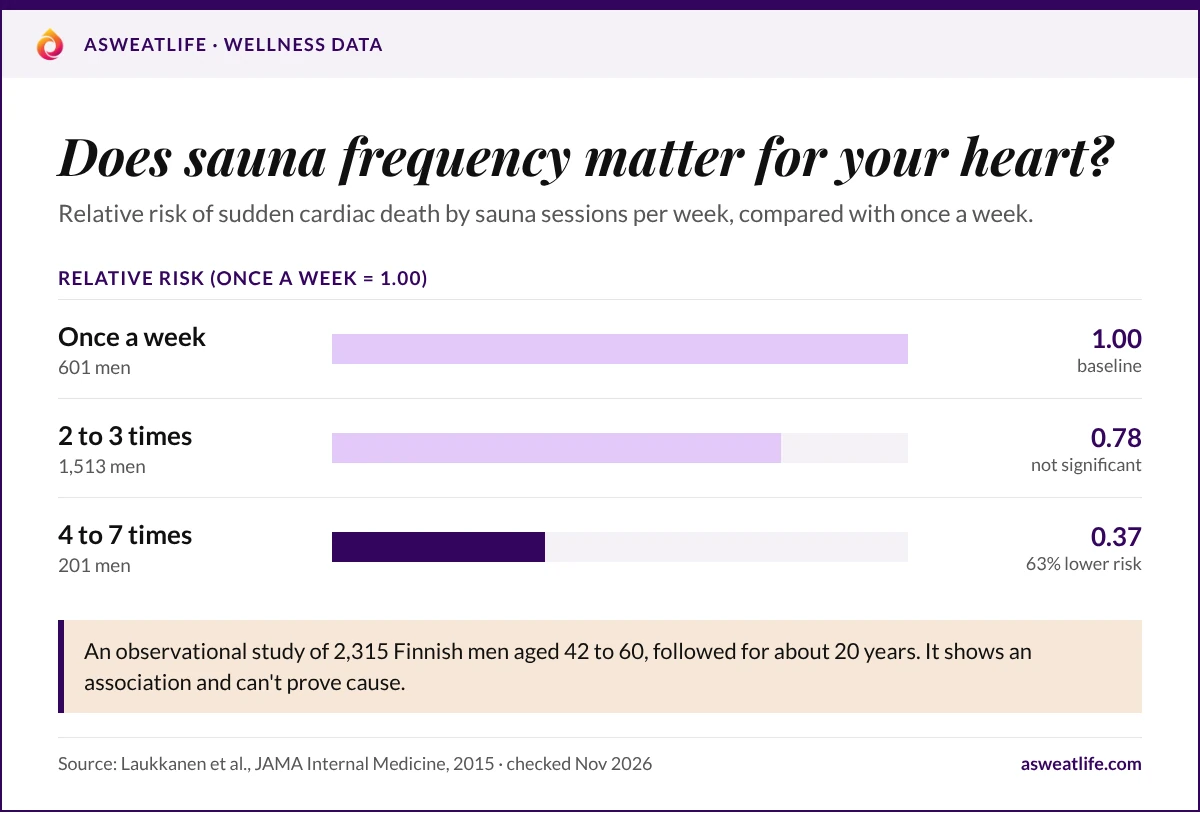
That study only included middle-aged men, and it shows an association that can’t prove cause. People who sit in a sauna most days may differ in plenty of other ways, so treat it as a reason for curiosity rather than a prescription.
Thinking About a Sauna at Home?
For an at-home setup, where a cabin can realistically sit matters more than any spec sheet. A unit squeezed into a cold garage you avoid all winter won’t build a habit. If you’re comparing options such as Vidalux infrared saunas, start with the room, the power supply and the space you’d actually walk into after a workout. Infrared models run at lower air temperatures than traditional saunas, which some people find easier to sit in for 20 minutes.
Before you buy from Vidalux or any other retailer, ask yourself two honest questions: how many evenings a week would this realistically get switched on, and where in the house does it need to sit for that answer to hold up in November? If space or budget won’t stretch to a cabin, our take on whether infrared sauna blankets really work looks at a smaller alternative.
Sauna and Recovery FAQs
Is It Better to Use the Sauna Before or After a Workout?
After is the more common choice, since starting a workout already hot and sweaty isn’t ideal. The recovery study above used the sauna straight after exercise. If building muscle is your main goal, NASM suggests separating sauna and strength training by a few hours or saving the sauna for rest days.
How Often Should You Use a Sauna for Recovery?
There’s no settled number for recovery. In the long-term Finnish study, two to three sessions a week was the most common pattern, and more frequent use was linked with better heart outcomes. Start with one or two short sessions, see how you feel the next day, and build from there if it suits you.
Can a Sauna Help You Lose Weight?
Any weight you drop in a sauna is water, and it comes straight back when you rehydrate, which you should. A sauna isn’t a fat-loss tool. Training, food and sleep do that work, and the sauna is simply a pleasant way to close out a session.