What to Eat After a Hard Workout: The 2-Hour Recovery Window
You just finished a hard session and you’re trying to figure out what to eat after a hard workout so tomorrow’s training doesn’t feel flat. Timing matters more than most people think: Sports Dietitians Australia’s fluids in sport fact sheet notes that losing just 2% of your body weight in sweat is enough to measurably dent performance.
Here’s why the first two hours count, how much carbohydrate and protein to aim for, how to rehydrate properly, and when you can relax about the clock.
Why Do the First Two Hours After a Workout Matter?
This article is for general education and isn’t a substitute for advice from your doctor or a registered dietitian, especially if you have diabetes, a digestive condition, a food allergy or a history of disordered eating.
A hard workout drains the carbohydrate your muscles store as glycogen, and your body is quickest to refill it straight afterward. In that stretch, your muscles are more sensitive to insulin and the transporters that pull glucose into muscle cells stay active for a while, so carbs you eat get stored efficiently.
The classic evidence comes from a study by John Ivy and colleagues, published in 1988. Cyclists who waited two hours before eating carbohydrate stored glycogen roughly half as fast as when they ate straight after riding.
That gap matters most when your next hard effort is close: a double day, back-to-back race heats, or a key session the following morning. If you train once a day with a rest day after, you have more breathing room, though a little structure still helps you feel better going into the next workout.

How Many Carbs Should You Eat After a Hard Workout?
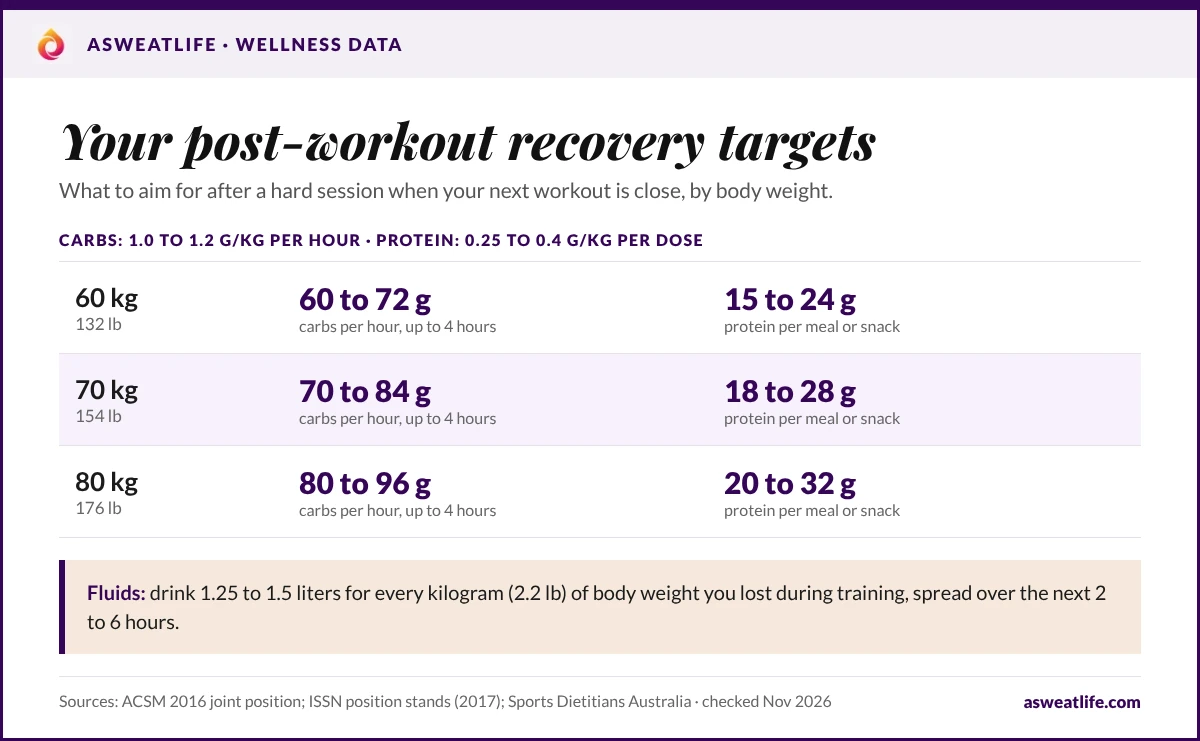
Current sports nutrition guidelines recommend about 1.0 to 1.2 grams of carbohydrate per kilogram of body weight per hour for up to four hours when you need to refuel quickly. For a 154-pound (70 kg) runner, that works out to roughly 70 to 84 grams an hour. Smaller snacks every 30 minutes or so often sit better than one big plate.
That number surprises a lot of people. A medium banana has about 27 grams of carbs, which covers barely a third of the hourly target for that runner, so you’ll usually need a combination of foods or a carb-containing drink to get close.
Planning is half the battle when you’re short on time to cook around training. One option is ordering meals from a meal-prep delivery service: Ideal Nutrition delivers ready-to-eat meals across much of Florida and lists the carbs and protein for each meal on its menu, which makes it easier to see how close a meal gets you to your numbers.
Which Carbs Work Best Right After Training?
High-glycemic carbohydrates are the easy win in the first hour. White rice, bagels, ripe bananas, rice cakes, honey, sports drinks and fruit juice digest quickly and tend to be gentle on a stomach that just worked hard.
Foods high in fat and fiber are better saved for later in the day. They slow down how fast your stomach empties, so the carbs reach your muscles more slowly. A bowl of lentils or a burger isn’t a problem, it’s just a slower route to refueling during those first two hours.
How Much Protein Do You Need After a Workout?
Protein supplies the amino acids your body uses to repair and rebuild muscle fibers. The International Society of Sports Nutrition’s position stand on protein and exercise puts an effective single dose at 0.25 to 0.4 grams per kilogram of body weight, or about 20 to 40 grams for most people, repeated every three to four hours across the day.
Protein also helps when you can’t hit the full carb target. The same society’s nutrient timing guidance says pairing 0.8 g/kg of carbohydrate per hour with 0.2 to 0.4 g/kg of protein per hour is a reasonable alternative to the higher carb-only dose. Good post-session sources include:
- Milk or chocolate milk (about 8 grams of protein per cup)
- Plain nonfat Greek yogurt (about 10 grams per 100 grams)
- Eggs (about 6 grams each)
- Cooked chicken breast, fish or lean beef (roughly 25 to 30 grams per 100 grams)
- Whey protein (usually 20 to 25 grams per scoop; check your label)
If you’re wondering whether more is better, our look at whether it’s possible to eat too much protein covers where the upper end sits.
Here’s how those carb and protein targets work out at a few common body weights:
How Should You Rehydrate After a Hard Session?
Most people finish a tough workout down on fluids, even if they drank during it. The simplest way to know how much is to weigh yourself in minimal clothing before and after training: every kilogram you lose is roughly a liter of sweat.
That same Sports Dietitians Australia fact sheet recommends replacing 125 to 150% of what you lost over the next two to six hours, because you keep losing fluid through urine after you stop. Lose 1 kg (2.2 pounds) on a long tempo run and you’d aim for about 1.25 to 1.5 liters.
Sodium helps that fluid stay put. Salty food or an electrolyte drink cuts down how much you pee out, so more of what you drink actually rehydrates you. Our explainer on electrolyte drinks and when you need one covers when plain water is enough.
What Are Some Easy Recovery Meals and Snacks?
All of this only helps if the food is ready when you finish. A lot of people leave a session tired, hungry and without a plan, then grab whatever’s closest. A snack in your gym bag solves most of that.
The options below are sized for a 154-pound (70 kg) athlete in the first hour after training. Numbers are approximate and vary by brand, so check labels and scale portions up or down for your body weight.
| Recovery snack | Carbs (approx.) | Protein (approx.) |
|---|---|---|
| 500 ml (about 2 cups) low-fat chocolate milk and a medium banana | 80 g | 18 g |
| 250 g plain nonfat Greek yogurt, 60 g granola and 1 tablespoon honey | 65 g | 32 g |
| Plain bagel, 2 eggs and 250 ml (about 1 cup) orange juice | 83 g | 25 g |
| 200 g cooked white rice with 120 g grilled chicken breast | 56 g | 43 g |
The rice and chicken bowl comes in under the carb target on its own, so add a glass of juice or a piece of fruit if your next session is close.
When Does the Recovery Window Matter Less?
The two-hour window is most important when your turnaround is short. In 2013, a meta-analysis by Schoenfeld found that when total daily protein was matched, protein timing didn’t have a meaningful effect on muscle growth. For most people lifting for strength, how much protein you eat across the day matters more than the minutes after your last set.
Let your schedule decide how strict to be:
| Your training | How strict to be |
|---|---|
| Two hard sessions in one day, or race heats | Treat the window as a firm rule and start eating right away |
| Hard sessions on back-to-back days | Eat soon after training and spread carbs over the next few hours |
| Once a day with a rest day after | A normal balanced meal within a few hours works well |
| Lifting two or three times a week | Focus on total daily protein; timing is a minor detail |
Whatever your schedule, go easy on alcohol after training. Research shows it can inhibit muscle protein synthesis after exercise even when you eat protein alongside it. If you’re building toward a race, our guide on how to recover during half marathon training covers the rest of the recovery picture.
Post-Workout Nutrition FAQs
How Soon Should You Eat After a Hard Workout?
If you train again within the day, aim to start eating within about 30 to 60 minutes and keep refueling over the next few hours. If your next hard session is a day or more away, a regular meal within a couple of hours is fine.
Is Chocolate Milk Good for Recovery?
It’s a convenient option because it combines carbs, protein and fluid in one drink. About 2 cups of low-fat chocolate milk gives roughly 52 grams of carbohydrate and 16 grams of protein, so pairing it with a banana gets most people close to a solid first-hour target.
Do You Need a Protein Shake After Every Workout?
No. A shake is handy when you’re on the go, but yogurt, eggs, milk, chicken or fish do the same job. What matters most is getting 20 to 40 grams of protein at regular meals across the day.