



If you know a walk would lift your mood but you still can’t get yourself out the door, understanding how exercise and mental health connect can take some of the blame off your willpower. You have plenty of company: 31% of adults worldwide, about 1.8 billion people, weren’t active enough in 2022, and for some of them, low energy and lost interest are symptoms of a mental health condition.
This guide covers what movement does for your mood, which workouts the research backs, how much activity to aim for, how to start when motivation is low and when it’s time to see a professional.
How Does Exercise Help Your Mental Health?
This article is for general education. It doesn’t replace advice from a doctor, psychiatrist or other qualified mental health professional, so check with yours before you change your treatment or start a new exercise program.
The World Health Organization counts fewer symptoms of depression and anxiety among the benefits of regular physical activity for adults, alongside better overall mental health. Some of the payoff shows up fast, too. The CDC lists reduced short-term feelings of anxiety and brain benefits right after a session of moderate to vigorous activity.
Mayo Clinic explains a few ways movement eases depression and anxiety symptoms:
- Feel-good brain chemicals: exercise may release endorphins, which help you feel better.
- A break from worry: focusing on your stride or your next rep pulls your attention away from the thought loops that feed depression and anxiety.
- Confidence: hitting a goal, even a tiny one, builds trust in yourself.
- Connection: a run club, a studio class or a walk with a friend adds social time to the sweat.
- A healthy way to cope: it gives you something active to do with a hard day.
Mayo is just as clear that exercise doesn’t replace talk therapy or medication. Treat it as one tool in your kit, and a pretty good one.
Which Types of Exercise Help Depression Most?
A 2024 BMJ review pooled 218 trials of exercise for depression with 14,170 participants. Walking or jogging, yoga and strength training showed the largest drops in depression symptoms, and effects grew with the intensity prescribed. The authors suggest these workouts could sit alongside therapy and antidepressants as core treatments, while flagging that the certainty of the evidence was low for walking or jogging and very low for the other types.


| Exercise type | How it ranked in the 2024 BMJ review | An easy first session |
|---|---|---|
| Walking or jogging | Largest reduction in symptoms | A 10-minute walk around the block |
| Yoga | Second largest | A short beginner flow at home |
| Strength training | Third largest | Bodyweight squats, push-ups and rows |
| Mixed aerobic exercise | Moderate reduction | A dance or cardio class |
| Tai chi or qigong | Moderate reduction | A beginner class or video |
Here’s how big each drop was in the review, compared with usual care or a placebo pill:

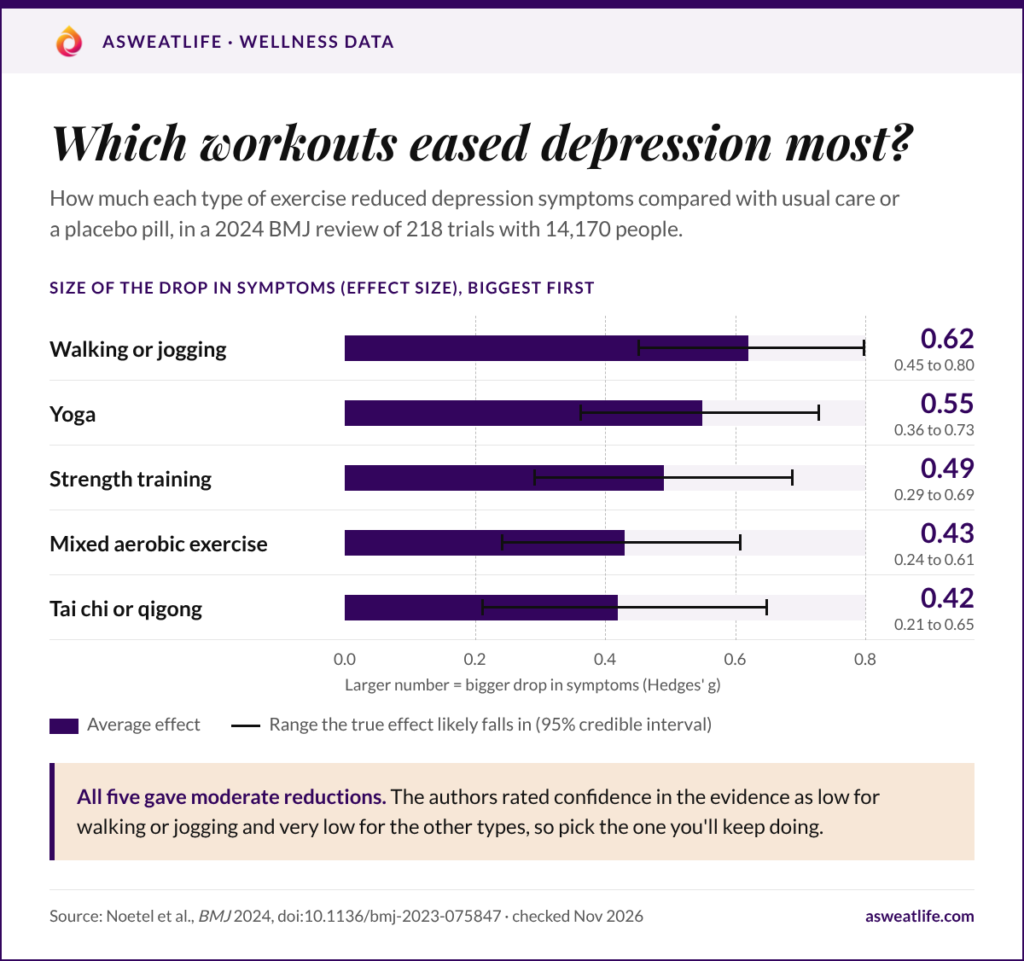
The best workout for your mood is still the one you’ll show up for. If yoga makes you feel calm and jogging makes you feel miserable, go with yoga.
How Much Exercise Do You Need for Your Mental Health?
The CDC’s guidelines for adults call for 150 minutes of moderate activity or 75 minutes of vigorous activity a week, plus muscle-strengthening work on at least two days. That’s 30 minutes a day, five days a week of something like brisk walking. Mayo adds that 10 to 15 minute bouts spread through your day add up.
If you’re starting from zero, build toward that goal slowly. This illustrative eight-week ramp is one way to get there (your doctor or a trainer can adjust it for you):
| Weeks | Cardio | Strength | Weekly cardio total |
|---|---|---|---|
| 1 to 2 | 10 minutes, 5 days | Optional | 50 minutes |
| 3 to 4 | 15 minutes, 5 days | 1 day | 75 minutes |
| 5 to 6 | 20 minutes, 5 days | 2 days | 100 minutes |
| 7 to 8 | 30 minutes, 5 days | 2 days | 150 minutes |
If you miss a day, pick it back up tomorrow. Consistency over a few months counts for far more than any single workout.
Why Can’t I Make Myself Exercise?
Sometimes the answer is a packed calendar or a program you don’t enjoy. Other times it’s your mental health. The National Institute of Mental Health lists fatigue, low energy and loss of interest in activities as signs of depression. A diagnosis requires symptoms most of the day, nearly every day, for at least two weeks.
If that sounds familiar, our explainer on what depression is and how to manage it is a helpful next read. Meanwhile, Mayo suggests a few ways to get moving when motivation is low:
- Pick something you like and schedule it for a time you’re most likely to follow through.
- Set a goal you can hit today, like a five-minute walk, and build from there.
- Name what’s in the way. If the gym makes you self-conscious, work out at home. If money is tight, walking is free.
- Bring a friend who’ll notice when you skip.
- Sneak in movement: take the stairs or park at the far end of the lot.
A solo walk is a low-pressure place to begin, and we’ve rounded up why taking yourself on walks pays off.
When Should You See a Psychiatrist?
Mayo recommends talking to a health care or mental health professional if depression or anxiety still gets in the way of daily life even though you exercise regularly. You don’t need to hit rock bottom first. If low mood has stuck around for weeks or keeps pulling you away from things you used to enjoy, that’s reason enough.
A psychiatrist is a medical doctor who can diagnose mental health conditions, prescribe medication and provide talk therapy. A psychologist focuses on therapy and testing and can’t prescribe. NIMH notes that treatment for depression usually involves psychotherapy, medication or both. Our guide on how to decide which mental health professional is right for you walks through who does what.
If getting to an office is its own hurdle, an online psychiatrist can do the evaluation over video. GABA Telepsychiatry, for example, says it offers evaluations, medication management and therapy by video for patients in California, Florida, Illinois, New Jersey, New York, South Carolina and Tennessee. It’s out of network for insurance, so ask about fees and reimbursement before you book.
Your first appointment is a great place to bring up exercise. Ask how movement fits with any treatment you’re considering, and keep it as part of your routine alongside therapy or medication.
How Exercise Fits Into the Eight Dimensions of Wellness
SAMHSA breaks wellness into eight dimensions: social, environmental, physical, emotional, spiritual, occupational, intellectual and financial. Exercise sits in the physical bucket, but it spills into the others. A Saturday class can be your social time, a lunchtime walk can clear your head before an afternoon of meetings and a training goal gives your week some structure.
Your next step can be small. Walk for five minutes today and notice how your head feels afterward. (Write it down, if you’re a notes-app person.) Give yourself grace on the days it doesn’t happen.
Exercise and Mental Health FAQ
Can Exercise Replace Therapy or Medication?
Mayo Clinic says exercise can ease symptoms of depression and anxiety but doesn’t replace psychotherapy or medication. Talk to your provider before you start or stop any medication.
How Fast Does Exercise Improve Your Mood?
Some benefits start right away. The CDC says a session of moderate to vigorous activity can reduce short-term feelings of anxiety, while benefits for depression come from staying active over time.
Is Walking Enough to Help Depression?
Walking or jogging showed the largest reduction in depression symptoms in a 2024 BMJ review of 218 trials. It works best as part of a plan you’ve discussed with a health care provider if you’re living with depression.
What Should I Do if I’m Having Thoughts of Suicide?
Call or text 988 to reach the 988 Suicide & Crisis Lifeline in the US, or chat at 988lifeline.org. If you’re in immediate danger, call 911.
Further Reading on Exercise and Wellness
- Gualdi-Russo E, Zaccagni L. Physical Activity for Health and Wellness. Int J Environ Res Public Health. 2021 Jul 23;18(15):7823. doi: 10.3390/ijerph18157823. PMID: 34360116; PMCID: PMC8345633.
- Cai L. Effect of Physical Exercise Intervention Based on Improved Neural Network on College Students’ Mental Health. Comput Math Methods Med. 2022 Jun 21;2022:4884109. doi: 10.1155/2022/4884109. PMID: 35774298; PMCID: PMC9239817.


